Gion Kyoto Guide: Hanamikoji Walking Route, the Private-Alley Photo Ban, and Evenings at Shirakawa and Yasaka Shrine
How to see Gion: Hanamikoji, the private-alley photo ban and what the 10,000 yen fine sign really means, Shirakawa, Yasaka Shrine, Kenninji, Gion Corner and a night walk.
Quick answer
Gion is the geisha district just west of Yasaka Shrine in Kyoto, centred on Hanamikoji Street, the Shirakawa canal and Shijo-dori. Hanamikoji itself is a public road, so walking and photographing there is fine. The issue is the private alleys that branch off it: the local council has banned photography on private roads since 2019, and in May 2024 it put up signs at the entrances of Kosode-koji saying entry without permission carries a 10,000 yen fine. Reporting noted the signs have no legal force, and a lawyer explained that the council cannot impose fines. Kenninji currently charges 800 yen, rising to 1,000 yen from January 1, 2027; Yasaka Shrine's grounds are free.
Gion is the geisha district just west of Yasaka Shrine and the most atmospheric place in Kyoto for an evening walk. In recent years, after visitors wandered into private alleys and chased maiko for photos, residents put up signs reading "no photography" and "10,000 yen fine". This guide explains where you can walk and take pictures, and whether those signs carry any legal weight. It then covers Hanamikoji Street, Gion Shirakawa, Yasaka Shrine, Kenninji, Yasui Konpiragu, Gion Corner and the Shijo area in turn, and ends with a dusk-to-night walking route, food budgets and an etiquette table.
How to explore Gion: the 7 key places
The short answer: Gion's core is compact. Starting from Keihan Gion-Shijo Station, the main sights are 5 to 10 minutes' walk from each other, so half a day covers them all. Shijo-dori splits Gion into north and south: the south side has Hanamikoji Street, Kenninji and Gion Corner; the north side has Shirakawa and Tatsumi Bridge; and Yasaka Shrine sits at the east end of Shijo-dori.
| Place | Location | Cost | Hours | Best time |
|---|---|---|---|---|
| Hanamikoji Street | South of Shijo-dori | Free (public road) | All day | Dusk to night |
| Gion Shirakawa and Tatsumi Bridge | North of Shijo-dori | Free | All day | Dusk; spring for cherry blossoms |
| Yasaka Shrine | East end of Shijo-dori | Grounds free | Generally listed as 24 hours[7] | After the lanterns light up |
| Kenninji | South end of Hanamikoji | 800 yen (1,000 yen from 2027) | 10:00 to 16:30 last entry[8] | Afternoon |
| Yasui Konpiragu | Higashiyama-Yasui on Higashioji-dori | Worship free; katashiro 100 yen or more | Open all day[12] | Daytime to early evening |
| Gion Corner | Southern part of Hanamikoji | General seats from 5,500 yen | Shows at 18:00 and 19:00[13] | Evening |
| Shijo-dori and Minamiza | East of Shijo Bridge | Free | All day | Any time |
Is photography really banned in Gion? The truth about the private-alley signs and the 10,000 yen fine
The short answer: Gion has no blanket photography ban, and no Kyoto City ordinance fines people for taking photos. What is off limits are the private alleys branching off the main streets, and the 10,000 yen on the signs is a warning from a local group, not a legal fine. That said, private alleys are private land, and if you see a sign you should not go in. There is no grey area on that.
Here is the timeline:
- October 2019: The Gion Machi Minamigawa district council, made up of residents and businesses, announced a ban on photography in the private alleys around Hanamikoji, with signs warning of a 10,000 yen fine. It also made clear that taking photos from public areas such as Hanamikoji's main street was still fine[4].
- March 2024: The council said it would put up signs in private alleys in several blocks of Gion stating "this is a private road, no through passage" with a 10,000 yen fine warning, while public roads would stay open. Kyoto City said at the time it was still confirming the details[3].
- May 29, 2024: Signs in Japanese, English and Chinese went up at both entrances of Kosode-koji, a private alley near Hanamikoji, saying entry without permission carries a 10,000 yen fine. The report stated plainly that the signs have no legal force and are meant as a deterrent[1].
A lawyer's view is clear: the owner of an ordinary private road can in principle restrict or ban passage, and if the council manages the road on the landowner's behalf, a no-entry sign is valid. But "fines" can only be set by national or local government through laws or ordinances, so a local council cannot impose one on its own. Entering a private road could in theory be a tort requiring compensation for actual damage, but it would be the landowner, not the council, who claims it, and simply walking through would not normally cause 10,000 yen worth of damage[2].
In other words, online claims that "Gion has banned entry since 2024 and you will be fined" mix up two things: the signs are real and you really cannot enter the private alleys, but the fine has no legal basis. For visitors the takeaway is simple: walk and take photos on Hanamikoji's main street as usual, and never enter alleys marked as private roads.
Gion etiquette: OK and not OK
| OK | Not OK |
|---|---|
| Walking and photographing the streetscape from public roads such as Hanamikoji and Shijo-dori | Entering alleys marked "private road", including Kosode-koji |
| Stepping aside when you see geiko or maiko from a distance | Following geiko or maiko for photos, or blocking their way to ask for a picture |
| Taking quick photos on Tatsumi Bridge and along Shirakawa | Sitting, leaning or taking photos in front of shop entrances and house doorways |
| Having your photo taken with a maiko at Gion Corner, which has a photo session after the show | Photographing residents and children without consent |
| Finishing food where you bought it before moving on | Eating while walking, littering, or walking side by side and blocking narrow lanes |
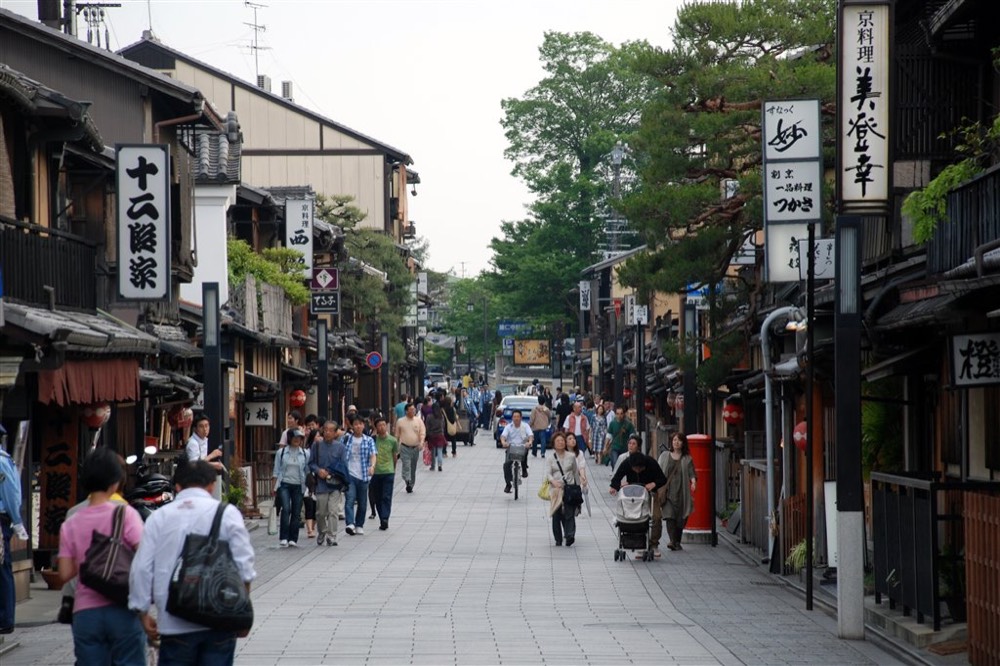
How to walk Hanamikoji Street: telling public roads from private alleys
The short answer: Hanamikoji Street is a stone-paved road running south from Shijo-dori to Kenninji's north gate, lined with teahouses and restaurants, and the main street is open to everyone.
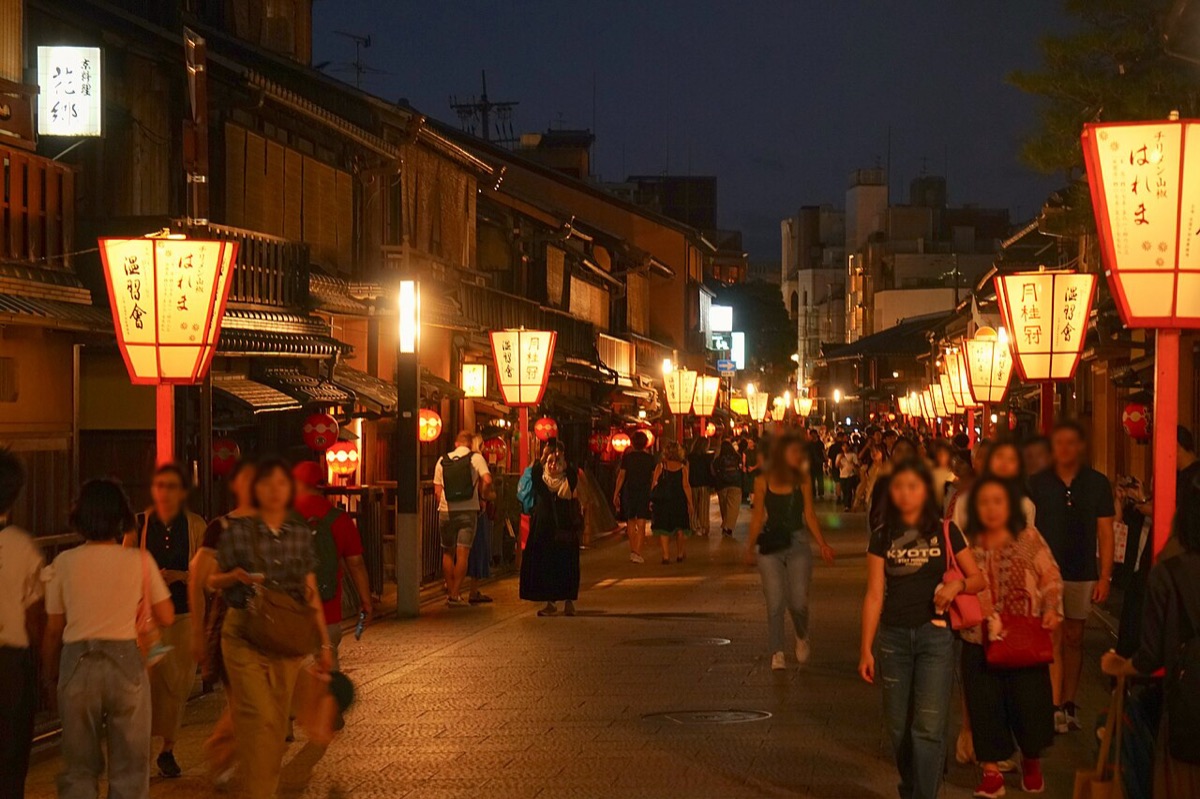
Walking south from the Shijo-dori entrance, the street gets quieter the further you go, and it ends at Kenninji. The whole street takes under 10 minutes, but it is worth taking slowly: red lattice frontages, inuyarai bamboo fences and lanterns at the doors make up Gion's most classic scene. After dark, when the lanterns are lit, the main street is busier than in the daytime, so step to the side to take photos rather than stopping in the middle.
How to tell public from private: the main street is a wide stone-paved road, while the narrow lanes branching off to either side, only wide enough for one or two people, are mostly private roads, often with multilingual signs at the entrance. If you are unsure, treat it as private and do not go in. If you plan to wear a kimono for photos in this area, see our Kyoto kimono rental guide for route suggestions that avoid private alleys and shop entrances.
Gion Shirakawa and Tatsumi Bridge: Kyoto's most photogenic stretch of water
The short answer: the Shirakawa-minami-dori bank and Tatsumi Bridge (Tatsumi-bashi) are the signature photo spots on the north side of Gion. They are free, open all day, and loveliest at dusk and in cherry blossom season.
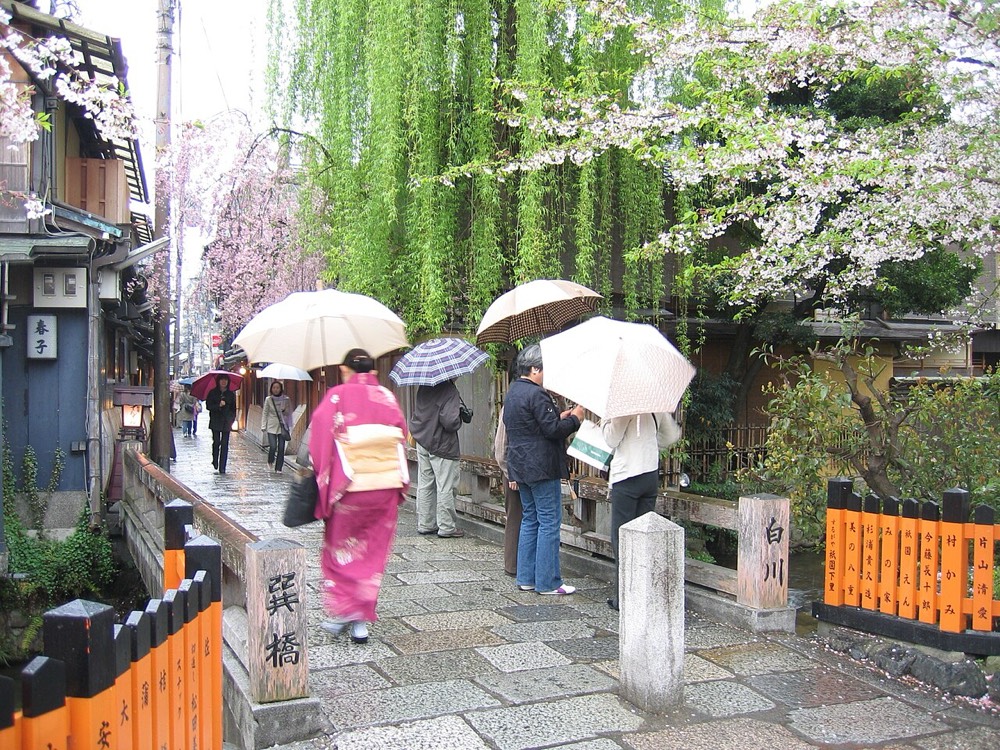
From the north end of Hanamikoji, cross Shijo-dori and walk a few minutes north to reach Shirakawa. The Shinbashi-dori area along Shirakawa is part of the Gion Shinbashi preservation district for historic buildings, and its teahouse architecture is remarkably well preserved. The small shrine beside Tatsumi Bridge is Tatsumi Daimyojin, worshipped by geiko and maiko who pray to improve their arts; its vermilion fence is easy to spot.
This is also a residential area and the bridge is narrow, so take your photos quickly and keep the way clear. In spring, when willows and cherry blossoms appear together, the crowds grow noticeably; for clean shots, come in the morning.
Yasaka Shrine: open at night, the natural end of a Gion walk
The short answer: Yasaka Shrine's grounds are free and generally listed as open 24 hours[7]. The main hall is a National Treasure, and the vermilion West Gate at the end of Shijo-dori is the entrance most people use.
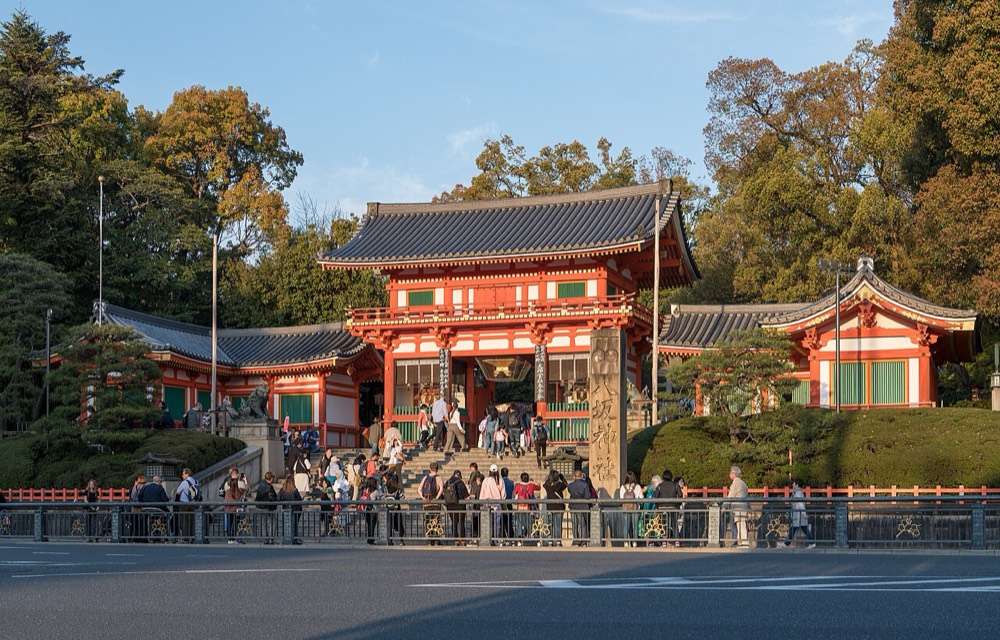
Locals call Yasaka Shrine "Gion-san", and the name Gion itself comes from the shrine's former deity Gozu Tenno and its old name, Gion-sha. The official site explains that the West Gate, which leads to the geisha district, is the one most worshippers pass through, but the true main gate is the South Gate facing the main hall[6]. The shrine office is open 9:00 to 17:00, so go within those hours if you want amulets or a goshuin.
In the evening, when the lanterns on the dance pavilion are lit, the grounds make a good end point for a night walk in Gion, with Maruyama Park just to the east. From the night of December 31 into early New Year's morning the shrine holds Okera Mairi, when worshippers carry the sacred okera fire away on a rope for good luck, followed by the hatsumode crowds. How to take the fire, the timings and New Year's Eve transport are covered in our Kyoto New Year guide.
As for the Kyoto Higashiyama Hanatouro lantern festival once held every March, Kyoto Prefecture has ended it: the final edition ran March 4–13, 2022[5], and it is no longer held. For autumn night views in Higashiyama, see our Kodaiji night illumination guide.
Kenninji: the Twin Dragons, the Wind and Thunder Gods screens, and a 2027 price rise
The short answer: Kenninji currently charges 800 yen for general admission and 500 yen for elementary, junior high and high school students; from January 1, 2027 general admission rises to 1,000 yen, while students stay at 500 yen[9].
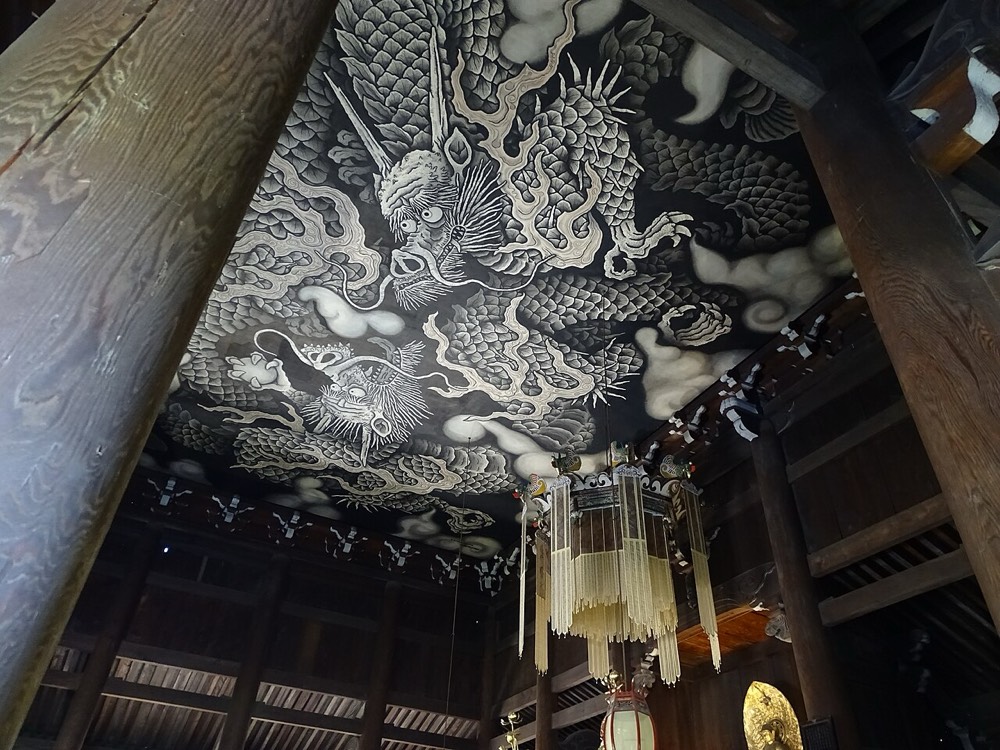
Kenninji stands at the south end of Hanamikoji and is one of Kyoto's oldest Zen temples. The official site lists opening from 10:00, last entry at 16:30 and gates closing at 17:00; children below elementary school age are free, as are holders of a disability certificate[8]. Must-sees are the Twin Dragons on the Dharma Hall ceiling, and the Wind God and Thunder God folding screens and dry landscape gardens in the abbot's quarters.
Know the photo rules before you go: Kenninji only allows handheld cameras or smartphones. Video, tripods, selfie sticks and gimbals are banned, as are sitting or crouching to shoot, group photos and commercial shoots, and anyone breaking the rules will be asked to leave[10]. The temple has also announced an after-hours special viewing with JR Central from November 20 to December 6, 2026[11]; for how to join, see the JR Central page linked from the temple's notice.
It is about 7 minutes on foot from Keihan Gion-Shijo Station, or about 5 minutes from the Higashiyama-Yasui city bus stop[8].
Yasui Konpiragu: how to pass through the en-kiri en-musubi stone
The short answer: Yasui Konpiragu's main hall and its en-kiri en-musubi stone can be visited 24 hours a day. The katashiro paper charms used for prayers sit on a stand to the left of the stone, and you take one after putting at least 100 yen in the offering box[12].
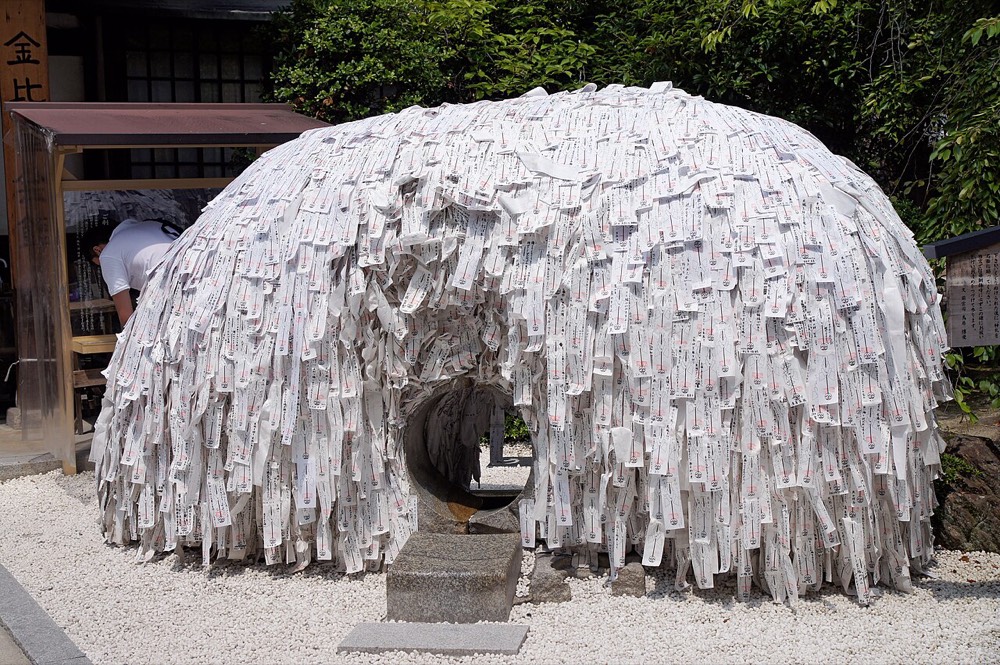
The shrine is known for cutting bad ties and forming good ones. The stone is about 1.5 m tall and 3 m wide, shaped like an ema votive plaque, and so densely covered in white katashiro that the rock is barely visible. The steps explained by the shrine are as follows[12]:
- Pray at the main hall first.
- Write the tie you want to cut or form on a katashiro.
- Holding the katashiro, crawl through the hole from the front of the stone to the back to cut bad ties.
- Crawl back from the back to the front to form good ties.
- Stick the katashiro anywhere on the stone.
The office selling amulets and ema is open 9:00 to 17:30[12]. The shrine is less than 200 m from Kenninji and about 10 minutes' walk south of Yasaka Shrine. When many people are queuing to pass through the stone you may have to wait, so go early on weekends.
Gion Corner: seven traditional arts in one hour
The short answer: a general seat at Gion Corner costs 5,500 yen for ages 23 and over, with two shows a day at 18:00 and 19:00, each about an hour long. From December 1 to March 11 is the winter season, with shows only Tuesday to Friday[13].
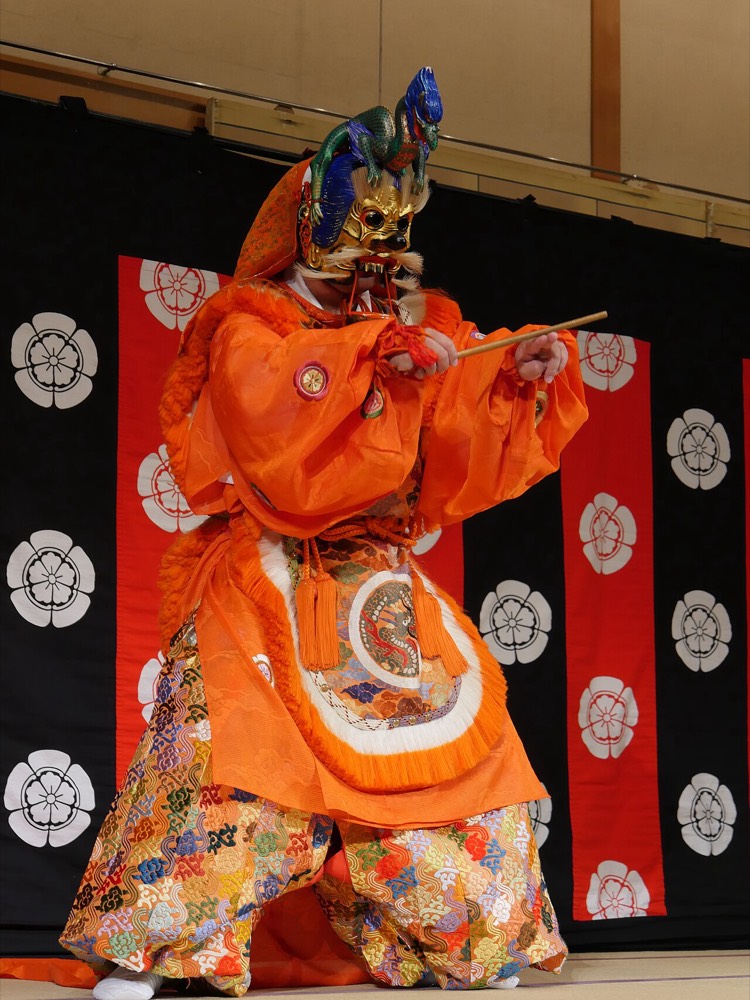
Gion Corner is held in the small theatre of the Gion Kobu Kaburenjo on the southern part of Hanamikoji. The programme includes Kyomai dance, tea ceremony, flower arrangement, koto, bugaku court dance, kyogen comedy, and bunraku puppetry or noh depending on the season. Official prices (tax included)[13]:
| Seat | Price |
|---|---|
| Premium seat (any age) | 6,600 yen |
| Tea ceremony experience seat (any age) | 6,050 yen |
| General, 23 and over | 5,500 yen |
| General, ages 16–22 | 3,850 yen |
| General, ages 7–15 | 3,300 yen |
| Preschool children | Free (charged if a seat is needed) |
Closed days are July 16, August 16, December 26 to January 4, February 11 and February 23, plus public holidays during the winter season. Winter shows end with a photo session with a maiko, which is the proper way to get a picture with one. Tickets can be bought online on the official site, and the theatre is about 5 minutes on foot from Keihan Gion-Shijo Station[14].
The Gion-Shijo area: Minamiza, Shijo-dori and transport
The short answer: Shijo-dori is Gion's main artery, with Shijo Bridge and the Minamiza kabuki theatre at its west end and Yasaka Shrine at its east end. Keihan Gion-Shijo Station and Hankyu Kyoto-Kawaramachi Station are both near the ends of this road.
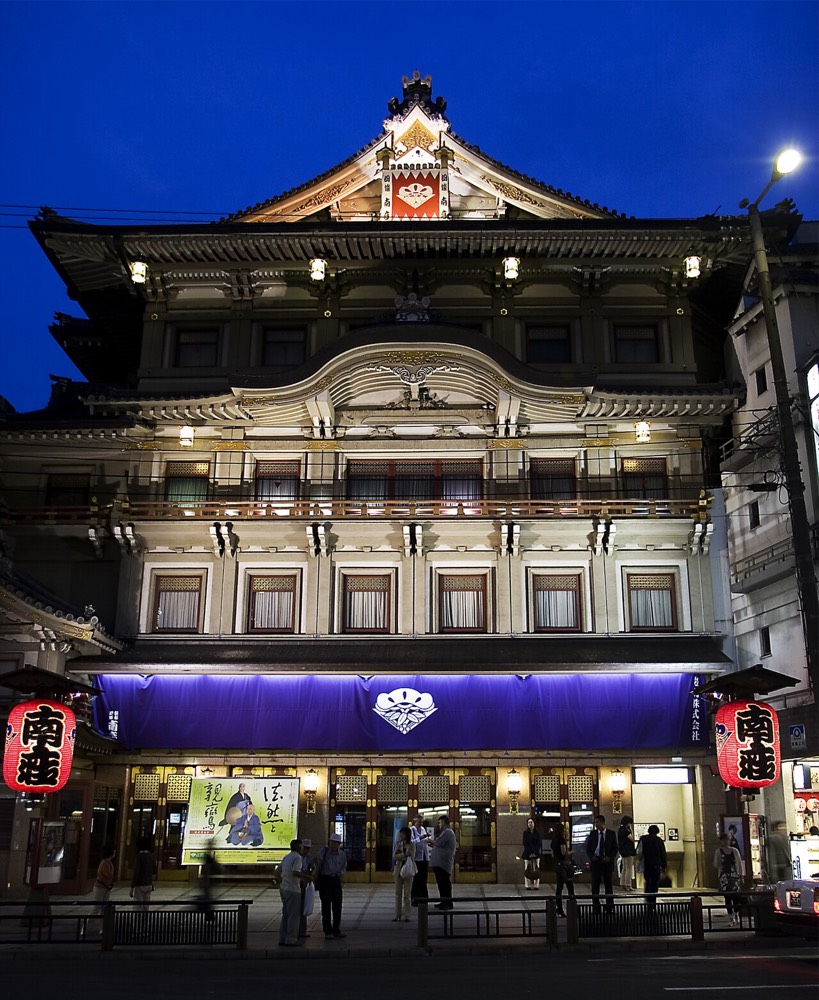
Minamiza stands right by the exit of Keihan Gion-Shijo Station, and its curved gable is easy to spot once lit in the evening; for programmes and prices, check Minamiza's official announcements. Both sides of Shijo-dori are lined with wagashi shops, tea merchants and souvenir stores, with covered arcades for rainy days. From Kyoto Station you can take a city bus to the "Gion" stop, or take the JR to Tofukuji and change to the Keihan line. Buses are packed at peak times; for the quickest options, see our Kyoto transport guide.
A dusk-to-night walking route through Gion (about 4 hours)
The short answer: see the temples with closing times in the afternoon, then walk Hanamikoji, Shirakawa and Yasaka Shrine after sunset. Using a late-November sunset of about 16:45 as an example:
| Time | Place | Stay | Notes |
|---|---|---|---|
| 14:30 | Yasui Konpiragu | 20 min | Get off at the Higashiyama-Yasui bus stop and pass through the stone |
| 15:00 | Kenninji | 60–70 min | About 5 minutes' walk; last entry 16:30 |
| 16:15 | Hanamikoji Street (south to north) | 20 min | Straight on from Kenninji's north gate, as the lanterns come on |
| 16:40 | Gion Shirakawa and Tatsumi Bridge | 20 min | Cross Shijo-dori heading north; take photos before it gets dark |
| 17:10 | Yasaka Shrine | 30 min | About 10 minutes east along Shijo-dori; the pavilion lanterns are lit |
| 17:45 | Dinner | 60–75 min | Around Gion or Shijo-dori |
| 19:00 | Gion Corner | About 60 min | Tuesday to Friday only during the winter season |
| 20:00 | Keihan Gion-Shijo Station | – | About 5 minutes on foot |
If you skip Gion Corner, walk Hanamikoji and Shirakawa again after dinner; the crowds are usually a little thinner than at dusk. To fit the Kiyomizu-dera area into the same day, do Kiyomizu-dera and Ninenzaka–Sannenzaka in the morning and start this route in the afternoon; see our Kiyomizu-dera guide.
Half-day cost estimate
| Item | Cost |
|---|---|
| Kenninji admission (2026) | 800 yen |
| Yasui Konpiragu katashiro | 100 yen or more (offering) |
| Yasaka Shrine, Hanamikoji, Shirakawa | 0 yen |
| Gion Corner general seat (23 and over) | 5,500 yen |
| One dessert | See the shop's price list |
| Total (excluding food) | About 6,400 yen |
From January 2027 Kenninji charges 1,000 yen, adding about 200 yen to the total.
Where to eat in Gion: kaiseki lunch, sukiyaki and sweets
The short answer: to try Kyoto cuisine on a budget, have kaiseki at lunch. Dinner courses often cost more than twice as much as lunch and usually require a reservation.
| Type | Budget guide | Good for |
|---|---|---|
| Kaiseki or kappo lunch | From about 4,000 yen | Trying Kyoto cuisine without spending too much |
| Kaiseki or kappo dinner | From about 10,000 yen, more at top restaurants | Special occasions, unhurried evenings |
| Sukiyaki and beef dishes | Depends on the set menu; dinner usually costs more | Wagyu lovers, group meals |
| Wagashi and matcha sweets | Around 1,000 yen up to several thousand yen | A break during your walk |
The kaiseki prices above come from Gion restaurant budgets published by a travel magazine in February 2024 and are a past reference[17]; check each restaurant's latest prices. For sukiyaki, the area from Shijo-dori to Gion has several long-established beef restaurants. The Kansai style sears the beef in the pot first and seasons it directly with sugar and soy sauce, unlike the Kanto style, which uses a premixed warishita sauce. Prices vary widely, so read the set menu carefully before booking.
For sweets, two old Gion shops with official websites are worth seeking out:
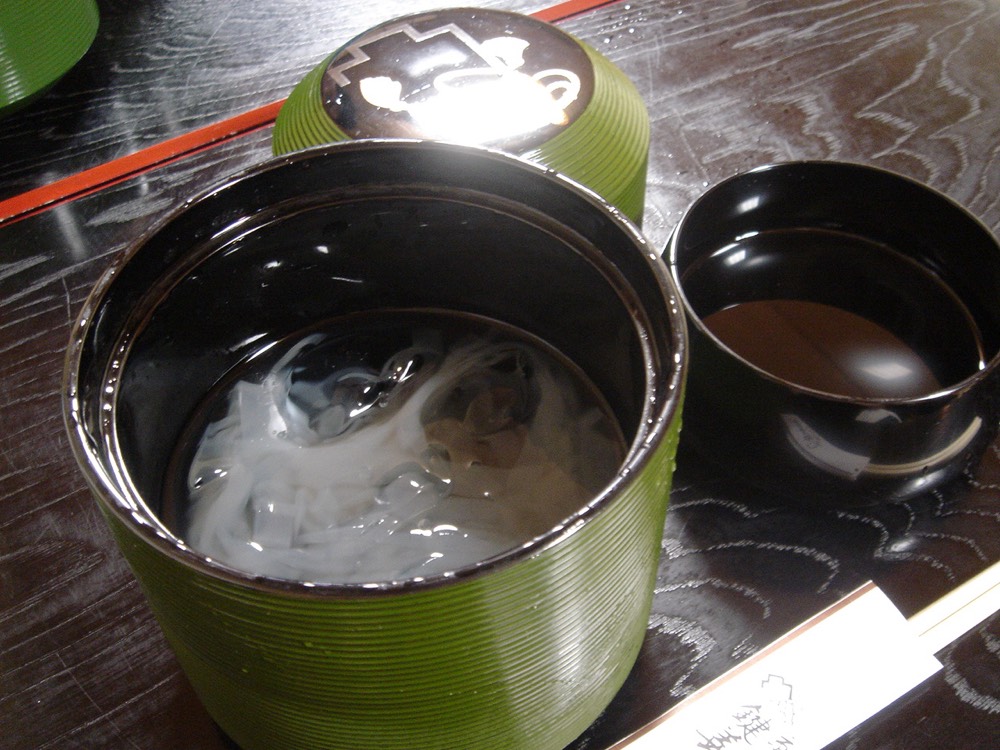
- Kagizen Yoshifusa: a wagashi shop that has traded in front of Yasaka Shrine since the mid-Edo period. Its Shijo main store and Kodaiji store serve its signature kuzukiri, eaten dipped in black syrup. Closed Mondays, or the following day if Monday is a public holiday[15].
- Gion Tsujiri / Saryo Tsujiri: an old Uji tea merchant. The Gion main store sells tea leaves and souvenirs, and Saryo Tsujiri's Gion main store serves matcha desserts[16]; expect queues at busy times.
Some Gion restaurants only accept regulars or introductions; do not simply walk into a place with no menu or opening sign outside. For more Kyoto food types, see our Kyoto food guide.
Staying in Gion: accommodation tax and choosing an area
The short answer: staying in Gion makes evening walks easy and lets you beat the crowds early in the morning, but rooms are pricier and it is farther from Kyoto Station.
Kyoto City's accommodation tax moved to five tiers on March 1, 2026, charging 200 to 10,000 yen per person per night depending on the room rate. Inns around Gion tend to be expensive, so the tax may fall into a higher tier; the calculation is explained in our Kyoto accommodation tax 2026 guide. If your plans include frequent trips to Nara or Osaka, Kyoto Station or Shijo-Kawaramachi will work better; compare areas in our where to stay in Kyoto guide.
Who is Gion for, and who might skip it?
Good for:
- Travelers who want to see a Kyoto geisha district at night and enjoy walking and street photography
- First-time visitors who want to link temples, shrines and old streets in half a day
- People who want to see traditional performing arts without sitting through a full-length play (Gion Corner covers them in an hour)
- Anyone looking for an indoor evening activity in winter
Less suited to:
- People coming only to photograph geiko and maiko up close: chasing them for photos will be stopped and is what locals resent most
- Visitors with strollers or limited mobility planning a weekend evening visit: Hanamikoji and Shijo-dori get very crowded
- Travelers on a tight budget hoping to have dinner in Gion: dinner prices are high, so eat around Kawaramachi instead
Before you go: how to plan it smoothly
- Temples in the afternoon, streets at dusk: Kenninji's last entry is 16:30, while Yasaka Shrine and Hanamikoji are fine at night.
- From December to mid-March, Gion Corner only runs Tuesday to Friday, and it is closed entirely from December 26 to January 4, so check dates before buying tickets.
- Kenninji's general admission rises to 1,000 yen from January 1, 2027; note this if you are visiting around New Year.
- The fine on the private-alley signs has no legal basis, but the ban on entering private alleys is real, so walk around them.
- Yasaka Shrine is extremely crowded on New Year's Eve; Keihan Gion-Shijo Station is the easiest way in and out. For a wider Kyoto plan, see our Kyoto attractions guide.
FAQ
Can you really be fined 10,000 yen for taking photos in Gion?
No Kyoto City ordinance fines people for taking photos in Gion. The 10,000 yen figure is a warning on signs put up by a local council; reporting noted the signs have no legal force, and a lawyer said fines can only be set by law or ordinance. Private alleys are still private land and owners can ban entry, so if you see a sign, stay out. That is basic courtesy and could otherwise lead to a civil dispute.
Can I take photos on Hanamikoji Street?
Yes. Hanamikoji Street is a public road and photographing the street from it is fine. What you should not photograph are the narrow side alleys marked as private roads, and geiko, maiko or residents without their consent. Keep to the side when taking pictures and do not use selfie sticks or tripods.
Can I visit Yasaka Shrine at night? Is there an admission fee?
Yes. The grounds are free and are generally listed as open 24 hours; the lanterns make it a lovely place for an evening stroll. Amulets and goshuin are only available at limited hours, and the shrine office is open 9:00 to 17:00, so go in the daytime if you want to buy them. On the night of December 31 the shrine holds Okera Mairi and gets very crowded.
How much is Gion Corner, and is there a show every day?
General seats are 5,500 yen for ages 23 and over, 3,850 yen for ages 16 to 22 and 3,300 yen for ages 7 to 15, with premium seats at 6,600 yen. There are normally two shows a day, at 18:00 and 19:00. During the winter season from December 1 to March 11 shows run only Tuesday to Friday and not on public holidays. It is closed from December 26 to January 4.
How long does Gion take, and what time of day is best?
Hanamikoji, Shirakawa and Yasaka Shrine alone take about 1.5 to 2 hours; add Kenninji, Yasui Konpiragu and dinner and allow half a day. Kenninji's last entry is 16:30, so put temples in the afternoon. In late November the sun sets around 16:45, and the atmosphere is best around 18:00, after dusk when the shops light up.
Sources
- Bengo4.com News: 'No entry' signs with 10,000 yen fine on Gion private road: Report of May 28, 2024; signs installed at both entrances of Kosode-koji on May 29, with no legal force
- Bengo4.com News: Is there a legal basis for Gion's '10,000 yen fine'?: May 4, 2024; lawyer explains owners may restrict passage but the council cannot impose fines
- Travel Voice: Gion private roads to get 'no passage, 10,000 yen fine' signs: March 11, 2024; Gion Machi Minamigawa district council plan, public roads stay open
- SoraNews24: Kyoto's popular tourist spot Gion to forbid photos on private roads: October 2019 private-road photo ban; photos from Hanamikoji main street still allowed
- Kyoto Prefecture: Kyoto Hanatouro in fiscal 2021: Higashiyama Hanatouro's final edition was March 4–13, 2022
- Yasaka Shrine: About Yasaka Shrine: National Treasure main hall, West and South Gates, shrine office 9:00–17:00
- Rurubu & more: Yasaka Shrine (Gion-san): Grounds open freely, 24 hours
- Kenninji: Access: Hours 10:00 to 16:30 last entry, closes 17:00; fees and access
- Kenninji: Notice of admission fee revision (September 14, 2026): General admission rises from 800 to 1,000 yen on January 1, 2027
- Kenninji: Photography rules (November 8, 2025): No video, selfie sticks, tripods or commercial shoots
- Kenninji: JR Central after-hours special viewing: After-hours special viewing November 20 to December 6, 2026
- GOOD LUCK TRIP: Yasui Konpiragu (supervised by the shrine): Size of the en-kiri en-musubi stone and prayer steps, open access, amulet office 9:00–17:30 (updated May 2026)
- Gion Corner: Performances and tickets: Ticket prices by seat, 18:00 and 19:00 shows, winter season and closed days
- Gion Corner: Access: Gion Kobu Kaburenjo small theatre, 5 minutes on foot from Keihan Gion-Shijo
- Kagizen Yoshifusa official site: Founded in the mid-Edo period, Shijo main store and kuzukiri, closed Mondays
- Gion Tsujiri / Saryo Tsujiri official site: Gion main store and Saryo Tsujiri Gion main store
- Mapple Web: Kyoto Gion lunch and cafes: Gion lunch and dinner budgets as published in February 2024 (past reference)
Fares, opening hours and event dates can change. Information checked on 2026.11.19; please confirm with official sources before you go.