Kyoto New Year's Eve 2026-2027: Temples Where You Can Ring the Bell, Chion-in's Great Bell, Yasaka Shrine Okera Mairi and Hatsumode Transport
Kyoto New Year's Eve 2026-27: temples where you can ring the joya no kane bell, Chion-in tickets, Yasaka Shrine okera mairi, hatsumode crowds and overnight trains.
Quick answer
The classic Kyoto New Year's Eve is to hear the joya no kane bells on December 31, take the okera fire at Yasaka Shrine, then make your first shrine visit after midnight. Chion-in's great bell is watch-only: 2026 tickets cost ¥3,000, with online sales from December 1. To ring a bell yourself, try Kodaiji, Seiganji, Eikando or Tenryuji, most of which hand out numbered tickets on the night (past-year reference). In past years Keihan ran all night but the Kyoto subway and city buses did not; 2026-27 transport plans are not yet announced.
The most memorable way to spend Kyoto New Year's Eve is not a fireworks countdown. It is hearing a temple ring its bell 108 times, carrying the okera fire from Yasaka Shrine on a rope, and making your first shrine visit of the year after midnight. This guide plans December 31 evening to New Year's morning for you: which temples let you ring the bell and when numbered tickets are handed out, how to get a ticket for Chion-in's great bell, how okera mairi works, hatsumode crowds at each shrine, and which trains still run in the middle of the night. Most temples and transport operators do not announce 2026-27 plans until December, so 2025 data in this article is marked as past-year reference (checked November 2026).
How do you spend New Year's Eve in Kyoto? Three things to know
The short answer: Kyoto's New Year's Eve revolves around "joya no kane → okera mairi → hatsumode." For transport, remember that Keihan has run all night in past years, while the Kyoto subway and city buses do not.
- Joya no kane: Late on December 31, temples ring their bells 108 times to send off the year's worldly desires. Some temples let the public ring; others are watch-only.
- Okera mairi: On New Year's Eve, Yasaka Shrine lights the "okera fire," and visitors transfer it to a fire rope and take it away, praying for good health in the new year.
- Hatsumode: The first visit of the new year to a shrine or temple. Fushimi Inari Taisha draws the biggest crowds in Kyoto.
Kyoto has no large New Year fireworks or countdown event. If you want a party atmosphere, Osaka is a better fit; the Universal Studios Japan countdown is covered in the Osaka New Year's Eve guide. For Japan-wide New Year shop closures, banks and lucky bags, see the Japan New Year guide; this article covers Kyoto only.
Who it suits and who it doesn't
- Good for: travelers who want a traditional Japanese New Year, can handle queuing outdoors for 1 to 2 hours on a winter night, and are staying along the Keihan line or within walking distance of Higashiyama.
- Not ideal for: people who hate the cold, families with small children or older relatives, anyone staying in an area reachable only by subway or bus, or those hoping for a countdown with fireworks. These travelers can head out for hatsumode early on New Year's morning instead, which is much easier.
Kyoto New Year's Eve bell ringing: which temples let you ring the bell?
The short answer: many Kyoto temples let the public ring the joya no kane, but places are usually given out as numbered tickets on the night, first come, first served, so for popular temples you should queue at least an hour ahead. Chion-in and Konkai Komyoji are watch-only.
The table shows the actual arrangements for December 31, 2025. Apart from Chion-in, which has announced its 2026 times, no temple has announced its 2026 plans yet, so this is past-year reference[3]; check each temple's notice before you go. "Donation" in the fee column means you give what you wish.
| Temple | Area | Can the public ring? | 2025 ringing time | Numbered tickets and limit | Fee |
|---|---|---|---|---|---|
| Chion-in | Higashiyama | No, watch only | 2026: about 22:20 to 24:15 | Ticket bought in advance | ¥3,000 |
| Kodaiji | Higashiyama | Yes | From about 23:45 | Tickets from 22:00, first 108 groups | Donation |
| Chishakuin | Higashiyama-Shichijo | Yes | About 23:40 to 0:40 | Limited numbers, figure not published | Free |
| Seiganji | Shinkyogoku | Yes | About 23:45 to 0:30 | Tickets from 23:00 at the Shinkyogoku gate, 108 groups (2 to 3 people each) | Free |
| Mibudera | Nakagyo | Yes | From 23:30 | 108 strikes, about 10 to 20 people ringing together each time | Free |
| Eikando (Zenrinji) | Sakyo | Yes, first come | 23:00 to 0:30 | No limit | Free |
| Hyakumanben Chionji | Sakyo | Yes | From 23:45 (after the year-end service) | 108 groups numbered on the day, then queue order | Free |
| Konkai Komyoji | Sakyo | No, watch only | From 23:00 | — | — |
| Tenryuji | Arashiyama | Yes | From 23:45 | Tickets from 23:30, first 108 groups | Free |
| Jojakkoji | Sagano | Yes | From about 23:45 | First 80 people, gate opens 22:00 | Free |
| Daigoji | Fushimi | Yes, advance application | From about 23:00 | Applications from December 10 at the Sanboin office, 105 people at each of two bell towers | ¥1,000 (includes a charm) |
| Manpukuji | Uji | Yes | From about 23:45 | Reception 23:00 to 0:00, no limit | Free |
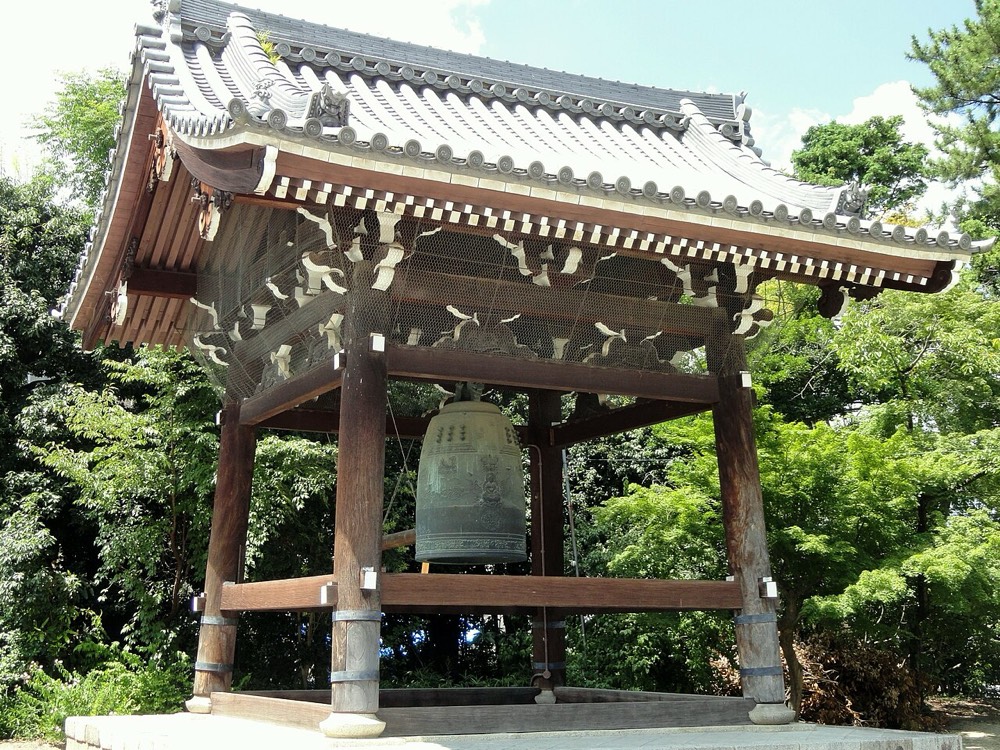
How to pick a temple if you want to ring the bell
- Staying in Gion or Higashiyama: Kodaiji is the most popular, and you can walk to Yasaka Shrine afterwards, but tickets start at 22:00 and there are only 108 groups, so queue before 21:30.
- Staying around Shijo-Kawaramachi: Seiganji is inside the Shinkyogoku shopping arcade and does not hand out tickets until 23:00, so there is no need to leave early.
- Don't want to compete for tickets: Eikando and Manpukuji had no limit in past years; just arrive within the ringing hours. One listing gives Eikando's start as 21:00, which conflicts with 23:00, so follow the temple's notice for the year.
- Staying in Arashiyama: Tenryuji or Jojakkoji, but late-night transport from Arashiyama is limited, so stay within walking distance.
Basic etiquette: when it is your turn, put your hands together and bow, pull the rope to strike once, then bow again. Don't block the people queuing behind you while taking photos.
How to see Chion-in's joya no kane: tickets, trial ringing and rules
The short answer: Chion-in's great bell is rung by 17 monks working together, so the public cannot ring it and can only watch with an admission ticket. In 2026 the ticket costs ¥3,000 per person, free for elementary school children and younger[1].
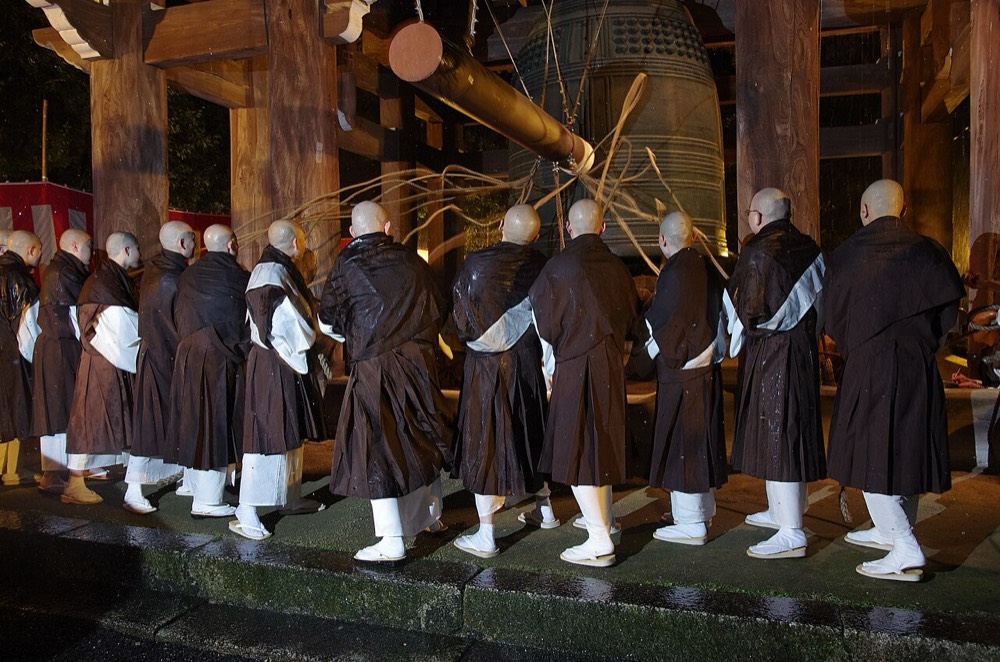
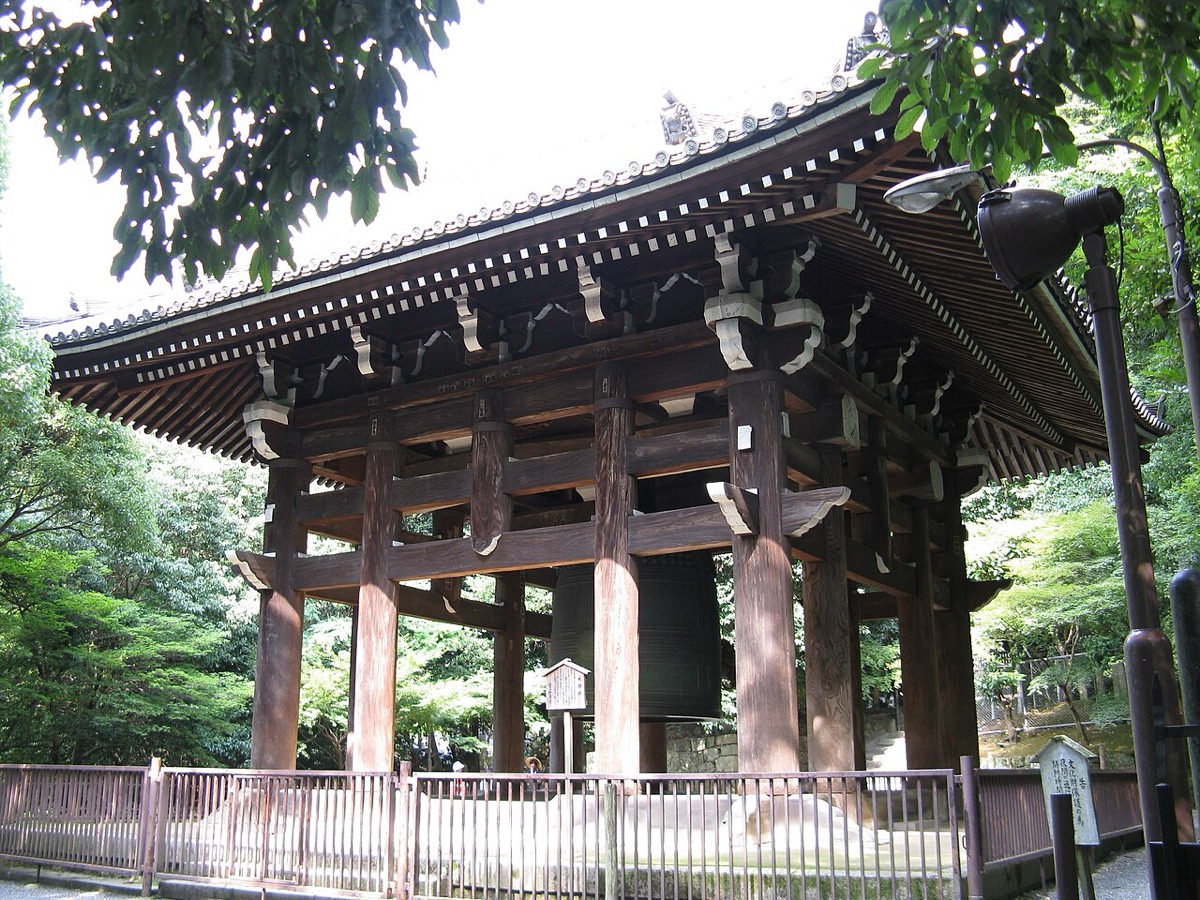
The great bell tower at Chion-in is the most famous image of New Year's Eve in Kyoto: one monk leans back pulling the log striker while the others haul on the ropes, and the huge bell booms out with their shouts. The 2026 arrangements are as follows[1]:
| Item | Thursday, December 31, 2026 |
|---|---|
| Bell tower service | About 22:00 |
| Ringing | About 22:20 to 24:15, 108 strikes |
| Ticket | ¥3,000 per person, free for elementary school children and younger |
| Online application | 14:00 Tuesday, December 1 to 16:59 Thursday, December 24, 4 groups of 500 people each, first come, first served, credit card only |
| Counter sales | Monday, December 7 to Thursday, December 24, 9:00 to 16:00, at the Yuzen-en counter, cash only, 400 tickets in 4 groups, until sold out |
| On the day | No same-day applications and no phone or email bookings; check in at the Kuromon bus area and enter through the Kuromon gate |
| Viewing time | About 30 minutes per group; no re-entry after leaving |
| Live stream | YouTube stream from about 22:00 to 24:15 |
After a successful online application, your meeting time and check-in details are sent by email, so arrive on time (checked November 27, 2026). For the latest notices, keep an eye on the Chion-in website.
No ticket? The trial ringing on December 27
Before the real ringing, Chion-in holds a "tameshi-zuki" trial. In 2026 it starts at 14:00 on Sunday, December 27[2], with no advance application, though entry may be limited if the bell tower gets too crowded[1]. You can hear the great bell in daylight, which is handy if your trip does not cover New Year's Eve.
Rules for entry
According to Chion-in, open flames are banned on the grounds; tripods, selfie sticks, drones, microphones and megaphones are not allowed; no flash photography or personal live streaming; and no drinking alcohol or arriving after drinking. The route is one-way, so use the restroom before entering the great bell tower[1]. Broadcast cameras are on site, so you may appear on screen.
What is okera mairi at Yasaka Shrine, and how do you take the fire?
The short answer: okera mairi runs from about 19:30 on December 31 to about 5:00 on January 1. Visitors transfer the "okera fire" from the lanterns to a fire rope; traditionally it was carried home as the first fire of the new year[4].
Every year, Yasaka Shrine kindles a sacred fire by the traditional drilling method early on December 28. After the Joyasai ritual at 19:00 on December 31, the fire is lit in the okera lanterns on the grounds. The lanterns burn "okera-gi" sticks inscribed with visitors' wishes, together with the medicinal herb okera (atractylodes)[4].
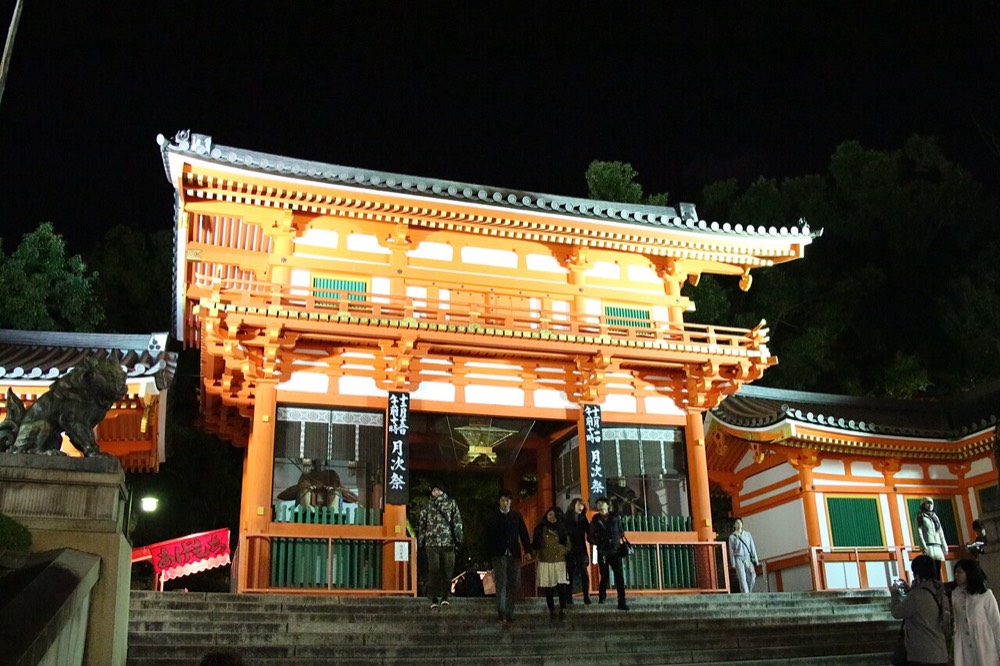
How to take the fire
- From Keihan Gion-Shijo Station, walk east along Shijo-dori to Yasaka Shrine's West Gate (the vermilion gate at the top of the stone steps).
- Get a fire rope at the amulet counter. Yasaka Shrine's site lists the "kakehinawa" fire rope at an offering of ¥1,000[4].
- At an okera lantern, hold one end of the rope to the flame to light it.
- Traditionally, people swung the rope in circles all the way home to keep it burning, then used it to light the household shrine lamp or cook the New Year zoni soup. Once out, the rope is hung in the kitchen as a "hibuse" charm against fire[4].
If you are staying at a hotel
A burning fire rope cannot go into a hotel room, and should not be taken onto trains or buses either. Yasaka Shrine's site does not mention public transport rules, so the safest approach is to light the rope and make your wish at the shrine, put the fire out completely before leaving, and keep the rope as a charm. The shrine and Shijo-dori get extremely crowded around midnight, so watch the people and clothing around you when swinging the rope.
Kitano Tenmangu has a similar custom: in 2025 it held the Hinomikosha fire ritual at 19:30 on December 31 and handed out fire ropes from 22:00[10], which is an option if you want to avoid the Yasaka crowds.
Where to go for hatsumode in Kyoto: five shrines compared
The short answer: Fushimi Inari Taisha is the most crowded (about 2.5 million visitors in a typical year), and Shimogamo Shrine is the relaxed choice. Yasaka Shrine, Kitano Tenmangu and Fushimi Inari let you worship right after midnight, and Heian Jingu has opened at 22:30 in past years.
| Shrine | Open on New Year's Eve night? (past-year reference) | Typical crowds | Access | Best for |
|---|---|---|---|---|
| Fushimi Inari Taisha | Open around the clock | About 2.5 million[8] | Right outside JR Inari Station; about 5 minutes' walk from Keihan Fushimi-Inari Station | Seeing the torii gates at midnight |
| Yasaka Shrine | Main hall open 24 hours | Crowded all day January 1 to 3[12] | Keihan Gion-Shijo Station | Combining with okera mairi |
| Heian Jingu | Opens 22:30 on December 31 until 19:00 on January 1 | About 500,000[9] | About 10 minutes' walk from subway Higashiyama Station | The giant torii and spacious grounds |
| Kitano Tenmangu | Opens 7:00 on December 31, open through the night until about 21:00 on January 1 | Over 600,000[10] | City bus "Kitano Tenmangu-mae" | Prayers for study, fire ropes |
| Shimogamo Shrine | Hours not listed officially | About 50,000[11] | About 10 minutes' walk from Keihan Demachiyanagi Station | Avoiding crowds |
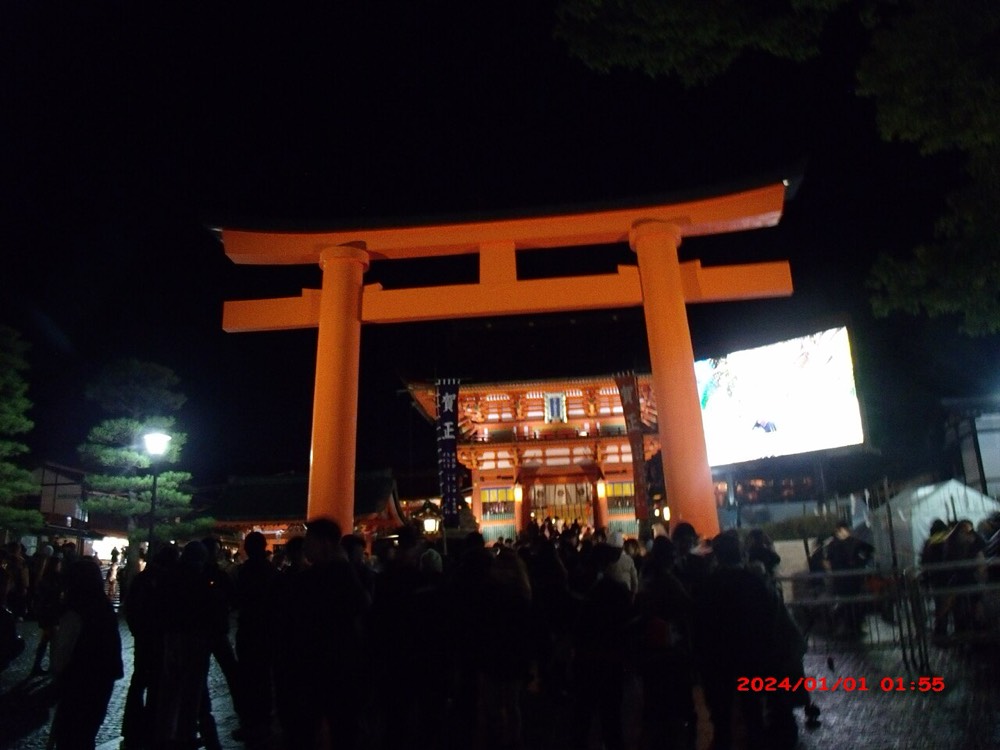
Crowd tips for each shrine
- Fushimi Inari Taisha: The car park is closed from December 30 to January 5 and there are traffic restrictions nearby[8], so take the train. During January it is busiest from 10:00 to 18:00, and the Saitansai ritual is at 6:00 on January 1. Over New Year, stay around the lower torii gates rather than climbing Mount Inari in the dark; normal hiking routes and night-visit tips are in the Fushimi Inari Taisha guide.
- Heian Jingu: In 2025-26, special New Year prayers paused from 4:30 to 8:30 on January 1 for a ritual, and visiting hours on January 2 and 3 were 6:00 to 18:30[9].
- Kitano Tenmangu: Open from 6:00 to about 20:00 on January 2 and 6:00 to about 19:00 on January 3 (2025-26)[10]. It is about 30 minutes by city bus from Kyoto Station, and there is no all-night bus on New Year's Eve, so plan your way back.
- Shimogamo Shrine: Kemari Hajime, a traditional court football ritual, was held at 14:00 on January 4, 2026[11]. If you want a traditional ceremony without the crush, put it on January 4.
Kyoto New Year's Eve transport: which trains run all night?
The short answer: in 2025-26, Keihan's Main and Oto lines ran all night, while the Kyoto subway and city buses neither ran all night nor extended last services, and Hankyu did not run all night[5][6]. Operators usually announce 2026-27 plans in early December, so the following is past-year reference.
| Transport | New Year's Eve 2025-26 | How to use it |
|---|---|---|
| Keihan Main and Oto lines (Demachiyanagi – Gion-Shijo – Fushimi-Inari – Yodoyabashi) | All night; New Year's Eve timetable from 18:00 on December 31 to 7:00 on January 1, roughly every 15 to 40 minutes late at night[6] | Easiest way between Gion, Higashiyama, Fushimi Inari and Demachiyanagi |
| Keihan Uji, Nakanoshima and Katano lines | All night[6] | Toward Uji for Manpukuji and Byodoin |
| Keihan Otsu lines (Keishin and Ishiyama-Sakamoto lines) | Not all night (2024-25)[7] | Take care if heading to Yamashina or Otsu |
| Kintetsu (Kyoto Line and others) | All night[6] | Toward Nara; intervals not published |
| JR West | Not all night in the Keihanshin area; extra trains after the last train on some lines only[6] | Check JR West's notice for Kyoto-area details |
| Hankyu Kyoto Line | No all-night or extra trains; Saturday/holiday timetable[6] | No way back to Osaka from Shijo-Kawaramachi after midnight |
| Kyoto Municipal Subway | Not all night, last trains not extended; Saturday/holiday timetable December 27 to January 4[5] | No trains after midnight |
| Kyoto City Bus | Not all night, last buses not extended; holiday timetable December 28 to January 4[5] | Sightseeing express buses EX100 and EX101 run daily December 27 to January 4 |
We could not find reliable information on Eizan Railway or Randen for New Year's Eve, so check each company's website. For everyday bus and subway tips, see the Kyoto transport guide.
Where is the best place to stay?
On New Year's Eve you will be getting around on foot or by Keihan, so stay near Keihan stations such as Gion-Shijo, Sanjo, Kiyomizu-Gojo or Shichijo, or within walking distance of Higashiyama. If you stay at Kyoto Station, after midnight your only options are walking 30 minutes or more or taking a taxi, and taxis are hard to get that night. Area comparisons are in where to stay in Kyoto.
Sample Kyoto New Year's Eve itinerary: December 31 evening to New Year's morning
The short answer: the smoothest route is "ring the bell in Higashiyama → okera mairi at Yasaka → Keihan to Fushimi Inari," done entirely on foot and by all-night Keihan trains. Times below are based on 2025 temple, shrine and transport arrangements; adjust once 2026 details are announced.
| Time | Plan | Notes |
|---|---|---|
| 17:00 | Dinner near your hotel | Many restaurants close early or shut on New Year's Eve, so book ahead; or buy toshikoshi soba at a supermarket |
| 19:30 | Okera mairi at Yasaka Shrine | The fire is lit after the Joyasai ritual, and crowds are still manageable |
| 21:00 | Back to the hotel to rest and add layers | It gets very cold at night; bring a hat, gloves and heat packs |
| 21:30 | Queue at Kodaiji | Numbered tickets from 22:00, only 108 groups |
| 23:45 | Ring the bell at Kodaiji | Turns go by ticket number, so your finish time depends on your number |
| 0:30 | Walk to Yasaka Shrine | About 10 to 15 minutes; the shrine is at its busiest just after midnight, so take it slowly |
| 1:15 | Board at Keihan Gion-Shijo Station | Toward Yodoyabashi, get off at Fushimi-Inari |
| 1:45 | Hatsumode at Fushimi Inari Taisha | Pray at the tower gate and main hall, see the torii gates at night |
| 3:00 | Keihan back to the hotel | Trains roughly every 15 to 40 minutes late at night; platforms get crowded |
| New Year's Day | After sleeping in, visit Heian Jingu or Shimogamo Shrine | Afternoons are usually less crowded; get back before evening |
Easy version: If you don't want to stay up, go to Yasaka Shrine for okera mairi at 19:30, then watch Chion-in's live stream from your hotel. Head to Fushimi Inari at around 6:00 on New Year's morning to see the grounds before the Saitansai ritual.
Arashiyama version: If you are staying in Arashiyama, queue for a ticket at Tenryuji by 23:30, visit a nearby shrine after ringing the bell, and don't plan on going into the city after midnight.
What's closed in Kyoto on January 1 to 3?
The short answer: most shrines and temples stay open, but some sights, most small independent shops and many market stalls close, especially on New Year's Day.
- Nijo Castle: Closed December 29 to 31. It opens January 1 to 3, but the Ninomaru and Honmaru palaces are closed to visitors[13].
- Nishiki Market: Many shops close January 1 to 3, while most stay open at the end of December[14]. Go during the day on December 30 or 31; market hours are in the Nishiki Market guide.
- Museums, galleries, the Kyoto Imperial Palace and similar facilities: Most close over the New Year holidays, with dates varying by venue, so check their websites.
- Kinkakuji: Officially open every day of the year, including New Year's Day; tickets and access are in the Kinkakuji guide.
- Restaurants: Many independently run restaurants close on New Year's Day, and quite a few stay closed until January 3. Hotel restaurants, malls around Kyoto Station and convenience stores are your backup for meals on January 1.
- Department stores and lucky bags: Kyoto department stores have not announced their 2027 first-sale dates yet; how to buy lucky bags is covered in the Japan fukubukuro guide.
To combine New Year's Eve with other winter plans in Kyoto, such as the Kyo no Fuyu no Tabi special openings, snowy Kinkakuji and Setsubun, see the Kyoto winter travel guide.
Kyoto New Year's Eve: before you go
- Check again in early December: Chion-in tickets go on sale from December 1, and the New Year's Eve timetables for Keihan and Kyoto City Transportation Bureau have usually been announced in early December. That is the best time to settle on a temple and hotel.
- Bring enough cash: Chion-in's counter takes cash only, and temple donations, amulet counters and food stalls mostly take cash too.
- Dress for the cold: Queuing to ring a bell plus a late-night shrine visit easily means 3 to 5 hours outdoors. Wear comfortable shoes and one more layer than you would during the day.
- Visit sober: Chion-in explicitly bans arriving after drinking, and being drunk in the crowds is a bad idea at any temple or shrine.
- Want a fireworks countdown?: Kyoto has no big New Year fireworks; for options in Tokyo and Osaka, see the Tokyo New Year's Eve guide.
FAQ
Where can I ring the New Year's Eve bell myself in Kyoto?
In 2025, Kodaiji (numbered tickets from 22:00, 108 groups), Seiganji (tickets from 23:00, 108 groups), Tenryuji (tickets from 23:30, 108 groups), Eikando (first come, no limit), Hyakumanben Chionji, Chishakuin and Manpukuji all let the public ring the bell, mostly free or for a donation. Chion-in and Konkai Komyoji were watch-only. Check each temple's notice for 2026.
Do I need a ticket for Chion-in's joya no kane? How do I get one for 2026?
Yes. For 2026 a ticket costs ¥3,000 per person, free for elementary school children and younger. Online applications open at 14:00 on December 1 (credit card only, 4 groups of 500), and cash sales run at the Yuzen-en counter from December 7 to 24 (400 tickets); no same-day entry. Without a ticket, watch the YouTube stream or go to the trial ringing from 14:00 on December 27.
Can I take the okera fire from Yasaka Shrine on a train?
Do not board with the rope still burning. The fire rope is meant for carrying the okera fire home, but a hotel room, train or bus is no place for an open flame. If you are staying at a hotel, light the rope and make your wish at the shrine, put the fire out completely before leaving, and keep the rope as a fire-protection charm. Yasaka Shrine's site gives no rule on public transport, so ask at the shrine office if unsure.
Do the Kyoto subway and buses run all night on New Year's Eve?
Not in 2025-26. Kyoto City Transportation Bureau said city buses and the subway would neither run all night nor extend last services on New Year's Eve. Keihan's Main and Oto lines (Demachiyanagi to Yodoyabashi via Gion-Shijo and Fushimi-Inari) ran all night, as did Kintetsu; Hankyu and JR West in the Keihanshin area did not. Plans for 2026-27 usually come out in early December.
Which Kyoto shrine is most crowded for hatsumode?
Fushimi Inari Taisha usually draws about 2.5 million New Year visitors, the most in Kyoto. Kitano Tenmangu gets over 600,000 and Heian Jingu about 500,000, and Yasaka Shrine is packed all day from January 1 to 3. To avoid crowds, go in the early morning rather than just after midnight, or wait until January 4 or later, which still counts as hatsumode.
Sources
- Chion-in | Joya no Kane: 2026 bell-ringing times, ticket price and sales, trial ringing, live stream, rules (checked November 27, 2026)
- Kyoto Kanko Navi | Chion-in trial bell ringing: 2026 trial ringing on December 27
- Rurubu &more | Kyoto joya no kane spots: 2025 public ringing, times, numbered tickets and fees by temple (past-year reference)
- Yasaka Shrine | New Year rituals: Joyasai and okera mairi times, fire rope and kakehinawa offering
- Kyoto City Transportation Bureau | New Year bus and subway timetables (announced December 8, 2025): 2025-26: no all-night or extended bus and subway service; holiday timetables
- Tetsudo Channel | Kansai railways' 2025-2026 New Year operations: 2025-26: Keihan and Kintetsu all night, JR West and Hankyu not (past-year reference)
- Keihan Electric Railway | New Year train operations (announced December 6, 2024): New Year's Eve timetable hours, late-night intervals, Otsu lines not all night (2024-25)
- Jorudan Hatsumode 2026 | Fushimi Inari Taisha: Typical visitor numbers, Saitansai, parking and traffic restrictions
- Jorudan Hatsumode 2026 | Heian Jingu: 2025-26 visiting hours, typical visitor numbers
- Jorudan Hatsumode 2026 | Kitano Tenmangu: 2025-26 gate hours, fire rope distribution, typical visitor numbers
- Jorudan Hatsumode 2026 | Shimogamo Shrine: Typical visitor numbers, Kemari Hajime
- Rurubu &more | Yasaka Shrine hatsumode: Main hall open 24 hours, crowded all day January 1 to 3
- Nijo Castle | Opening hours and closed days: Closed December 29 to 31; Ninomaru and Honmaru palaces closed January 1 to 3
- Kyoto Nishiki Market Association | FAQ: Many shops closed January 1 to 3
Fares, opening hours and event dates can change. Information checked on 2026.11.27; please confirm with official sources before you go.