Kinkaku-ji Guide: Admission, Opening Hours, Getting There, and Combining Ginkaku-ji and Ryoan-ji
Kinkaku-ji costs 500 yen for adults, opens 9:00–17:00 daily and needs no booking. Route, autumn and snow timing, subway-plus-bus access, Ginkaku-ji and Ryoan-ji.
Quick answer
Kinkaku-ji (officially Rokuon-ji, Kita Ward, Kyoto) is open 9:00–17:00 every day of the year. Admission is 500 yen for adults (high school age and up) and 300 yen for elementary and junior high students, bought on the spot with no booking; the ticket itself is a paper talisman. A visit takes about 30–40 minutes. From Kyoto Station, take the Karasuma subway line to Kitaoji, then city bus 204 or 205 for about 11 minutes to Kinkakuji-michi and walk 5–8 minutes. Ginkaku-ji rose to 1,000 yen in April 2026 and is far away, so pair Kinkaku-ji with Ryoan-ji and Ninna-ji in the same half day.
Kinkaku-ji admission is 500 yen for adults, the gates open at 9:00 and there is no booking, but how to get there from Kyoto Station, how much time to allow, and how to choose between it and Ginkaku-ji are where first-time visitors usually get stuck. Using the temple's official site and Kyoto City Transportation Bureau information from October 2026, this guide covers Kinkaku-ji admission and opening hours, the one-way route, access, autumn leaves and snow timing, and how to link it with Ryoan-ji and Ninna-ji along the Kinukake-no-michi road for a half-day walk, plus the differences between Kinkaku-ji and Ginkaku-ji.
How much is Kinkaku-ji admission? Opening hours and tickets
The short answer: 500 yen for adults (high school age and up) and 300 yen for elementary and junior high students, open 9:00–17:00 every day of the year, bought on the spot with no booking[1]. This price was set on April 1, 2023[5], and the official site still showed the same amount in October 2026; many Kyoto temples have raised prices recently, but Kinkaku-ji has not changed again so far.
| Item | Details |
|---|---|
| Official name | Rokuon-ji, commonly called Kinkaku-ji |
| Opening hours | 9:00–17:00, open all year |
| Adults (high school and up) | 500 yen |
| Elementary and junior high students | 300 yen |
| Group discount | None (groups of 30+ should enter as a group) |
| Payment | Cash, Omairi Pay mobile payment (not for amulets, other temple items or goshuin) |
| Time needed | About 30–40 minutes on the one-way route |
Source: Kinkaku-ji official site[1].
Is the Kinkaku-ji ticket a talisman?
Yes. The Kinkaku-ji admission ticket is not an ordinary stub but a paper talisman (ofuda) printed with words of blessing, and many visitors put it up by their front door or keep it in a notebook as a souvenir. Since the ticket itself is a keepsake, don't throw it out with your other receipts.
Can you take photos at Kinkaku-ji? What are the rules?
Yes, but only casual snapshots with a small camera for personal use. The official FAQ bans group photo shoots, live video streaming and drones[3]. To protect the roughly 600-year-old garden, the grounds have no barrier-free facilities, and there are steps after you pass the pavilion, so wheelchairs and strollers will struggle[3].
What is the route around Kinkaku-ji, and how long does it take?
The short answer: Kinkaku-ji has a one-way loop: enter through the main gate, view the pavilion along Kyoko-chi Pond, circle up the hillside and leave near the Fudo-do hall, in about 30–40 minutes at a normal pace. The official grounds guide lists, in order, the Somon gate, bell tower, Karamon gate, Ashiharajima island, the Golden Pavilion, the Hojo, Rikushu-no-matsu pine, Gingasen spring, Ryumon waterfall, Anmintaku pond, Sekkatei teahouse and Fudo-do[2].
- Main gate → ticket counter: buy your ticket and receive the talisman.
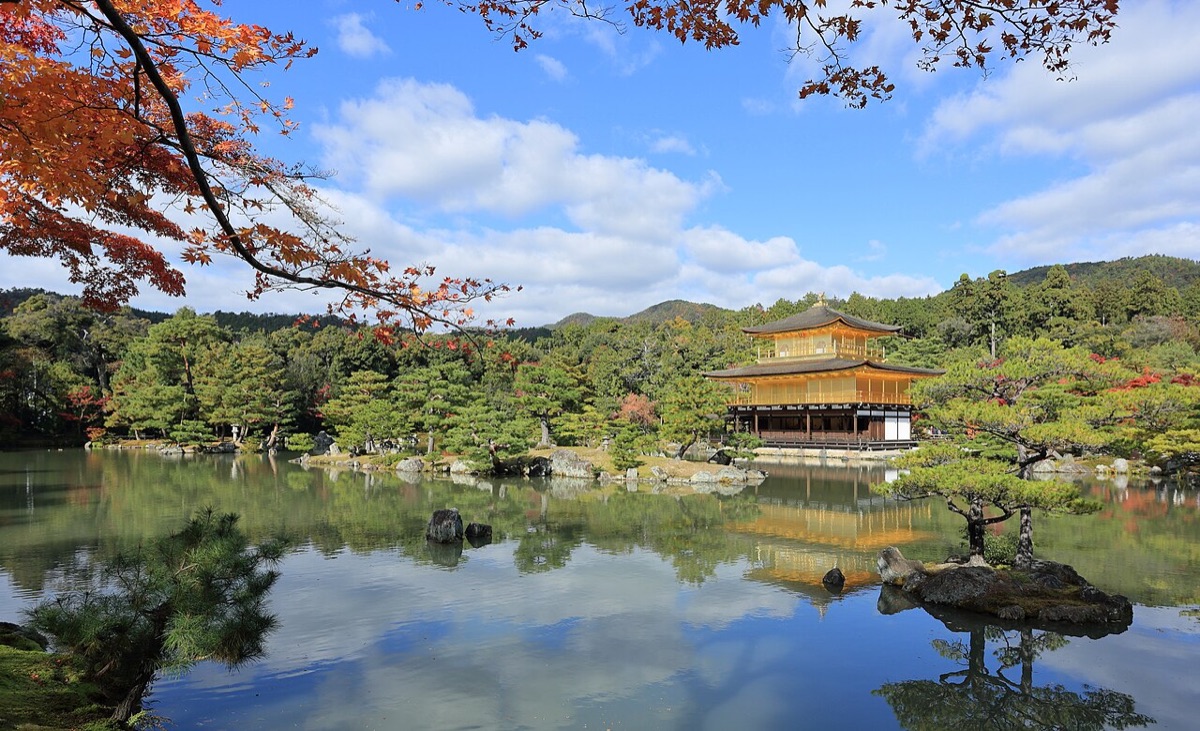
- Kyoko-chi Pond: your first view of the pavilion and the classic photo spot. The official site says the pond covers about 6,600 square meters, with Ashiharajima and other islands of various sizes[2]. This is the most crowded spot; take your photo and move on, as there are other angles ahead.
- The Golden Pavilion up close: follow the pond to the side of the pavilion. The first floor is in shinden style, the second and third are covered in pure gold leaf over lacquer, and a phoenix stands on the roof[2]. Regular visitors cannot go inside.
- Rikushu-no-matsu: a pine beside the Hojo trained into the shape of a boat.
- Gingasen spring and Ryumon waterfall: the spring Ashikaga Yoshimitsu is said to have used for tea, and the waterfall with its carp stone[2].
- Sekkatei: a teahouse up the slope, built for Retired Emperor Go-Mizunoo by Horin Josho, who restored the pavilion in the Edo period[2].
- Fudo-do → exit: before the exit there is a rest area and shop selling matcha and amulets.
Kinkaku-ji began as Kitayama-dono, the villa of Ashikaga Yoshimitsu, third shogun of the Muromachi shogunate; after his death it became a Zen temple according to his wishes, and it belongs to the Shokoku-ji branch of the Rinzai school[4]. The current pavilion was rebuilt in 1955 after it burned down in 1950.
When is Kinkaku-ji least crowded?
Opening time at 9:00 and the last hour before closing are the quietest. Around midday, school trips and tour groups peak, and you often have to wait for a spot at the pond-side photo point. The gold leaf shines brightest and the reflection is clearest on sunny, windless days, so for good photos pick a fine morning.
Getting to Kinkaku-ji: how to go from Kyoto Station
The short answer: the Kyoto City Official Travel Guide recommends taking the Karasuma subway line to Kitaoji Station, then city bus 204 or 205 from the Kitaoji Bus Terminal next to the station for about 11 minutes to Kinkakuji-michi, and walking 5–8 minutes from the stop[6]. Bus 205 straight from Kyoto Station needs no transfer, but it makes many stops and is often packed, and the guide explicitly advises against it[6].
| Route | How | Notes |
|---|---|---|
| From Kyoto Station (recommended) | Karasuma line to Kitaoji → buses 204 or 205 from the blue stops (E–G) at Kitaoji Bus Terminal, about 11 min | Subway leg avoids traffic; most reliable |
| From Kyoto Station, direct | City bus 205 to Kinkakuji-michi | Many stops, often full; in peak season you may wait for the next bus |
| From the JR Sagano Line | JR Enmachi Station, then city bus 204 or 205 | In peak season buses may be too full to board |
| From Shijo-Kawaramachi | Hankyu to Karasuma, Karasuma subway line, then the Kitaoji route | Taking a bus directly from Kawaramachi is not recommended |
| From Ginkaku-ji | Bus 204 from Ginkakuji-michi to Kinkakuji-michi | Bus 102 also runs on weekends and holidays |
| From the Shokoku-ji area | Bus 59 from Karasuma Imadegawa or Doshisha-mae | — |
Sources: Kyoto City Official Travel Guide[6], Kinkaku-ji official site[1].
Kyoto city bus fares and day passes
The city bus flat fare is currently 230 yen for adults and 120 yen for children[7], and transit IC cards are accepted. If you will ride the subway and several buses in a day, the Kyoto City Transportation Bureau's Subway & Bus One-Day Pass costs 1,100 yen for adults and 550 yen for children, with unlimited rides on all subway lines and city buses that day[9]. The old bus-only one-day pass was discontinued at the end of September 2023, so ignore older guides that mention it.
For getting around Kyoto in general, see the Kyoto transport guide.
Kinkaku-ji autumn leaves and snow: when is it most beautiful?
The short answer: autumn color around Kinkaku-ji usually peaks from mid-November to early December[14], while snow depends on the winter's cold snaps and mostly appears on mornings after snowfall in January and February. The grounds are mainly pine, so the maples don't blanket the hills as at Tofuku-ji or Eikan-do; instead they frame the pavilion and pond, giving an autumn-only mix of gold, red and green.
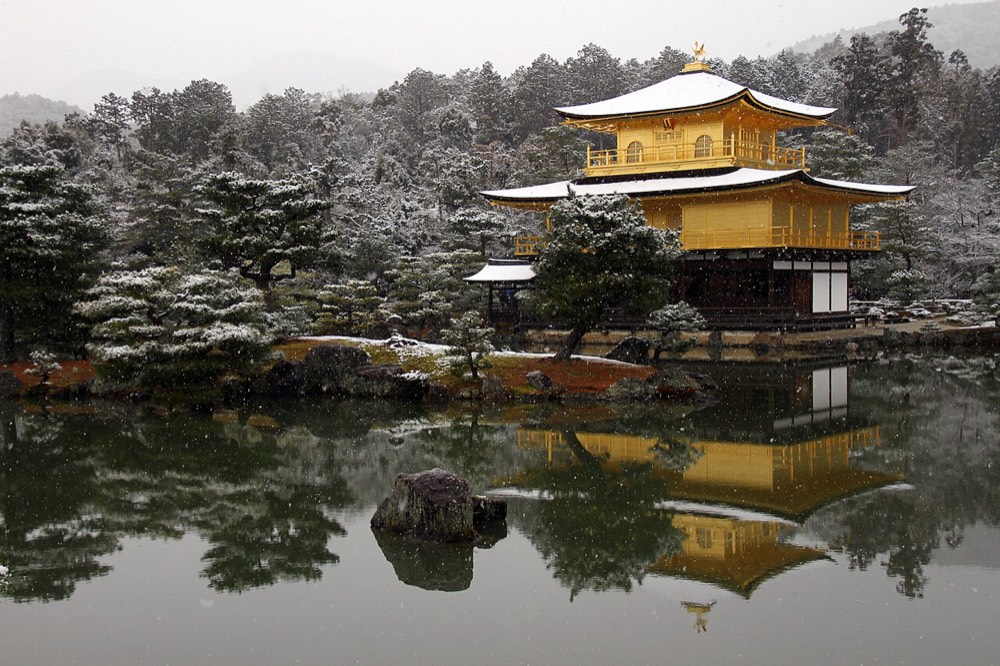
Kinkaku-ji in snow is often called one of the hardest winter scenes in Kyoto to catch. Snow in central Kyoto rarely lasts past noon, so if snow is forecast overnight, be there before opening. On snowy days queues may form at the gate earlier than usual and paths get slippery, so non-slip shoes are a good idea.
For an autumn leaf itinerary in Kyoto, pair this with Kyoto autumn leaves 2026 for peak times and illumination dates at each spot. Kinkaku-ji itself has no evening illumination and closes at 17:00.
What is the difference between Kinkaku-ji and Ginkaku-ji?
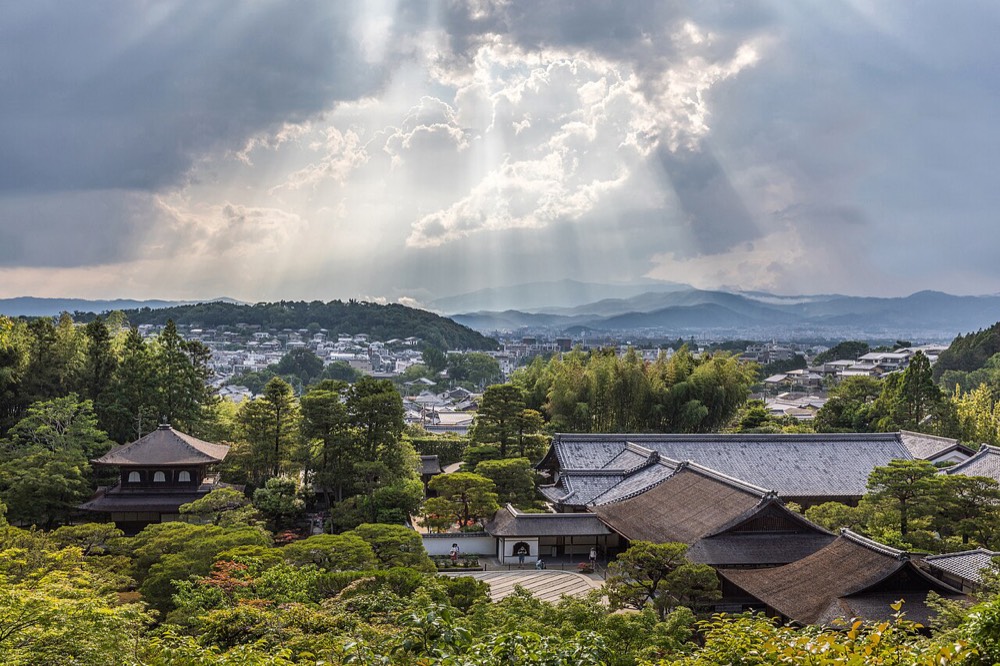
The short answer: both belong to the Shokoku-ji branch of the Rinzai school, but Kinkaku-ji is the lavish villa Ashikaga Yoshimitsu built in the late 14th century, while Ginkaku-ji is the Higashiyama villa his grandson Ashikaga Yoshimasa built in the late 15th century; one is dazzling, the other restrained. Since April 2026 Ginkaku-ji costs 1,000 yen, now double Kinkaku-ji[10][11].
| Kinkaku-ji (Rokuon-ji) | Ginkaku-ji (Jisho-ji) | |
|---|---|---|
| Built by | Ashikaga Yoshimitsu (3rd shogun) | Ashikaga Yoshimasa (8th shogun) |
| Signature building | Golden Pavilion, gold leaf on floors 2–3 | Silver Pavilion (Kannon-den), no silver on the exterior |
| Garden highlights | Reflection in Kyoko-chi Pond | Ginshadan, Kogetsudai, moss garden |
| Adult admission | 500 yen | 1,000 yen (from April 2026) |
| Elementary/junior high | 300 yen | 500 yen |
| Hours | 9:00–17:00 | Mar–Nov 8:30–17:00, Dec–Feb 9:00–16:30 |
| Area | Kita Ward, near Ryoan-ji and Ninna-ji | Sakyo Ward, north end of the Philosopher's Path |
Sources: Kinkaku-ji official site[1], Ginkaku-ji official site[10][12].
Ginkaku-ji's official site describes the Kannon-den Silver Pavilion as the only surviving pavilion-garden building of the Muromachi period, and the neighboring Togu-do is also a National Treasure[12]. The white-sand Ginshadan and the cone-shaped Kogetsudai are linked in legend to moon viewing. With Ginkaku-ji's higher price, first-time visitors short on time can prioritize Kinkaku-ji; if you love gardens and wabi-sabi, Ginkaku-ji plus a walk on the Philosopher's Path is still well worth it. The two temples sit on opposite sides of the Kyoto basin and the bus ride takes a while, so plan them separately.
Combining Kinkaku-ji, Ryoan-ji and Ninna-ji: a half-day Kinukake-no-michi route
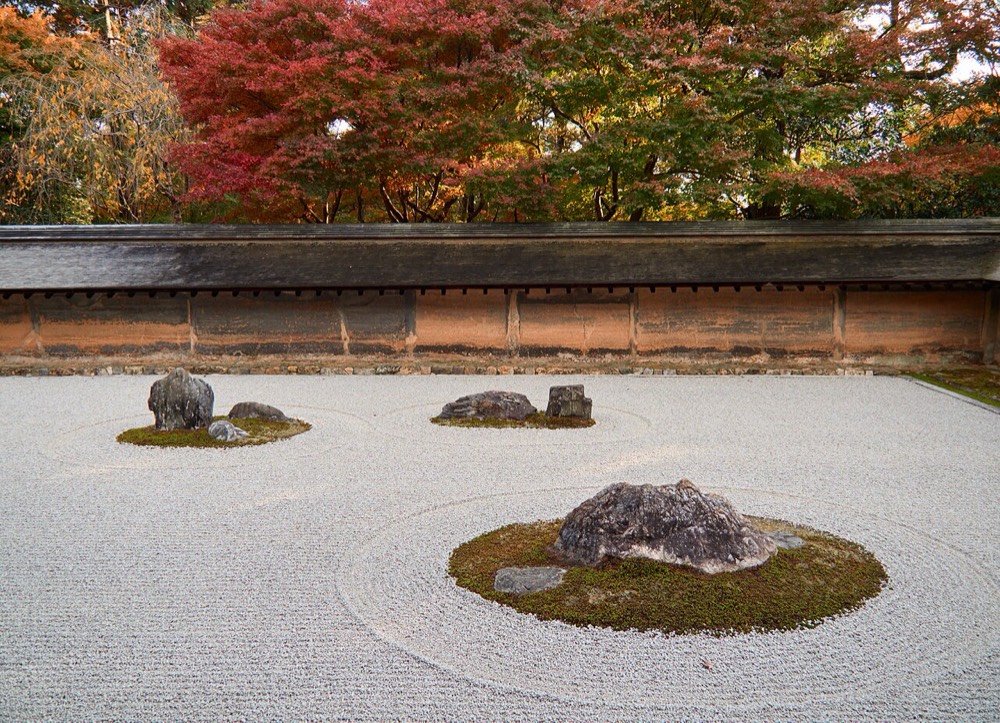
The short answer: walk south from Kinkaku-ji along the Kinukake-no-michi, a sightseeing road at the foot of Mount Kinugasa about 2.5 km long, to link Ryoan-ji and Ninna-ji, three World Heritage sites in about half a day[15]. Finish by taking the Randen tram from in front of Ninna-ji to Arashiyama for the afternoon.
| Time | Plan | Notes |
|---|---|---|
| 9:00 | Enter Kinkaku-ji at opening | About 40 min |
| 9:50 | Walk the Kinukake-no-michi to Ryoan-ji | About 20 min |
| 10:15 | Ryoan-ji rock garden and Kyoyo-chi Pond | About 45 min |
| 11:00 | Walk to Ninna-ji | About 10–15 min |
| 11:15 | Ninna-ji grounds and Goshō Garden | About 1 hour |
| 12:30 | Randen from Omuro-Ninnaji Station toward Arashiyama | Arashiyama in the afternoon |
- Ryoan-ji: famous for its Hojo rock garden of 15 stones on white gravel. Several travel sites list adult admission as 600 yen, but as of October 2026 this could not be confirmed on the official site, so go by the notice on site.
- Ninna-ji: normally the Nio-mon gate and five-story pagoda area can be visited freely; the paid Goshō Garden is 800 yen for adults and free for students up to high school, about 3 minutes' walk from Randen Omuro-Ninnaji Station[13]. In spring, its Omuro cherries are among the last to bloom in Kyoto.
- On to Arashiyama: the Randen Kitano line from Omuro-Ninnaji connects to Arashiyama; for the bamboo grove and Togetsukyo Bridge in the afternoon, see the Arashiyama day trip.
If you are still deciding where to stay, the northern sights are far from the center, so the Kyoto Station or Karasuma area with easy subway access works best; see where to stay in Kyoto. For the Higashiyama side, combine this with the Kiyomizu-dera guide and top Kyoto attractions.
Buying Kinkaku-ji amulets and other tips before you go
The short answer: amulets and goshuin are sold at the counter before the exit, and bring cash, since the official site says mobile payment does not cover amulets, other temple items or goshuin[1]. The types and prices of amulets depend on what is on site, and you can also pray at the Fudo-do near the exit.
Check these before you set out:
- Arrive right at 9:00: the best light for photos before the midday groups arrive.
- Subway plus bus beats the direct bus: going via Kitaoji from Kyoto Station is more reliable than bus 205 direct[6].
- Keep your ticket: the talisman ticket is a souvenir, so don't toss it.
- Do Ginkaku-ji separately: the temples are far apart with different prices; pair the north with Ryoan-ji and Ninna-ji, and Higashiyama with the Philosopher's Path.
- Leave early in autumn and on snowy days: late-November weekends and snowy mornings are especially busy, and buses fill up quickly.
FAQ
How much is Kinkaku-ji admission, and do I need to book?
Adults (high school age and up) pay 500 yen and elementary and junior high students 300 yen, with no group discount. No booking is needed; just buy at the ticket counter. Besides cash, the temple accepts the Omairi Pay mobile payment service, but amulets and goshuin stamps follow on-site rules. This price was set in April 2023 and is still current (checked October 2026).
What are Kinkaku-ji's opening hours, and how long does a visit take?
9:00 to 17:00 every day, all year. The route is a one-way loop: view the pavilion across Kyoko-chi Pond, pass the Sekkatei teahouse and leave near the Fudo-do hall. At a normal pace it takes 30 to 40 minutes, or about an hour if you take lots of photos or buy amulets. To avoid tour groups, arrive before opening or after 16:00.
Can you go inside the Golden Pavilion?
Regular visitors cannot enter the Golden Pavilion (Shariden); you view it from across Kyoko-chi Pond and from the path beside it. Its second and third floors are covered in pure gold leaf over lacquer, with a phoenix on the roof. For the interior, see the grounds guide and live camera on the temple's official site.
What is the difference between Kinkaku-ji and Ginkaku-ji? Which is more worth it?
Kinkaku-ji was built by Ashikaga Yoshimitsu and is famous for its gold-leaf exterior and pond reflection; Ginkaku-ji was built by his grandson Ashikaga Yoshimasa, is not actually covered in silver, and is known for its white-sand Ginshadan, Kogetsudai cone and moss garden. Kinkaku-ji costs 500 yen; Ginkaku-ji rose to 1,000 yen in April 2026. Both are worth seeing on a first trip, but they are in different parts of Kyoto, so give each its own half day.
When can you see autumn leaves and snow at Kinkaku-ji?
Autumn color around Kinkaku-ji usually peaks from mid-November to early December, relatively late for Kyoto. Snow depends on the year: snowfall in central Kyoto mostly comes during cold snaps in January and February, and it often lasts only one morning, so set out early whenever snow is forecast.
Sources
- Kinkaku-ji (Rokuon-ji) official: Access and visiting: Hours 9:00–17:00, open all year, 500 yen adults and 300 yen elementary/junior high, bus routes stopping at Kinkakuji-michi, parking (checked October 2026)
- Kinkaku-ji (Rokuon-ji) official: Grounds guide: Kyoko-chi Pond, the Golden Pavilion, Rikushu-no-matsu pine, Ryumon waterfall, Sekkatei, Fudo-do and other features
- Kinkaku-ji (Rokuon-ji) official: FAQ: Accessibility, photography rules, pets
- Kinkaku-ji (Rokuon-ji) official: About Kinkaku-ji: Official name Rokuon-ji and its origin as Ashikaga Yoshimitsu's Kitayama-dono
- Kinkaku-ji (Rokuon-ji) official: Notice of admission fee revision: Admission revised from April 1, 2023
- Kyoto City Official Travel Guide (Kyoto Kanko Navi): Access to Kinkaku-ji: Recommends the Karasuma line to Kitaoji then bus 204 or 205 for about 11 minutes; advises against bus 205 direct from Kyoto Station
- Kyoto City Transportation Bureau: City bus fares (non-pass): Flat-fare zone 230 yen adults, 120 yen children
- Kyoto City Transportation Bureau: Outline of resident-priority city bus fares: Announced June 3, 2026; planned for fiscal 2027, about 350–400 yen for non-residents
- Kyoto City Bus & Subway Guide: Subway & Bus One-Day Pass: 1,100 yen adults, 550 yen children, valid on the day of use
- Ginkaku-ji (Jisho-ji) official: Access and visiting: 1,000 yen adults, 500 yen elementary/junior high, summer and winter hours
- MATCHA: Kyoto's Ginkaku-ji raises admission from April 1: From April 1, 2026, raised from 500 to 1,000 yen, the first increase in 32 years
- Ginkaku-ji (Jisho-ji) official: Grounds guide: Ginshadan, Kogetsudai, Kannon-den (Silver Pavilion), Togu-do
- Ninna-ji: Visitor information: Goshō Garden 800 yen for adults, free for students, about 3 minutes' walk from Randen Omuro-Ninnaji Station
- Walkerplus: Kinkaku-ji area autumn leaves: Autumn color around Kinkaku-ji usually mid-November to early December
- Travel.jp: Kinukake-no-michi linking three Kyoto World Heritage sites: About 2.5 km sightseeing road linking Kinkaku-ji, Ryoan-ji and Ninna-ji
Fares, opening hours and event dates can change. Information checked on 2026.10.27; please confirm with official sources before you go.