Fushimi Inari Taisha Guide: Senbon Torii Route, Hiking Times, Night Visits, Access and Food
Fushimi Inari Taisha guide: how long the Senbon Torii and Mt Inari hike take, 24-hour free entry, how to get there, night visit tips, fox ema and street food.
Quick answer
Fushimi Inari Taisha is the head shrine of about 30,000 Inari shrines across Japan. Its grounds never close, are open every day and are free to enter. Take the JR Nara Line from Kyoto Station to Inari Station; the great torii stands right outside. Walking only the Senbon Torii to the Okusha Hohaisho and back takes about 30-45 minutes; climbing to Yotsutsuji and back takes about 1.5 hours; the full loop of Mount Inari (about 4 km, highest point Ichinomine at 233 m) takes about 2-3 hours. According to Kyoto City's official guide, the amulet counter is open 8:00-18:00 and prayer reception 8:30-16:30.
Fushimi Inari Taisha is one of Kyoto's most iconic sights, and its vermilion Senbon Torii climbing the mountain are almost a shorthand for Kyoto itself. This guide answers what first-time visitors ask most: how long the Senbon Torii and the Mount Inari hike take, the fastest way to get there, when crowds are thinnest, whether you can go at night, and which snacks, fox ema and amulets are worth seeking out, so you can decide how far to go based on your time and energy.
What is Fushimi Inari Taisha? Opening hours and admission
The short answer: the grounds of Fushimi Inari Taisha have no closing time, are open every day and charge no admission, so you can visit whenever you like; only the amulet counter and prayer reception keep fixed hours.
Fushimi Inari Taisha is the head shrine of about 30,000 Inari shrines across Japan. The Inari deity is honored as a guardian of good harvests, prosperous business and household safety. Mount Inari behind the shrine is the southernmost of Kyoto's 36 Higashiyama peaks, and the whole mountain belongs to the shrine grounds, which are very large[7]. The deity's messengers are foxes, so you will see fox statues holding rice ears, keys or jewels in their mouths all over the grounds.
According to Kyoto Kanko Navi[2]:
| Item | Hours / fee |
|---|---|
| Shrine grounds | No closing time, 24 hours, open every day |
| Admission | Free |
| Amulet counter (amulets, ema, goshuin) | 8:00-18:00 |
| Prayer reception | 8:30-16:30 |
| Suggested time | About 1 hour for the Senbon Torii; 2-3 hours for the full loop |
Different media list slightly different counter hours, and they are extended at special times such as New Year's Eve. If you must buy an amulet, going during the day is safest.
Senbon Torii and the Mount Inari hike: how long to each point?
The short answer: about 30-45 minutes round trip to see the Senbon Torii and reach the Okusha, about 1.5 hours to Yotsutsuji, and about 2-3 hours to loop all of Mount Inari. Most visitors turn back after the Kyoto view at Yotsutsuji; if you have energy left, head for the summit.
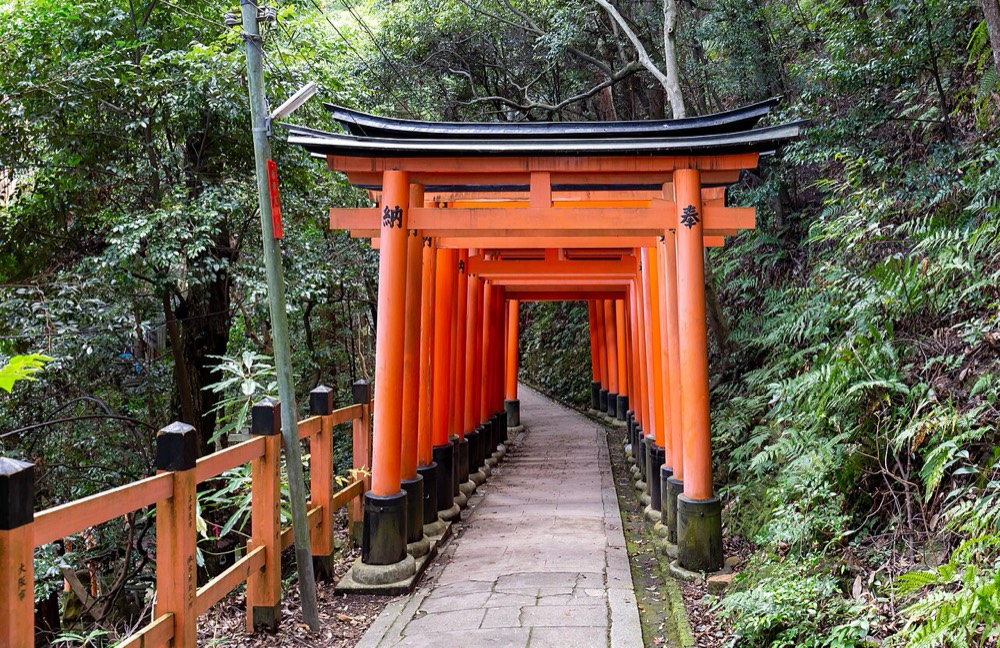
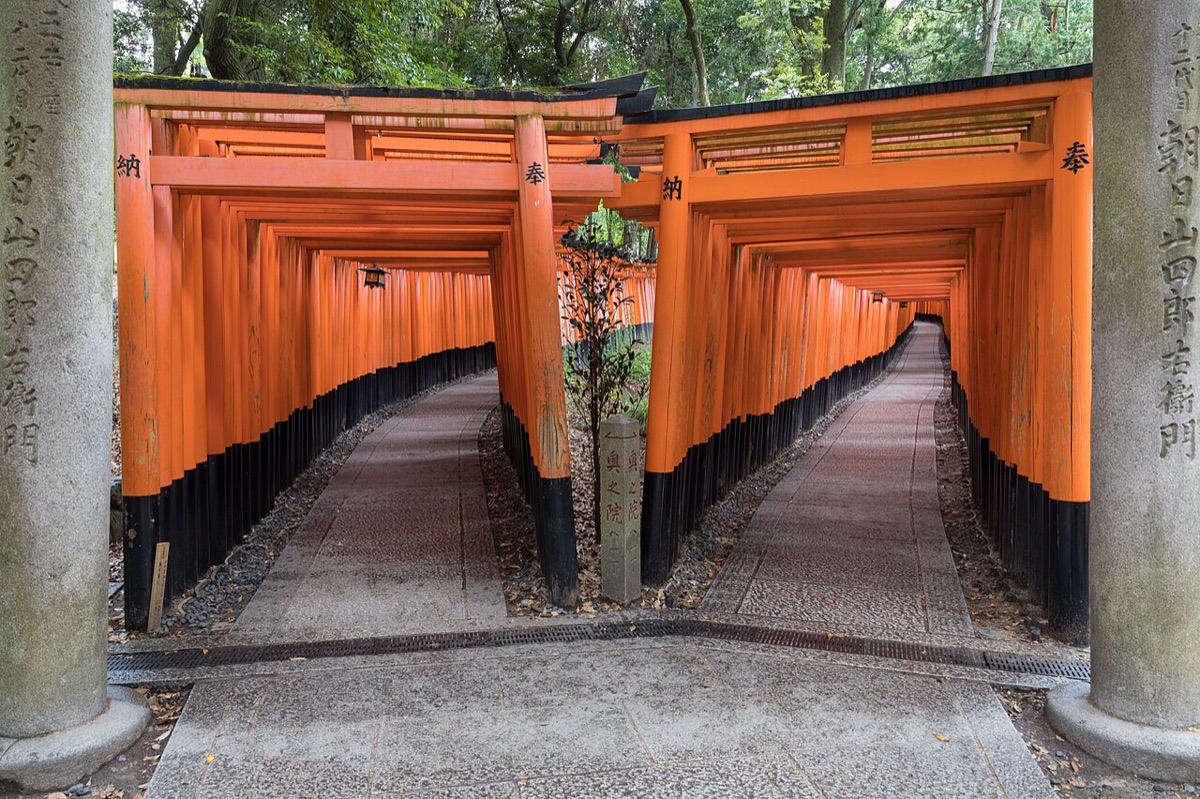
Walk behind the tower gate and main hall and you enter the famous Senbon Torii. Here the gates form two parallel paths, the result of worshippers donating torii from the Edo period onward in thanks for answered prayers; the shrine says there are about 10,000 torii across the mountain[7]. Past the Senbon Torii is the Okusha Hohaisho, known as the Oku-no-in. Behind it on the right stand the Omokaru-ishi stone lanterns: make a wish, lift the stone on top, and if it feels lighter than expected your wish is said to come true[3].
Higher up, the gates become a little more spaced out as you pass Kumataka-sha and Mitsutsuji before reaching Yotsutsuji. Yotsutsuji is a junction partway up the mountain where the view opens to the west over Kyoto, and there are teahouses for a rest. From here a loop circles the mountain, and its highest point, Ichinomine (Kamisha Shinseki), stands at 233 m[3]. Kyoto Kanko Navi lists the full "Oyama-meguri" circuit as about 4 km and about 2 hours[2], but with all the steps and ups and downs, most people at a normal pace need 2.5-3 hours.
| Route | Round-trip time (guide) | Best for |
|---|---|---|
| Tower gate → Senbon Torii → Okusha Hohaisho | 30-45 minutes | Short on time, with older travelers or kids |
| Okusha → Kumataka-sha → Mitsutsuji → Yotsutsuji | About 1.5 hours | Most visitors who want the Kyoto view |
| Yotsutsuji → Ichinomine → full loop | 2-3 hours | Fit hikers who want to escape the crowds |
Practical tips for the mountain:
- Wear good walking shoes: Almost the whole route is stone steps, slippery after rain; sandals and heels are a bad idea.
- Buy water at the bottom: Teahouses and vending machines on the mountain usually charge more, and in summer water is essential.
- Pick one direction for the loop: From Yotsutsuji you can circle to Ichinomine either way; follow one direction around and you will not double back.
- Do not block the path for photos: Shrine rules forbid taking over narrow paths to shoot photos[5]. The Senbon Torii entrance jams most easily, so take your shot and keep moving.
Getting to Fushimi Inari: JR Inari Station or Keihan Fushimi-Inari Station?
The short answer: the JR Nara Line from Kyoto Station to Inari Station is fastest, about 5 minutes, and the great torii is right across from the exit; from Gion or Kawaramachi, use the Keihan Main Line.
The shrine's official site lists these options[1]:
| Mode | Stop | Walk | Best starting point |
|---|---|---|---|
| JR Nara Line | Inari Station | Right outside | Kyoto Station (second stop) |
| Keihan Main Line | Fushimi-Inari Station | About 5 minutes east | Gion-Shijo, Sanjo, Demachiyanagi |
| City Bus Minami 5 | Inari Taisha-mae | About 7 minutes east | Kyoto Station (slower) |
Common mistakes:
- Some JR Nara Line trains skip Inari: Certain "Rapid" and "Miyakoji Rapid" trains do not stop at Inari, so check before boarding; a "Local" train is the safe choice.
- JR Inari and Keihan Fushimi-Inari are different stations: They are close together but run by different companies. IC cards work on both, but tickets are not interchangeable.
- Driving is not recommended: The shrine notes that nearby roads get congested, parking is for worshippers only, and the on-site lot closes from December 30 to January 6[1].
A few more stops south on the JR Nara Line is Uji, so Fushimi Inari in the morning and Byodoin in the afternoon is an easy pairing; see the Uji day trip guide. The first JR stop, Tofukuji, is a famous autumn-leaf temple that fits into the same autumn outing; peak timing for each temple is in Kyoto autumn leaves 2026. Other ways to get around the city are covered in the Kyoto transport guide.
When is Fushimi Inari least crowded?
The short answer: before 8 a.m. or after 5 p.m. the Senbon Torii are at their quietest; from 10 a.m. to 3 p.m. tour groups and day-trippers pile in.
Kyoto Kanko Navi's Kyoto Sightseeing Comfort Map gives an hourly crowd forecast for the Fushimi Inari area, switchable between sunny and rainy weather, and is worth checking the night before[8]. Rules of thumb for avoiding crowds:
- Early morning is best: From sunrise to 8 a.m. you can often photograph the Senbon Torii almost empty, in soft light.
- Crowds thin as you climb: Most visitors turn back at the Okusha or Yotsutsuji, so the trails above Yotsutsuji stay relatively calm even by day.
- Avoid holidays and weekends: Japanese public holidays, the November autumn-leaf season and the New Year period are the busiest.
- Rain can work in your favor: Light rain cuts visitor numbers noticeably, but the steps get slippery, so go only as far as the Okusha or Yotsutsuji.
In autumn, the leaves are best around Yashima-ga-ike pond and the teahouses up the mountain; Kyoto Kanko Navi gives the peak as roughly mid to late November[2].
Can you visit Fushimi Inari at night? Tips for a night visit
The short answer: yes, Fushimi Inari Taisha is open at night, and the lit tower gate and Senbon Torii have a special atmosphere; at night, though, turn back at Yotsutsuji and do not loop the mountain alone.
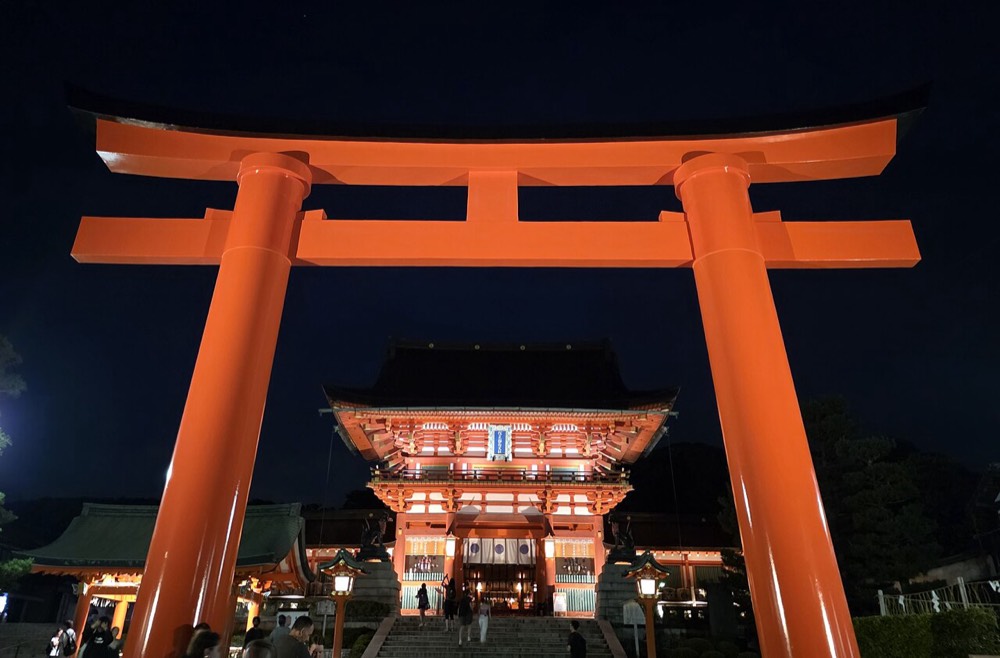
At night the daytime crowds are gone, and stone lanterns and lights on the torii make the vermilion glow, so many people come specifically for night photos. Bear in mind that the mountain lighting is meant for worshippers, not built to the standard of a tourist trail:
- Go with someone: Above Yotsutsuji there is hardly anyone at night, so avoid climbing alone.
- Bring a light and a power bank: Some sections are dim, and a phone torch drains the battery fast.
- Keep away from wild animals: Mount Inari is forest, and shrine rules forbid approaching or feeding wild birds and animals[5].
- Check the last train: JR Inari and Keihan Fushimi-Inari stations run until late, but look up your last train back in advance.
- The amulet counter is closed at night: Go during the day if you want amulets or a goshuin.
Fushimi Inari amulets and fox ema: what to buy
The short answer: the most popular item is the white fox ema you decorate yourself; among amulets, the ones for business and money are most typical of Fushimi Inari.
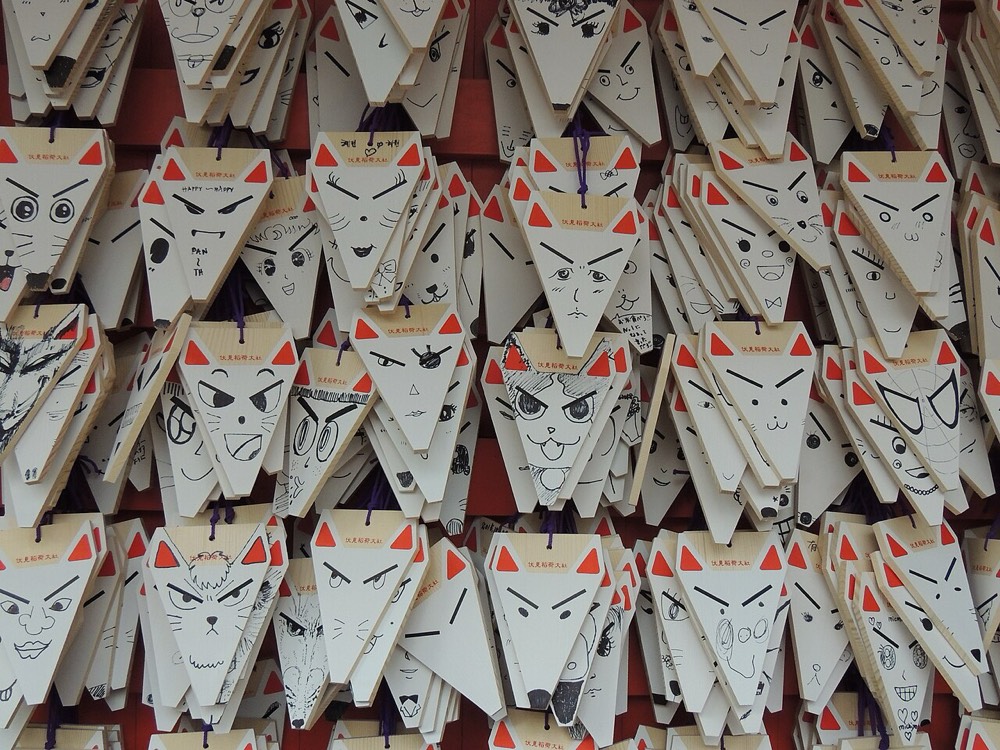
The white fox ema is an inverted triangle shaped like a fox's face. You write your wish on the back and draw your own fox expression on the blank front. Around the Okusha Hohaisho whole walls are covered in fox faces, some cute and some comic, a fun sight in itself.
Offering fees for some amulets listed on the official site[4]:
| Amulet | Purpose | Offering fee |
|---|---|---|
| Shobai Hanjo Mamori | Business prosperity | 1,000 yen |
| Fukuzeni Mamori | Source of money | 1,000 yen |
| Takara Mamori | Money luck | 1,500 yen |
| Shigoto Mamori | Achieving goals | 1,000 yen |
| Gakutoku Mamori | Studies | 800 yen |
| Shintai Kenzen Mamori | Health | 1,500 yen |
The official site does not list the price of the white fox ema; follow the notice on site. The shrine also suggests renewing amulets and talismans once a year.
Fushimi Inari food: inari sushi and grilled sparrow on the approach
The short answer: at Fushimi Inari, eat inari sushi and kitsune udon (udon with fried tofu), both linked to the legend that the deity's fox messengers love fried tofu.
The main approach from JR Inari Station to the tower gate, and the shopping street from the Keihan station, are lined with eateries and long-running shops. A few with checkable details:
- Nezameya: A long-established shop beside the approach known for its homemade inari sushi, listed by JAL's travel site in 2024 at 600 yen for four; it also grills eel and quail, adds sparrow in winter only, and opens about 10:00 until around 16:00, closing when sold out[6].
- Fushimi Inari Sando Chaya: A place to sit down with amazake (sweet rice drink) and desserts[6].
- Kyozuan Fushimi Inari: Its tofu soft-serve is a popular snack[6].
Kitsune udon is served at almost every eatery along the approach; prices and hours vary by shop. Note that shrine rules forbid eating while walking in the grounds, so finish snacks inside the shop or in the rest area[5]. For more of Kyoto's local food, see Kyoto food guide.
Hatsumode and festivals: Fushimi Inari's busiest days
The short answer: January 1-3, the hatsumode (first shrine visit of the year) period, is Fushimi Inari's busiest time of year, with crowd control at the stations and on the approach; other big festivals fall in February, April-May, July and November.
Fushimi Inari Taisha is one of the Kansai region's leading hatsumode shrines, and from New Year's Eve through the first three days lines start right at the station exits. The shrine notes that temporary traffic controls apply during hatsumode (see Kyoto Prefectural Police notices), and the on-site parking closes from December 30 to January 6[1]. For New Year customs and holiday closures across Japan, see the Japan New Year guide.
Main festivals as listed by Kyoto Kanko Navi[2]:
| Festival | When | What happens |
|---|---|---|
| Hatsuuma Taisai | First Horse day of February | Marks the shrine's founding in 711; large crowds |
| Inari Matsuri | Around April 20 to May 3 | The biggest festival of the year, with five mikoshi processions |
| Motomiya-sai | July (19 and 20 in 2026) | Lanterns across the grounds are lit on the eve |
| Hitaki-sai | November 8 | Over 100,000 prayer sticks are burned |
How to plan it: a half-day at Fushimi Inari
Putting Fushimi Inari at dawn on your first day in Kyoto is the most widely recommended approach. A sample schedule:
- 7:00 Take the JR Nara Line from Kyoto Station to Inari Station.
- 7:10-9:30 Pray at the tower gate and main hall, walk the Senbon Torii, enjoy the Kyoto view from Yotsutsuji and head down.
- 9:30-10:30 Once the counter opens, buy amulets and an ema, then have inari sushi on the approach for brunch.
- After that Ride the JR south to Uji, or one stop north to Tofukuji, before returning to Kyoto Station.
Hours and fees for Kiyomizu-dera, Kinkaku-ji and the other must-sees are in Kyoto attractions. Because Fushimi Inari has so many steps and the timing depends so much on stamina, decide in advance how far you will go and you can plan the rest of the day precisely.
FAQ
Does Fushimi Inari Taisha charge admission, and when does it open?
There is no admission fee. The grounds have no closing time and are open every day, so you can visit at dawn or late at night. The amulet counter and prayer reception keep fixed hours, though: according to Kyoto City's official guide, the counter is open 8:00-18:00 and prayers 8:30-16:30, so you cannot buy amulets very early or late.
How long does it take to walk the Senbon Torii at Fushimi Inari?
Seeing just the Senbon Torii and walking to the Okusha Hohaisho and back takes about 30-45 minutes. Continuing up to Yotsutsuji, where you can look out over Kyoto, takes about 1.5 hours round trip. To reach the summit at Ichinomine and loop the whole of Mount Inari (about 4 km), allow 2-3 hours, almost all of it on stone steps.
Is it safe to visit Fushimi Inari at night?
The grounds are open at night, and the tower gate, main hall and Senbon Torii are lit, which makes for quiet photos. Beyond Yotsutsuji, however, lighting thins out, the steps are steep and you may meet wild animals. At night it is best to turn back at Yotsutsuji, go with someone, carry a phone torch and skip the climb in rain.
What is the fastest way from Kyoto Station to Fushimi Inari?
Take the JR Nara Line toward Nara and get off at Inari, the second stop, about 5 minutes away; the great torii is right across from the station. From the Gion and Shijo area, take the Keihan Main Line to Fushimi-Inari Station and walk east about 5 minutes. City Bus route Minami 5 stops at Inari Taisha-mae, about a 7-minute walk away.
Which amulets or ema are special at Fushimi Inari?
The best known is the white fox ema, a plaque shaped like a fox's face on which you draw your own fox expression and write your wish. For amulets, the official site lists types tied to business and money, such as the Shobai Hanjo Mamori, Fukuzeni Mamori and Takara Mamori, mostly between 800 and 3,000 yen; the Shobai Hanjo Mamori is 1,000 yen.
Sources
- Fushimi Inari Taisha official: Access: JR Inari Station, Keihan Fushimi-Inari Station, City Bus Minami 5 and the New Year parking closure
- Kyoto Kanko Navi (Kyoto City official): Fushimi Inari Taisha: No closing time, amulet counter and prayer hours, the roughly 4 km, 2-hour mountain circuit, festivals
- Fushimi Inari Taisha official: Shrine map: Senbon Torii, Okusha Hohaisho, Omokaru-ishi, Ichinomine at 233 m
- Fushimi Inari Taisha official: Amulets: Types of amulets and talismans and their offering fees
- Fushimi Inari Taisha official: Notes for visitors: Visitor rules: no drones, no eating while walking, no pets, and more
- OnTrip JAL: Food around Fushimi Inari (September 2024): Nezameya's inari sushi and winter-only grilled sparrow
- Fushimi Inari Taisha official: FAQ: About 10,000 torii, size of the grounds, head shrine status
- Kyoto Kanko Navi: Kyoto Sightseeing Comfort Map (Fushimi): Hourly crowd forecast around Fushimi Inari
Fares, opening hours and event dates can change. Information checked on 2026.10.22; please confirm with official sources before you go.