Aomori in Winter: Tsugaru Railway Stove Train, Oirase Ice Falls, Hakkoda Snow Monsters and a Sample Itinerary
How to do Aomori in winter: the Tsugaru Railway Stove Train 2026-27 timetable and fares, Oirase ice fall tours, Hakkoda snow monsters, Sukayu Onsen, a 3-day plan.
Quick answer
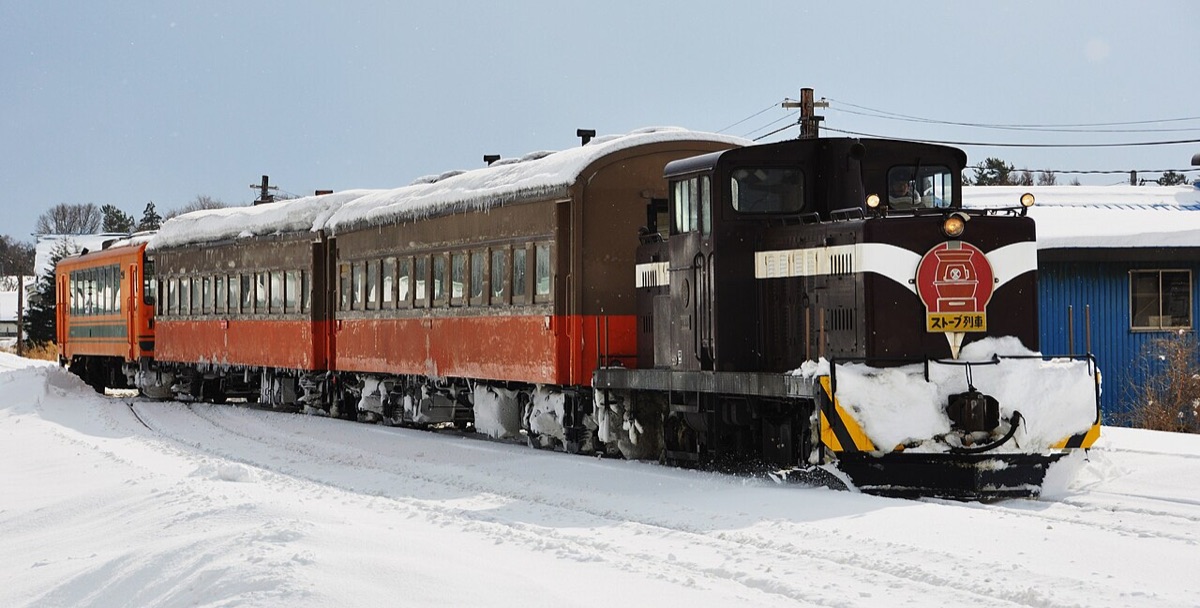
Aomori's three big winter highlights are the Tsugaru Railway Stove Train, the Hakkoda snow monsters and the frozen waterfalls of Oirase Gorge. After a coupling separation on December 29, 2025, the stove cars were not attached for the rest of that season; the railway has announced a restart from December 1, 2026 to March 31, 2027, three round trips daily, no reservations, with a 1,000-yen Stove Train ticket on top of the fare, cash only. The Hakkoda Ropeway runs 9:00–15:40 in winter for 2,500 yen round trip; Oirase ice fall tours run mainly on weekends from December 25, 2026 to February 28, 2027 and must be booked online.
Aomori in winter suits travelers who want to see real snow country: riding a Tsugaru Railway train heated by a coal-burning stove across snowfields, looking out over a whole slope of snow monsters at the top of Hakkoda, following a guide into the frozen Oirase Gorge, then soaking at Sukayu Onsen surrounded by heavy snow. This guide covers the timetables, prices and booking rules announced so far for winter 2026-27, with a 3-day itinerary and a comparison table, and says plainly which places are not suited to driving yourself.
The most important news: the Tsugaru Railway Stove Train is confirmed to restart on December 1, 2026[1]. Last season the stove cars ran for less than a month before they stopped being coupled, so if you saw old news about the Stove Train being suspended, it is running again, but there are some rules worth knowing.
What to do in Aomori in winter: 5 experiences compared
Short answer: with only 2–3 days, prioritize the Stove Train and the Hakkoda snow monsters, which run every day and are reachable by public transport. The Oirase ice falls run mainly on weekends, so you need to match the dates, and the Hirosaki Castle Snow Lantern Festival lasts only 5 days in February.
| Experience | 2026-27 period | How to get there | Cost (adult) | Booking needed? |
|---|---|---|---|---|
| Tsugaru Railway Stove Train | Dec 1, 2026–Mar 31, 2027, 3 round trips daily | Walk from JR Goshogawara Station to Tsugaru-Goshogawara Station | Fare + 1,000-yen Stove Train ticket (1,870 yen for the full line) | No reservations, cash only |
| Hakkoda snow monsters (ropeway) | Snow monsters best Jan–late Feb; ropeway 9:00–15:40 in winter | JR bus from Aomori Station, about 80 min | Ropeway 2,500 yen round trip, bus 1,290 yen one way | No |
| Oirase ice fall tour | Dec 25, 2026–Feb 28, 2027, mainly weekends | From Shichinohe-Towada Station, central Towada or Oirase Keiryu Onsen | 3,300–4,400 yen | Yes, online, credit card |
| Sukayu Onsen day bathing | Winter (from Dec) 9:00–16:00 | Bus about 15 min from the Hakkoda Ropeway | 1,500 yen | No |
| Hirosaki Castle Snow Lantern Festival | Feb 10–14, 2027 | Bus or walk from JR Hirosaki Station to Hirosaki Park | Free | No |
Prices and dates were checked in November 2026; check each official site again before you go.
Tsugaru Railway Stove Train 2026-27: timetable, fares and how to ride
The Stove Train (Sutobu Ressha) is a set of vintage coaches the Tsugaru Railway adds in winter, each heated by a coal-burning "Daruma stove", and it is Aomori's most iconic winter experience. According to the railway, the 2026-27 season runs daily from December 1, 2026 to March 31, 2027, with three round trips a day[1].
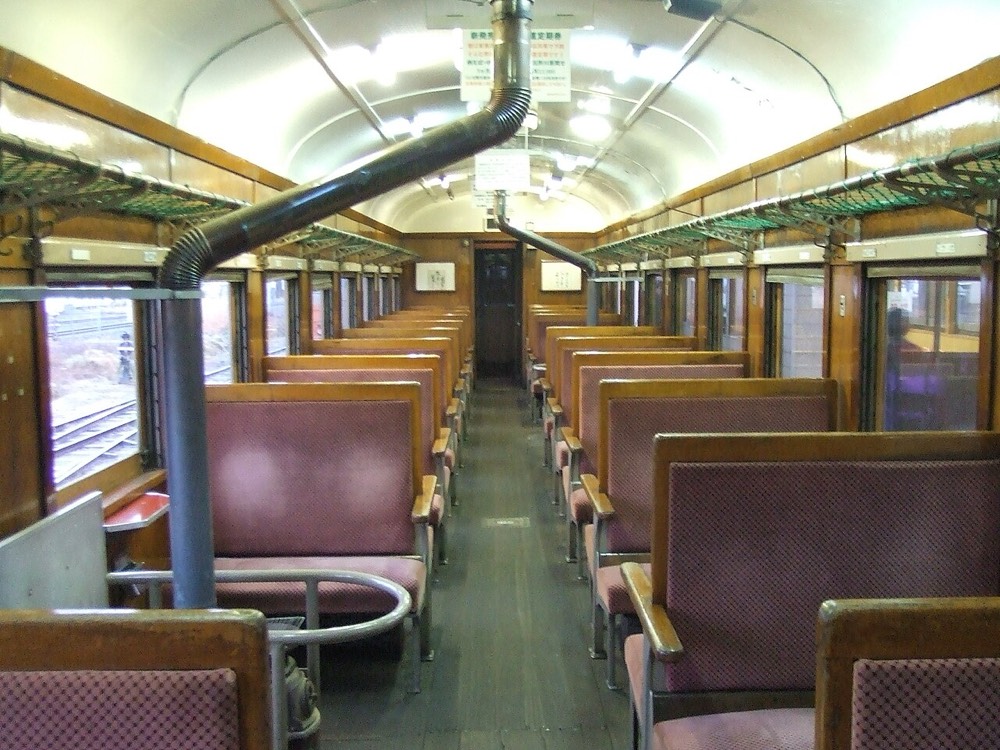
What happened last season?
On December 29, 2025, a four-car train near Tsugaru-Iizume Station had the coupler and brake hose between its second and third cars separate while moving, and made an emergency stop; one of about 200 passengers had a minor bruise[2]. The stove coaches were not coupled again for the rest of the season and were only opened for free viewing at Goshogawara. In April 2026 the railway attributed the incident to several overlapping factors, including vertical track movement, worn coupler parts and height differences between vehicles. It repaired the track, adjusted the coupler height on every vehicle and tightened inspections, and resumed coupling after approval from the Tohoku District Transport Bureau[2].
2026-27 Stove Train timetable
| Train | Departs | Arrives |
|---|---|---|
| 151 | Tsugaru-Goshogawara 9:35 | Tsugaru-Nakasato 10:18 |
| 152 | Tsugaru-Nakasato 10:46 | Tsugaru-Goshogawara 11:29 |
| 153 | Tsugaru-Goshogawara 12:00 | Tsugaru-Nakasato 12:44 |
| 154 | Tsugaru-Nakasato 13:37 | Tsugaru-Goshogawara 14:21 |
| 155 | Tsugaru-Goshogawara 14:40 | Tsugaru-Nakasato 15:24 |
| 156 | Tsugaru-Nakasato 15:54 | Tsugaru-Goshogawara 16:37 |
The railway notes that weekends, holidays and the 12:00 from Goshogawara and 13:37 from Nakasato are the most crowded[1]. If you want a seat near the stove, a weekday or the first train at 9:35 is the safest bet.
How to buy tickets and ride
- Leave JR Goshogawara Station on the Gono Line and walk a few minutes to the Tsugaru Railway's Tsugaru-Goshogawara Station next door.
- At the window, buy a regular ticket plus a 1,000-yen Stove Train ticket; cash only, no cards or e-money[1]. The full Goshogawara–Nakasato fare is 870 yen, 1,870 yen in total; riding only to Kanagi is 560 yen plus 1,000 yen.
- Line up at the ticket gate. Seats are first come, first served; there are no seat reservations.
- If the stove coaches are full, ride the regular car coupled to the same train (Tsugaru 21 series) to Nakasato and switch to the stove coaches on the way back, or wait for the next Stove Train.
Another common misunderstanding: the Tsugaru Railway's "Tsugaru Free Pass" cannot be used on the Stove Train[3]. JR EAST PASS holders should also note that the Tsugaru Railway is a private line, so you need a separate ticket; see our JR East Pass Tohoku guide for how the pass works.
How to see the Hakkoda snow monsters: ropeway fares and access
Hakkoda's snow monsters are counted among Japan's three great juhyo areas along with Zao in Yamagata and Moriyoshi in Akita, and they look best from January to late February. To see them, take the Hakkoda Ropeway from the base station up to Sancho Koen (summit park) Station, about 10 minutes, with departures every 15–20 minutes[4].
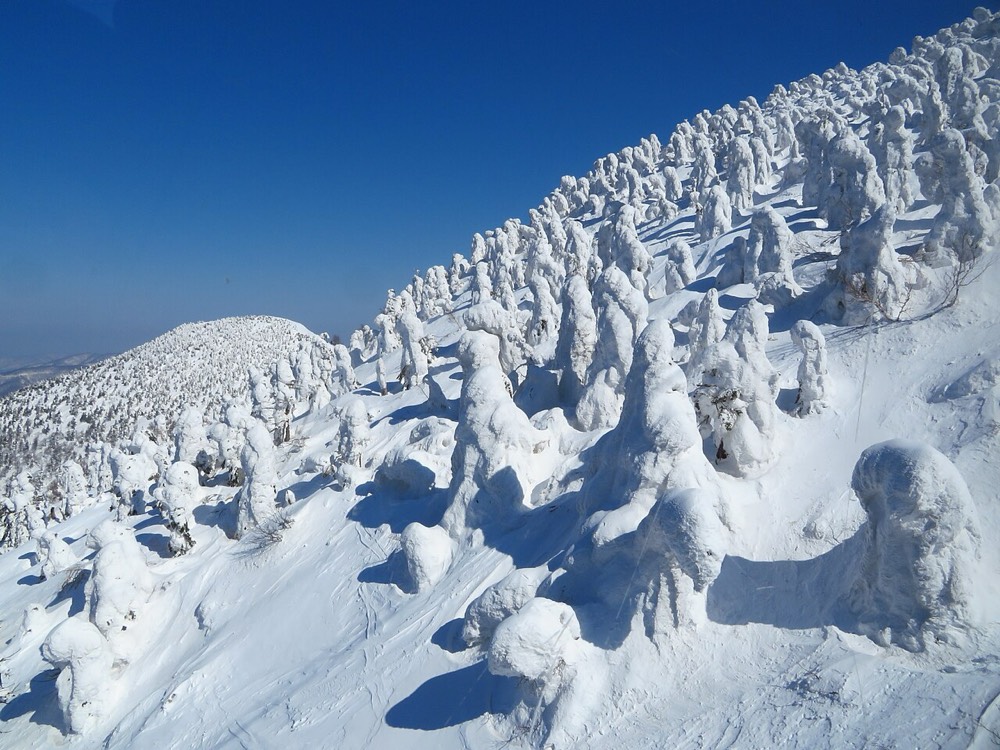
- Fares: From August 1, 2026, 2,500 yen round trip and 1,550 yen one way for adults; 700 yen round trip for elementary school children[4].
- Winter hours: From mid-November to February, first departure 9:00 and last ride up 15:40[4].
- Suspensions: The ropeway stops in winds of 25 m/s or more or in severe weather. Hakkoda is often very windy in winter, so go in the morning and keep a spare day in your plan.
- At the top: In winter the summit walking trail is buried in snow, so regular visitors view the snow monsters around the summit station. The ski runs are advanced terrain; if you are not used to snow, stay near the station.
For access, in winter the JR bus from Aomori Station to "Hakkoda Ropeway-eki-mae" takes about 80 minutes and costs 1,290 yen one way; because some roads close in winter, the JR bus only runs as far as Sukayu Onsen[5]. There are fewer buses than in summer, so check the JR Bus Tohoku timetable first and note the last bus back.
Snow monsters form at well below zero in strong wind, so dress as warmly as you would for Zao; our Zao snow monsters guide lets you compare the two.
Sukayu Onsen: winter day-bathing hours and rules
Sukayu Onsen sits at about 925 m in the Hakkoda mountains and is famous for its huge wooden mixed bath, the "Hiba Sennin-buro", with winter snow often piled higher than one story. It is close to the ropeway, so pairing it with the snow monsters on the same day works best.
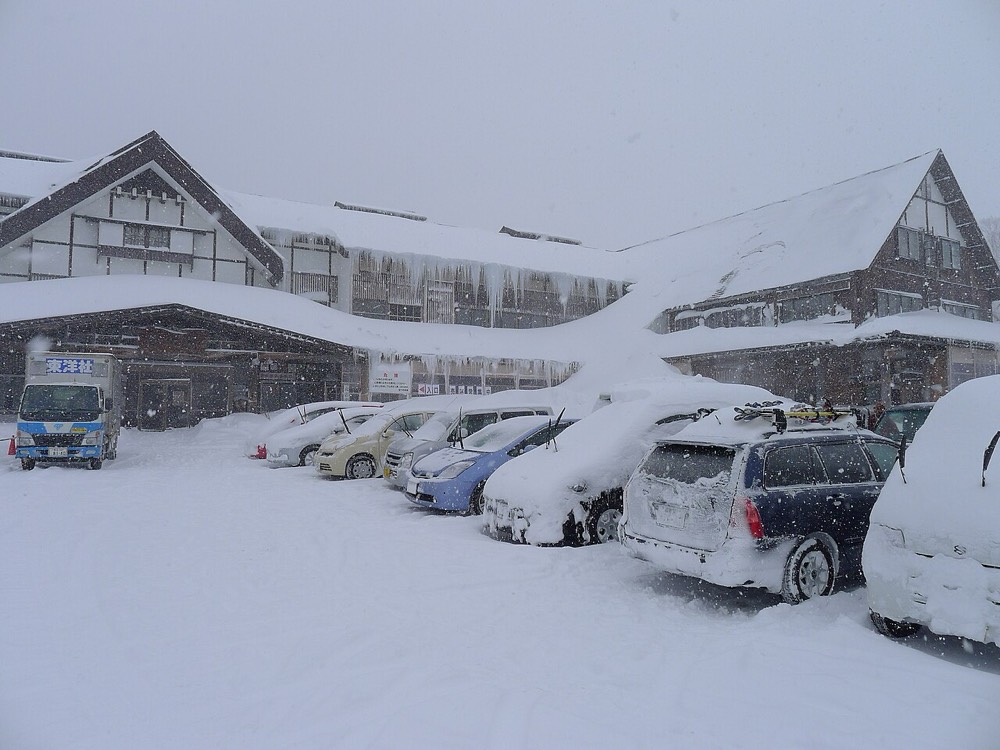
- Winter day bathing: From December 1, 2026, both the Sennin-buro and the gender-separated "Tama-no-yu" are open 9:00–16:00 (last entry 15:30), 1,500 yen for junior high school age and up, 500 yen for elementary school children[6]. Hours and prices through the end of November are different, so watch for the seasonal switch.
- Mixed-bathing rules: The Sennin-buro is mixed-gender. Bathing wear is allowed, but only the kind sold or rented at the inn, not your own; rental is 500 yen[6].
- Guest shuttle: Overnight guests can request a free shuttle between Shin-Aomori Station's east exit and Sukayu when booking, about 60 minutes each way[7].
The JR bus between the ropeway and Sukayu Onsen takes about 15 minutes and costs 460 yen[5], so you can bathe before heading back. For more snowy hot springs, the entry controls and booking tips in our Ginzan Onsen winter guide are worth a look.
Oirase ice falls: guided bus tours and night light-up tours
In winter Oirase Gorge is not the walk-it-yourself trail it is in summer. Snow, avalanches, rockfall and falling trees are real risks, and the gorge lies in a special protection zone of Towada-Hachimantai National Park, so a guided tour is the practical way to see it in winter.
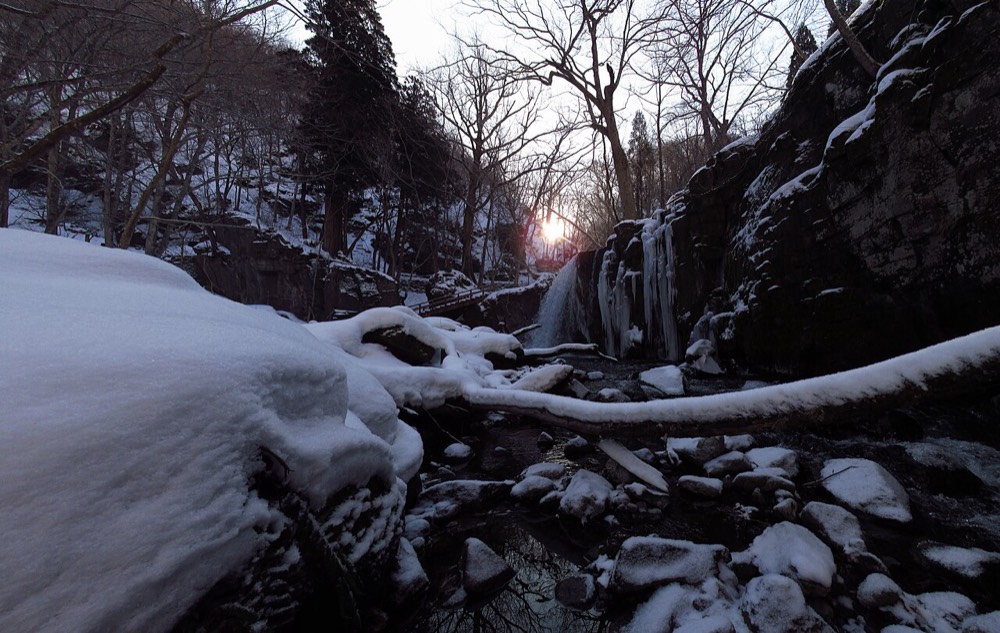
Towada City's Oirase Gorge Ice Waterfall Tour
The ice waterfall tour organized by Towada City runs from December 25, 2026 to February 28, 2027 in the 2026-27 season, mainly on weekends; check the booking calendar for exact dates[8].
- Daytime tour: Departs from Shichinohe-Towada Station on the Tohoku Shinkansen, central Towada or Oirase Keiryu Onsen, and visits frozen waterfalls, icicles and animal tracks in the snow.
- Night tour: Departs from central Towada, Oirase Keiryu Onsen or the Lake Towada shore; a vehicle carrying lighting equipment leads you to 5 illuminated snowy spots.
- Price: 3,300–4,400 yen per adult and 1,650–2,200 yen per elementary school child depending on the plan; preschoolers free[8].
- Booking: Book on the official site and pay by credit card. Tours may be canceled with a full refund if the weather is bad or the ice falls can't be seen.
The same site also offers an access bus between central Towada and Lake Towada, 1,650 yen one way for adults, booked separately[8].
The Oirase Keiryu Hotel light-up tour
The Oirase Keiryu Hotel (Hoshino Resorts), right by the gorge, runs the "Oirase Gyutto Ice Waterfall Light-up Tour" from December 25, 2026 to February 28, 2027, departing nightly at 18:00, 19:00, 20:00 and 21:00. Each tour lasts about an hour for up to 25 people and costs 2,200 yen, free for ages 0–3; apply by 18:00 the day before[9]. The page does not say whether non-guests can join, so if you are not staying there, check with the hotel first.
Hirosaki and Aomori city: Snow Lantern Festival, winter cherry trees and the Nebuta Museum
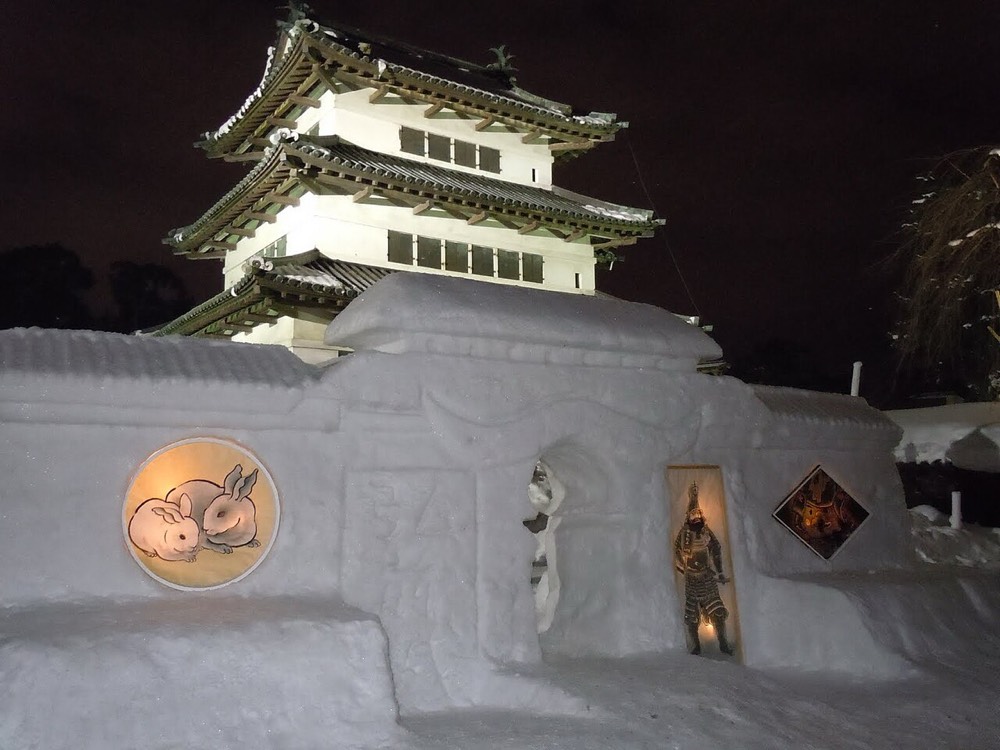
The Hirosaki Castle Snow Lantern Festival (Hirosaki-jo Yuki-doro Matsuri) fills Hirosaki Park with snow lanterns and snow sculptures. The Hirosaki Tourism and Convention Bureau lists the 2027 dates as February 10–14[10]; lighting times and the program have not been announced, so follow the official notices. The same site lists the "Winter Cherry Blossom Light-up" (Fuyu ni Saku Sakura) in Hirosaki Park from December 1, 2026 to February 28, 2027, lighting snow-covered cherry branches in pink, so there are night views even outside the festival.
Aomori city works well on arrival day or when the weather is bad:
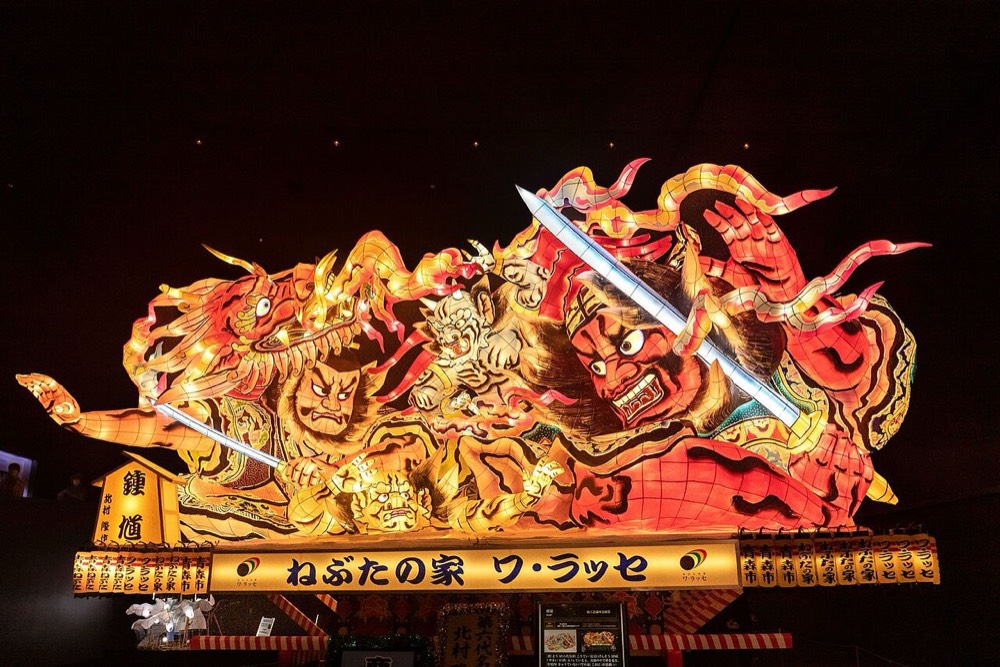
- Nebuta Museum Wa Rasse: Next to Aomori Station, displaying full-size lantern floats from the Aomori Nebuta Festival. From September to April it is open 9:00–18:00 (last entry 17:30); adults 620 yen; closed December 31 and January 1[11].
- A-FACTORY: A market-style complex near Aomori Station with an apple cider workshop and Aomori specialties, handy for killing time before a train or buying souvenirs.
Sample 3-day Aomori winter itinerary
This plan relies on the shinkansen and public transport. If you go over a weekend, add the Oirase ice falls on day 4.
| Time | Day 1: Aomori city | Day 2: Hakkoda | Day 3: Tsugaru and Hirosaki |
|---|---|---|---|
| Morning | Tohoku Shinkansen from Tokyo to Shin-Aomori (about 3 hours) | JR bus from Aomori Station to the Hakkoda Ropeway (about 80 min) | JR to Goshogawara, 9:35 Stove Train to Nakasato |
| Midday | JR to Aomori Station, drop luggage, lunch | Ropeway up to see the snow monsters, photos around the summit station | 10:46 Stove Train back to Goshogawara (arrives 11:29) |
| Afternoon | Nebuta Museum Wa Rasse, A-FACTORY | Bus to Sukayu Onsen for a bath (enter by 15:30) | JR to Hirosaki, walk around Hirosaki Park |
| Evening | Seafood around Aomori Station | Bus back to Aomori city | Winter cherry light-up; stay in Hirosaki or return to Aomori |
Planning tips:
- Put Hakkoda on the morning of day 2: The ropeway often stops in strong winds; if it is closed that day, swap with day 3.
- Take the first Stove Train: The 9:35 train 151 is easier to get a seat on than the midday one, and the return train 152 also has stove coaches. Getting from Aomori to Goshogawara means changing to the Gono Line at Kawabe, and trains are infrequent, so check JR times the day before.
- Add day 4 for the ice falls: On a weekend, join the daytime ice fall tour from Shichinohe-Towada Station and leave by shinkansen from the same station afterward, with no need to return to Aomori.
Is driving in Aomori in winter safe? Transport and clothing tips
Driving in Aomori in winter is possible, but mountain routes such as Hakkoda and Oirase are risky if you have no snow-driving experience. Sukayu Onsen advises four-wheel drive or chains, says roads are generally not plowed after 17:00, and notes that the Kumoya gate toward Aomori city closes at night in winter, with emergency closures possible[7]. The Hakkoda Ropeway also says some roads close in winter, so the summer route from Hakkoda via Sukayu straight to Lake Towada and Oirase is not passable and you face a long detour[5].
- Driving suits you if: you have winter driving experience in snow country, your plan centers on lowland towns (Aomori, Hirosaki, Goshogawara), and you are willing to check road restrictions every day. For snow-driving technique, see our Hokkaido winter driving guide.
- Better not to drive if: it is your first time driving on snow, you mainly want Hakkoda and Oirase, or your schedule is tight.
- Getting there: The Tohoku Shinkansen takes about 3 hours from Tokyo to Shin-Aomori; Aomori Airport has connecting buses to Aomori and Shin-Aomori stations timed to flights. Travelers flying from overseas, including from Taiwan, can check whether there are direct flights to Aomori that season; otherwise most connect via Tokyo or Sendai and take the shinkansen.
For clothing, Aomori is one of Japan's snowiest cities, and roads in the city are often icy in January and February, while the Hakkoda summit is colder and windier still. Waterproof, non-slip snow boots matter most, followed by removable layers, gloves, a knit hat and a neck warmer; see our Hokkaido winter clothing guide, which applies just as well in Aomori.
Who it suits, and who it doesn't
- Suits: rail fans and lovers of nostalgic trains, people who want snow monsters without Zao's crowds, and anyone willing to adjust plans around the weather.
- Doesn't suit: people who can't accept changing plans because of wind and snow, or anyone with only one day who wants the Stove Train, Hakkoda and Oirase all at once. These three are in different directions across the prefecture; one highlight per day is the realistic maximum.
FAQ
Is the Tsugaru Railway Stove Train running in winter 2026?
Yes. Tsugaru Railway has announced that the Stove Train restarts on December 1, 2026 and runs until March 31, 2027, three round trips a day. Last season the stove cars were not coupled after the December 29, 2025 separation incident; track and coupler fixes have since been made and the Tohoku District Transport Bureau has allowed coupling to resume.
Do I need to reserve the Stove Train, and how much is it?
You can't reserve; seats are first come, first served. Buy a regular ticket plus a 1,000-yen Stove Train ticket at the Tsugaru-Goshogawara, Kanagi or Tsugaru-Nakasato station window, cash only. The full Goshogawara–Nakasato fare is 870 yen one way, so 1,870 yen in total. The Tsugaru Free Pass is not valid on the Stove Train.
When are the Hakkoda snow monsters at their best?
Hakkoda's snow monsters are generally fullest from January to late February; in December they are still forming and in March they start to thin. You see them from the Hakkoda Ropeway's summit station. The last winter ride up is 15:40 and the ropeway stops in winds of 25 m/s or more, so go in the morning and keep a spare day.
Can I visit the Oirase Gorge ice falls on my own in winter?
It's not recommended. The gorge is deep in snow in winter, with avalanche and rockfall risks, and there is little public transport. The Oirase Gorge Ice Waterfall Tour organized by Towada City runs mainly on weekends from December 25, 2026 to February 28, 2027, with daytime tours from Shichinohe-Towada Station, for 3,300–4,400 yen per adult. Book online and pay by credit card.
Is driving in Aomori in winter dangerous?
It is risky if you have no snow-driving experience. Snow is very deep around Hakkoda; Sukayu Onsen advises four-wheel drive or chains, says roads are generally not plowed after 17:00, and notes the Kumoya gate closes at night in winter. Some mountain roads toward Lake Towada are closed all winter. On a first winter trip, rely on the shinkansen, JR buses and guided tours.
Sources
- Tsugaru Railway | Stove Train restart (from December 1, 2026): 2026-27 operating period, timetable, tickets and sales stations
- Tsugaru Railway | Report on the train separation incident and resumption of Stove Train coupling: Cause of the December 29, 2025 incident and fixes
- Tsugaru Railway | Stove Train: Stove Train ticket price; Tsugaru Free Pass not valid
- Hakkoda Ropeway | Hours and fares: Fares from August 2026, winter hours, suspension conditions
- Hakkoda Ropeway | Access: JR bus winter travel time, fare and route section
- Sukayu Onsen | Day-trip bathing: Day-bathing hours and prices from December 2026; bathing wear rules
- Sukayu Onsen | Access: Guest shuttle and winter driving notes
- Oirase Gorge Ice Waterfall Tour 2026-27 official site: Tour period, departure points, prices and Lake Towada access bus
- Oirase Keiryu Hotel | Oirase Gyutto Ice Waterfall Light-up Tour: Night light-up tour times and price
- Hirosaki Tourism and Convention Bureau | Events: 2027 Snow Lantern Festival and winter cherry light-up dates
- Nebuta Museum Wa Rasse | Admission and hours: Admission and winter opening hours
Fares, opening hours and event dates can change. Information checked on 2026.11.13; please confirm with official sources before you go.