Meiji Jingu Guide: Harajuku Visiting Route, Hatsumode Crowds and Hours, Omotesando Add-on
Meiji Jingu is free, with gate hours that follow sunrise and sunset. Which entrance to use, Inner Garden and museum fees, omamori, hatsumode times and a Harajuku route.
Quick answer
Meiji Jingu sits next to JR Harajuku Station and is free to visit. Gate hours follow sunrise and sunset and change monthly, for example 6:10-16:10 in November and 6:40-16:00 in December. From each of its three entrances (Harajuku, Yoyogi and Sangubashi) it is about a 10-minute walk to the main shrine. Only the Inner Garden (500-yen maintenance fee) and the Meiji Jingu Museum (1,000 yen for adults, closed Thursdays) charge admission. Hatsumode usually draws about 3 million people over the first three days of January; in 2026 the shrine was open 0:00-19:00 on January 1, and the shrine is expected to post 2027 information in December.
Meiji Jingu (めいじじんぐう) is the largest forest in central Tokyo and one of the shrines in Japan that draws the most New Year visitors. This guide covers Meiji Jingu's opening hours, which of its three entrances to use, what costs money, omamori and the Omigokoro omikuji, and hatsumode crowds and times, and ends with a half-day route that adds Takeshita Street and Omotesando shopping in Harajuku, so you know when to go, where to enter and how much time to allow.
Meiji Jingu opening hours and basics
The short answer: Meiji Jingu is free to visit, its gates open and close with sunrise and sunset, so hours change monthly, and it is closed at night[2]. In winter it closes as early as 16:00, so arriving in the afternoon leaves little time.
Meiji Jingu enshrines Emperor Meiji and Empress Shoken and marked its centennial in 2020. Its grounds cover an area of about 15 Tokyo Domes, and the trees were donated from all over Japan when the shrine was built[1].
| Month | Opens | Closes |
|---|---|---|
| January | 6:40 | 16:20 |
| February | 6:20 | 16:50 |
| March | 5:40 | 17:20 |
| April | 5:10 | 17:50 |
| May | 5:00 | 18:10 |
| June | 5:00 | 18:30 |
| July | 5:00 | 18:20 |
| August | 5:00 | 18:00 |
| September | 5:20 | 17:20 |
| October | 5:40 | 16:40 |
| November | 6:10 | 16:10 |
| December | 6:40 | 16:00 |
These are the regular hours published on the official site[2]; New Year hours are different (see the hatsumode section below). The address is 1-1 Yoyogi Kamizonocho, Shibuya-ku, Tokyo, and the phone number is 03-3379-5511. The grounds have a rest area with restaurants, Forest Terrace Meiji Jingu, and a café, Mori no Terrace[4]; the old treasure hall is currently closed[4].
Getting to Meiji Jingu: Harajuku, Yoyogi or Sangubashi entrance?
The short answer: on a first visit, or if you plan to explore Harajuku and Omotesando afterward, use the Harajuku entrance (South Approach) from JR Harajuku Station. Consider the other two entrances if you are coming from the Shinjuku side or along the Odakyu Line.
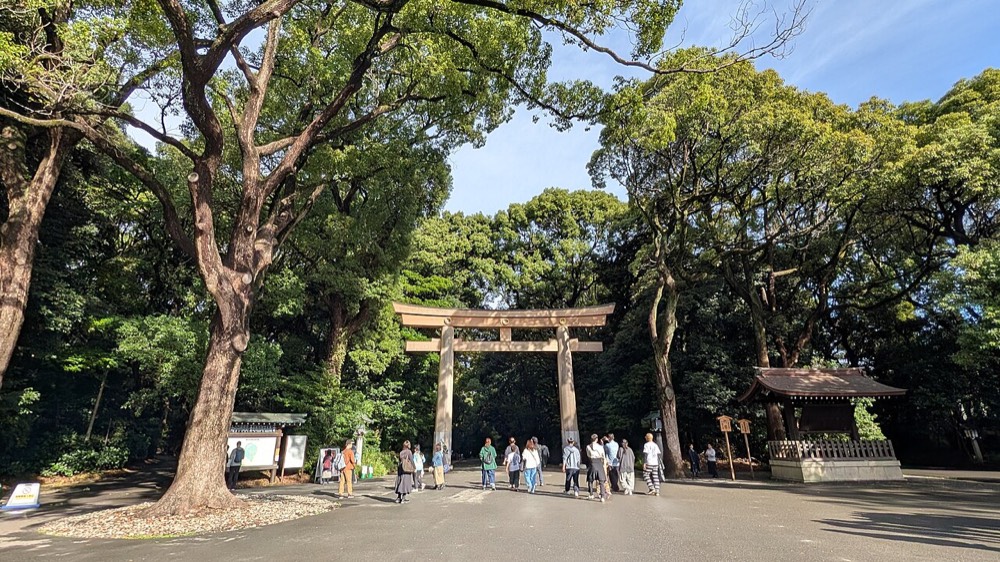
According to the official site, Meiji Jingu has three entrances, and from any of them it is about a 10-minute walk to the main shrine[3]. The difference is which station is closest and what you do next:
| Entrance (approach) | Nearest stations | Station to entrance | Best for |
|---|---|---|---|
| Harajuku entrance (South Approach) | JR Yamanote Line Harajuku Station; Tokyo Metro Chiyoda and Fukutoshin Lines Meiji-jingumae (Harajuku) Station | About 1 min | First-timers, continuing to Takeshita Street and Omotesando |
| Yoyogi entrance (North Approach) | JR Yoyogi Station; Fukutoshin Line Kita-sando Station | About 5 min | Coming from Shinjuku; the only entrance for cars |
| Sangubashi entrance (West Approach) | Odakyu Line Sangubashi Station | About 3 min | Staying along the Odakyu Line, or wanting a quieter approach |
Walking times from stations are based on GO TOKYO and a railway news site[8][11]. The South Approach passes the sake barrels, wine barrels and great torii, making it the most complete route; the West Approach has denser forest and fewer visitors, good for a quiet walk. The official site warns that the parking lot is often full and you may not be able to get in, and recommends public transport[3]. For subway and JR tips and passes, see the Tokyo transport guide.
Must-sees at Meiji Jingu: great torii, sake barrels, Meoto Kusu and the main shrine
Entering from the South Approach, all of these spots are free, and seeing them along the way takes about 30 to 40 minutes.
The great torii: Japan's largest wooden myojin-style torii
Walking from the South Approach toward the main shrine, you pass through the great torii, the most striking landmark on the way.
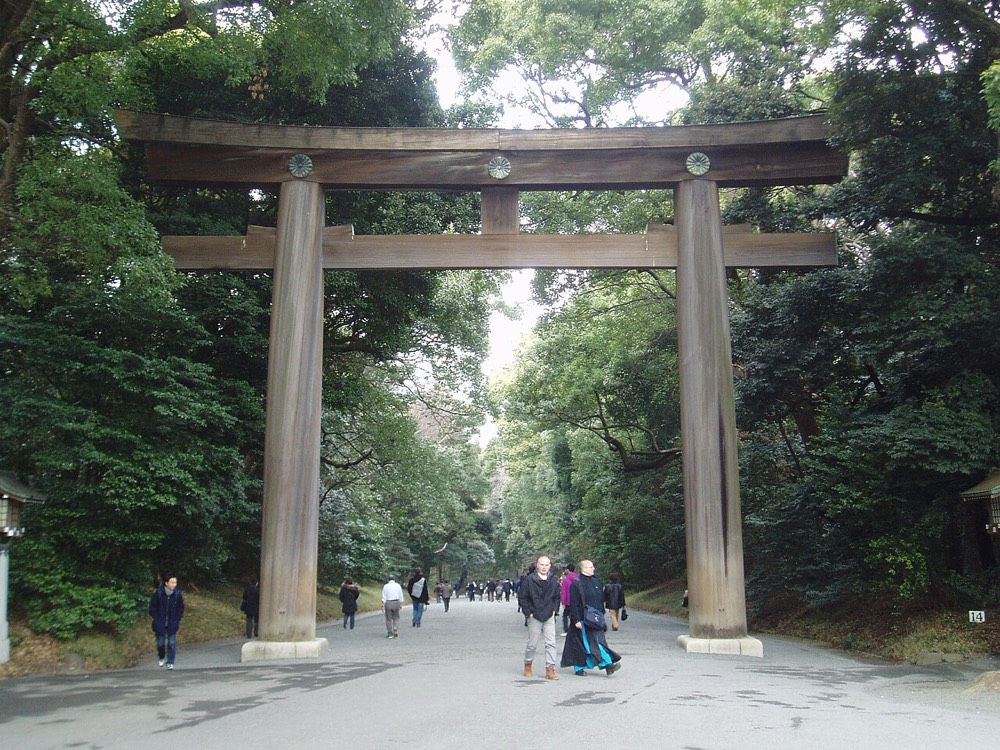
According to the official precinct map, the great torii is 12 m tall, 9.1 m between the pillars, with pillars 1.2 m in diameter and a top beam 17 m long[4]. It is described as Japan's largest wooden myojin-style torii[12]. People usually give a light bow before and after passing through a torii, and walk toward the side of the approach, since the center is considered the path of the deity.
Sake barrels and wine barrels: Japanese and Western side by side
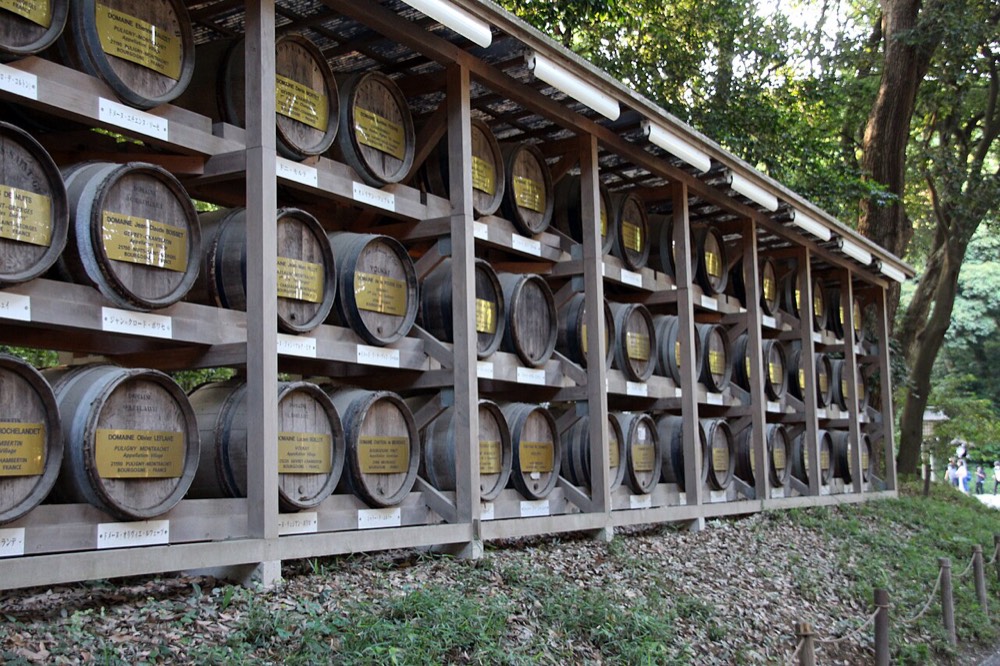
Along the South Approach stands a whole wall of straw-wrapped sake barrels offered by breweries across Japan; opposite them is a row of wine barrels from Burgundy, France.
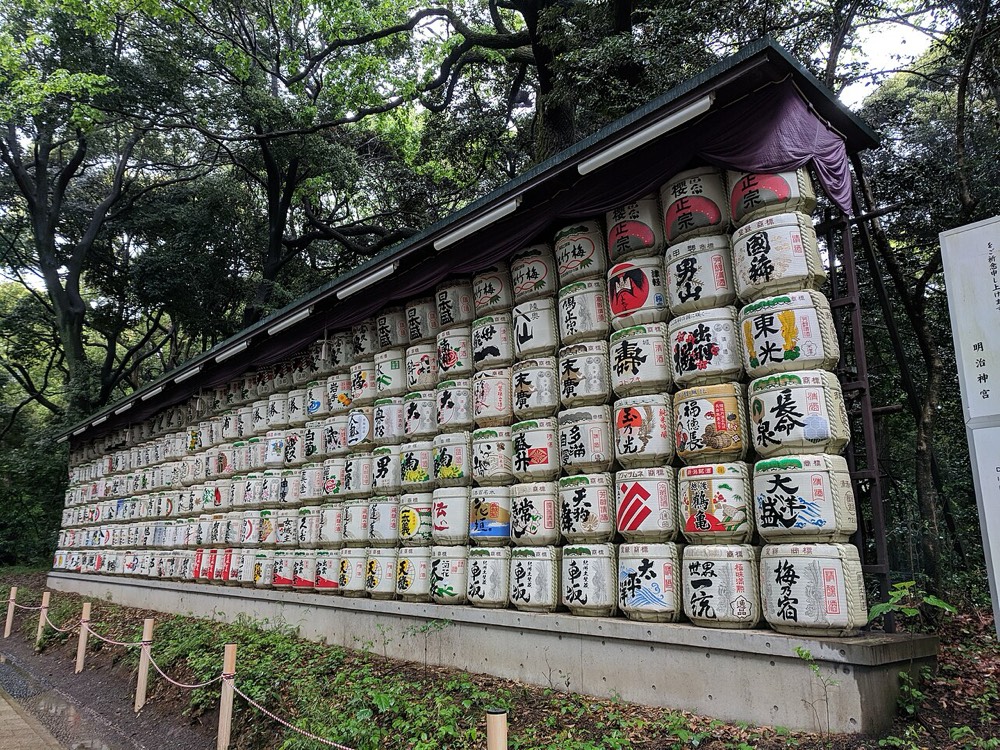
The wine barrels are there because Emperor Meiji also drank wine for his health, and the two displays side by side symbolize keeping Japanese tradition while adopting the best of Western culture[12]. This is a favorite photo spot for international visitors and gets busy during the day; for a shot without crowds, come right at opening.
Meoto Kusu: the matchmaking trees in front of the shrine
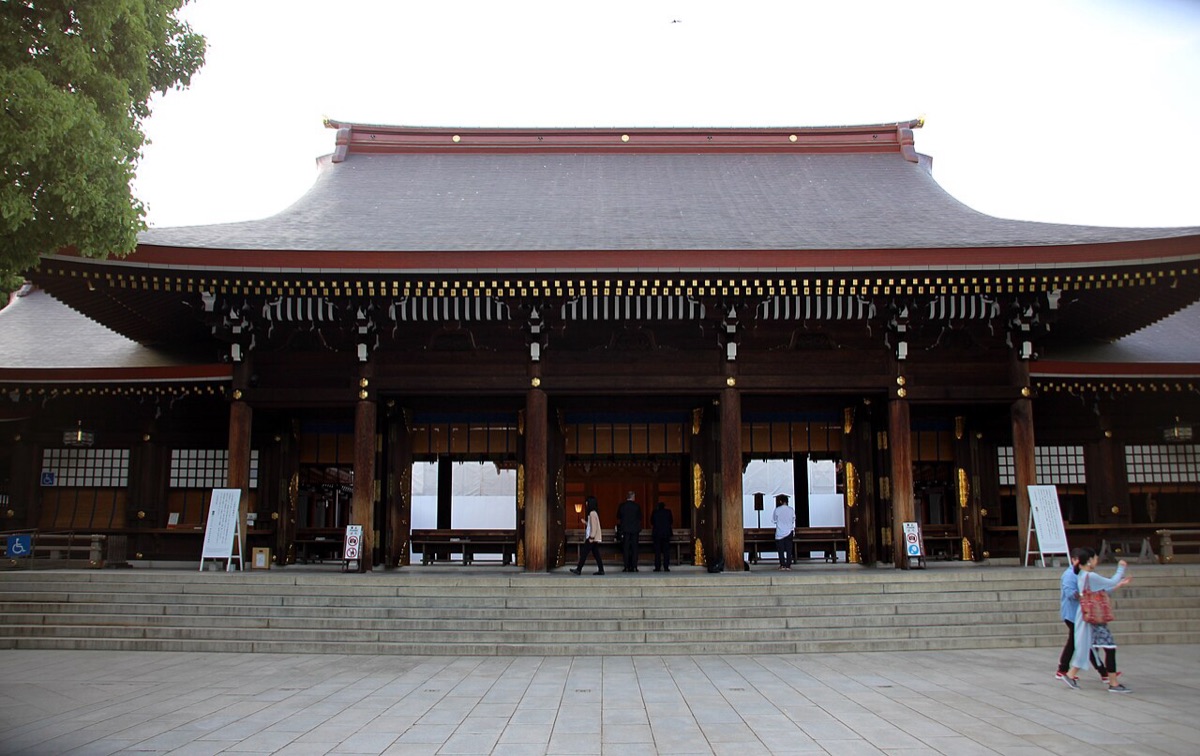
Through the South Gate into the courtyard in front of the main shrine, on the left as you face the worship hall, stand two large camphor trees side by side, joined by a shimenawa rope. These are the Meoto Kusu, or "husband and wife camphors."
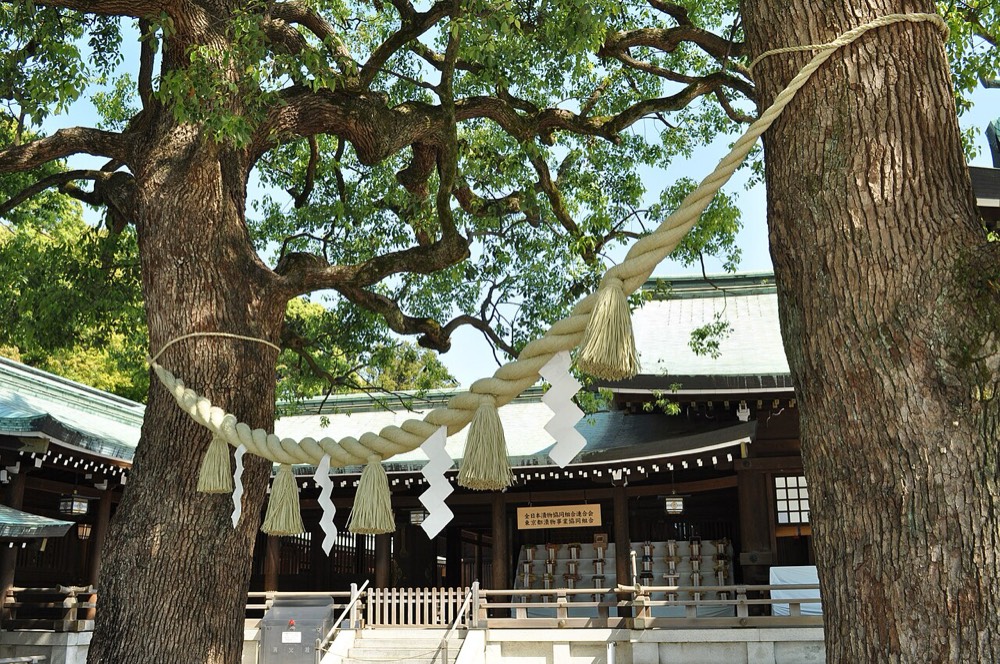
It is commonly said that praying toward the worship hall from between the two trees brings good relationships, a happy marriage and family safety[12]. You may also see a Shinto wedding procession crossing the courtyard; if so, step aside and avoid standing in front of it to take photos.
How to pray at the main shrine
The main shrine was rebuilt in 1958[4]. Visitors pray in front of the outer worship hall, following the same steps as at most shrines in Japan:
- At the temizuya, rinse your hands and mouth (left hand, right hand, mouth, left hand).
- Step up to the worship hall and drop in an offering (any amount).
- Two bows: bow deeply twice.
- Two claps: clap twice in front of your chest and make your wish silently.
- One bow: finish with one more bow.
Please do not take photos inside the worship hall; photograph from the courtyard outside, and follow any notices on site.
What costs money at Meiji Jingu? Inner Garden, Kiyomasa Well and the Meiji Jingu Museum
The short answer: visiting the shrine is free; the only paid areas are the Inner Garden (500 yen) and the Meiji Jingu Museum (1,000 yen)[5][6]. If you are short on time you can skip both; go in if you like gardens or history.
| Item | Fee | Hours | Closed | Suggested time |
|---|---|---|---|---|
| Meiji Jingu shrine | Free | Sunrise to sunset, by month | None | 40-60 min |
| Meiji Jingu Inner Garden | 500 yen | Mar-Oct 9:00-16:30; Nov-Feb 9:00-16:00 | Open every day | 30-45 min |
| Meiji Jingu Museum | Adults 1,000 yen; high school students and younger 900 yen; preschool children free | 10:00-16:30 (last entry 30 min before closing) | Thursdays (open if a holiday), exhibition changeovers | 40-60 min |
Meiji Jingu Inner Garden: irises and the south pond
The Inner Garden is a stroll garden beside the South Approach; pay the 500-yen maintenance fee at the gate to enter[5].
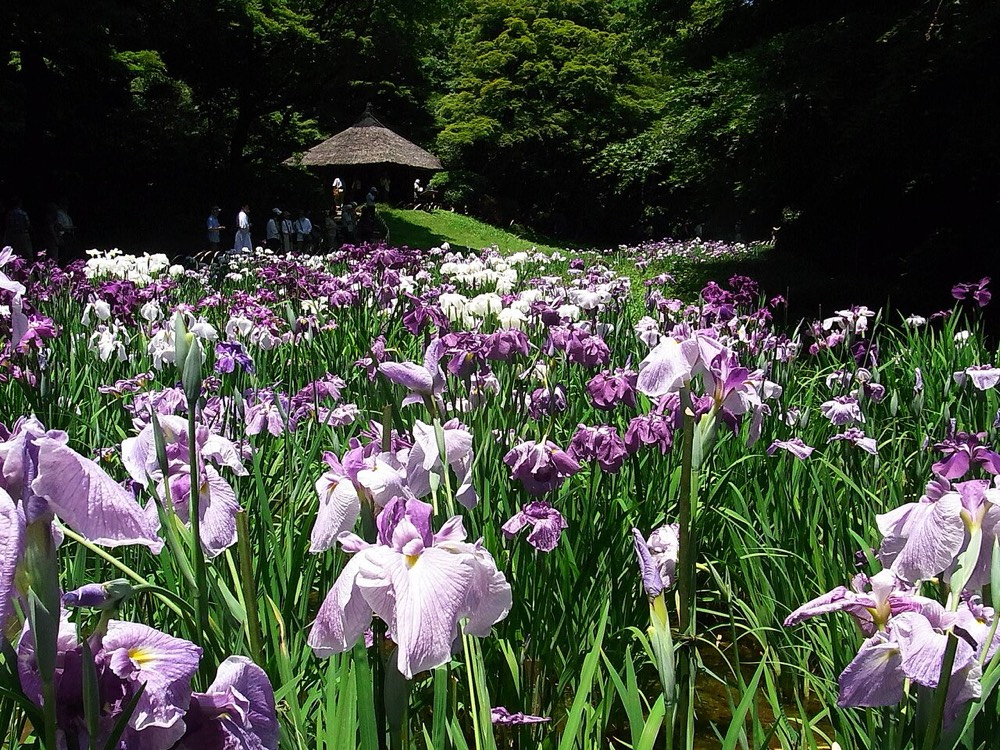
According to the official site, the iris field has about 150 varieties and 1,500 plants. June is the most popular season, and on some days during the month the garden extends its hours to 8:00-17:00 (until 18:00 on weekends)[5]. In other seasons you can see water lilies on the south pond, migratory birds in winter, and Kakuun-tei, the teahouse Emperor Meiji built for Empress Shoken (the current building was rebuilt in 1958).
Kiyomasa Well: the spring inside the garden
Kiyomasa Well (きよまさのいど) lies inside the Inner Garden. Legend says it was dug by the warlord Kato Kiyomasa, and it is one of Tokyo's best-known springs.
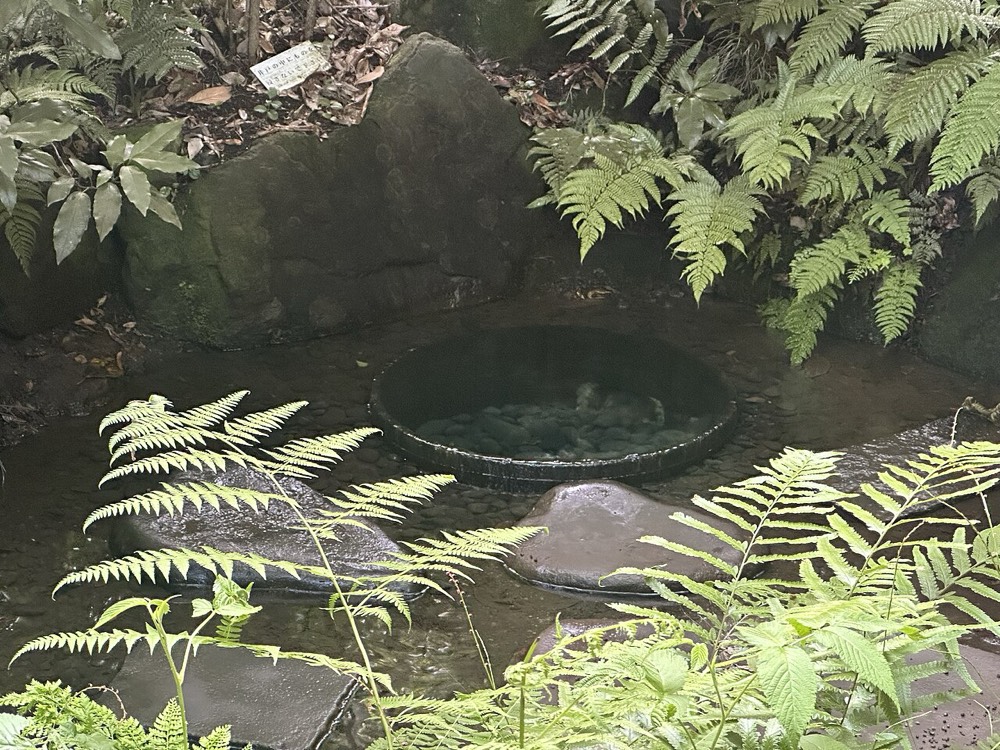
According to the official site, it produces about 60 liters of water per minute at a steady temperature of about 15°C all year, has never run dry, and feeds the south pond[5]. Because it is called a "power spot," numbered tickets have been handed out at peak times[12]. Note that Kiyomasa Well is inside the Inner Garden, so you cannot see it without paying the maintenance fee; from November to February the garden closes at 16:00, so plan it for the morning.
Meiji Jingu Museum
The Meiji Jingu Museum (明治神宮ミュージアム) is inside the grounds, not far from the Harajuku entrance. It displays treasures from the shrine's collection, and the special exhibition room on the second floor hosts rotating exhibitions.
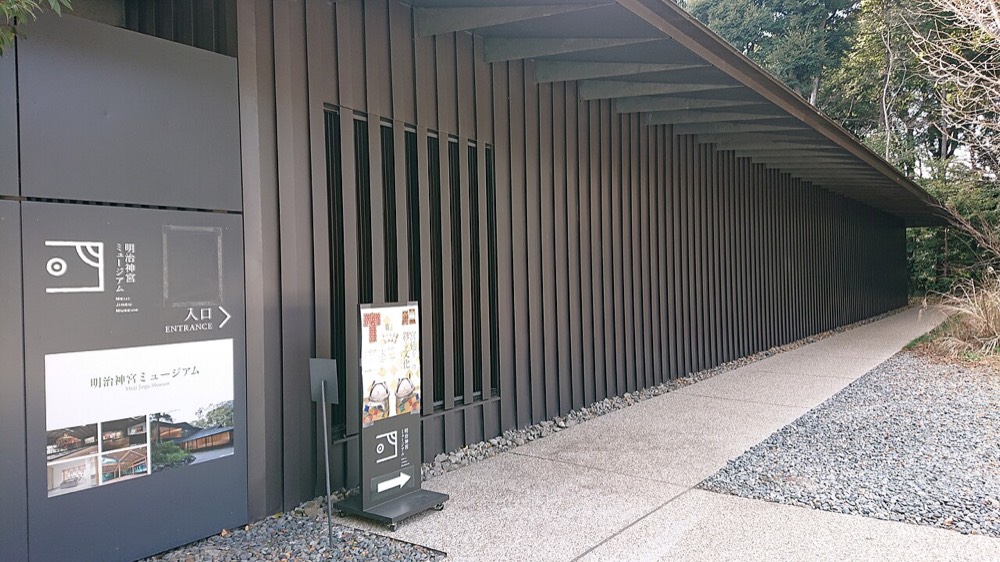
It is open 10:00-16:30 and closed every Thursday, and elementary school children and younger must be accompanied by a guardian[6]. It is about a 5-minute walk from the Omotesando exit of JR Harajuku Station or Exit 2 of Meiji-jingumae Station. Check the official exhibitions page for what is on, and keep Thursdays in mind if the museum is on your list.
Meiji Jingu omamori, Omigokoro omikuji and goshuin
The short answer: omamori, omikuji and goshuin are all handled at the counters around the main shrine, and goshuin are available from 9:00 until closing[2].
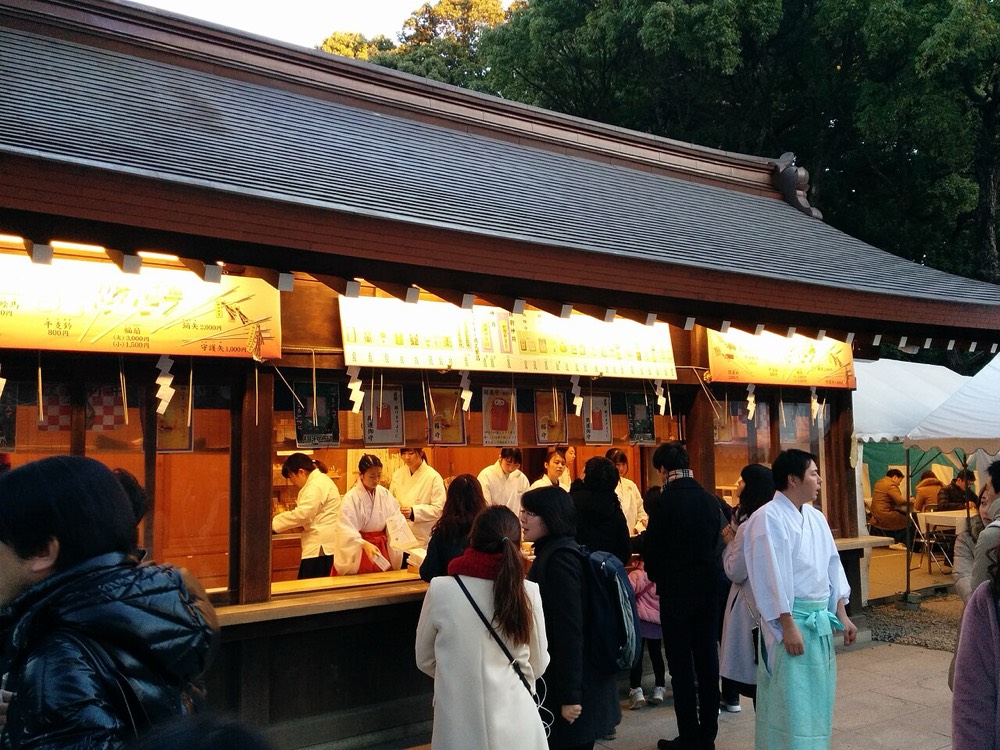
- Omamori: The counters are at the Nagatono hall, the Kaguraden hall and the South counter[2]. The official site lists types including the nishiki charm for health, study and exam-success charms, relationship charms, misfortune-warding charms, traffic safety, good fortune, job success and safe childbirth charms, plus the wish-fulfillment Minori charm made from wood of the shrine's sacred trees[7]. Prices are not published online, so check the signs on site.
- Omigokoro (おおみごころ) omikuji: Meiji Jingu's omikuji does not tell good or bad luck. Instead it uses 30 poems, 15 each chosen from about 90,000 waka by Emperor Meiji and about 27,000 by Empress Shoken, as guidance for life, with an explanation and an English translation[7], so you can read it even without Japanese.
- Goshuin: Available 9:00 until closing; on some days the location changes[2]. The fee is not listed on the official site, so check on site. Limited-edition stamps are sometimes offered during the autumn grand festival and other periods, so watch the official news page.
- Returning old amulets: The Kojinpu Nosho, to the right of the south temizuya, accepts only Meiji Jingu ofuda and omamori[2].
Meiji Jingu hatsumode: hours, crowds and how to avoid them
The short answer: the shrine is expected to announce 2027 hatsumode hours in December; the figures below are from past years for reference. Meiji Jingu typically draws about 3 million visitors over the first three days of January[10], and the early hours and the middle of the day on New Year's Day are the most crowded.
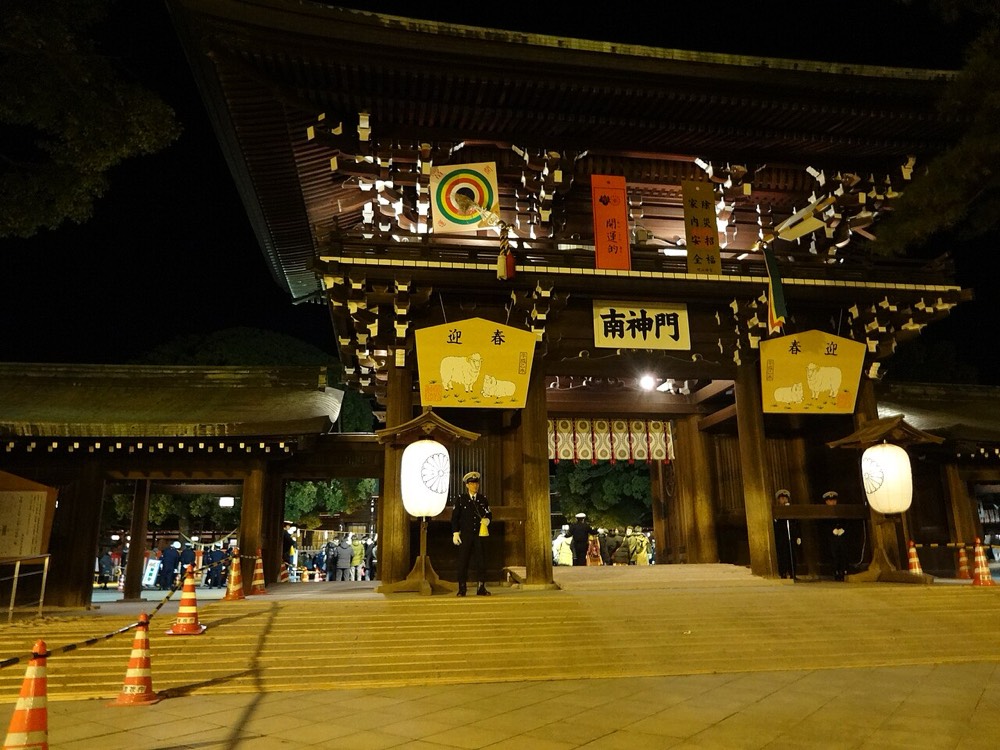
Past hatsumode hours (2026 for reference)
| Date | 2026 hours (reference) |
|---|---|
| December 31 | All-night worship in past years |
| January 1 | 0:00-19:00 |
| January 2-3 | 6:40-18:30 |
| January 4-5 | 6:40-18:00 |
| January 6 | 6:40-17:30 |
| January 7 | 6:40-17:00 |
| January 8 | 6:40-16:20 |
The 2026 hours come from Rurubu, which listed them as provisional at the time[9]; all-night worship on New Year's Eve is from GO TOKYO[8]. Whether 2027 will be the same, check the official Meiji Jingu site in December[1]. On January 1 the New Year's first drumming takes place at 0:00 and the Saitansai ceremony at 7:00[10].
When to go to avoid hatsumode crowds
- New Year's Day, 6:00-8:00: The time a railway news site recommends for January 1[11], after the midnight crowds have left and before the daytime crowds arrive.
- Early morning or late afternoon on January 2 and 3: Around midday is still crowded; just after opening or the last 1 to 2 hours before closing are easier.
- Avoid 0:00-3:00 and 11:00-15:00 on New Year's Day: These are the New Year's Day peaks[9], and waiting times get much longer.
- Weekdays from January 4: The New Year decorations and amulet counters are still there, but lines are much shorter. Best for flexible schedules.
For transport, in 2025-26 traffic restrictions applied around Harajuku Station from 21:00 on December 31 to 18:00 on January 1, and from 9:00 to 18:00 on January 2 and 3, and parking meters on Omotesando and nearby streets could not be used during the first three days[11]. Cars cannot enter the grounds during those three days[9]. Take the train; besides the Harajuku entrance, you can also enter via the Sangubashi or Yoyogi entrance.
To pair a countdown with a midnight shrine visit, see Tokyo New Year 2026-2027; to see the Emperor and Imperial family's New Year greeting on January 2, add the Imperial Palace New Year Greeting 2027. Nationwide New Year closures, lucky bags and transport are covered in the Japan New Year guide.
Half-day route: Meiji Jingu, Takeshita Street and Omotesando
The short answer: visit Meiji Jingu in the morning, walk Takeshita Street at midday, explore Omotesando in the afternoon and walk on to Shibuya in the evening, about 5 to 6 hours in total. Using November as an example (shrine open 6:10-16:10):
| Time | Plan | Notes |
|---|---|---|
| 9:00 | JR Harajuku Station to the Harajuku entrance | About 1 minute to the South Approach |
| 9:10-10:00 | Sake barrels, great torii, then the main shrine and Meoto Kusu | Get an omamori or draw an Omigokoro omikuji |
| 10:00-10:40 | Inner Garden and Kiyomasa Well (optional) | 500 yen; or the museum instead (closed Thursdays) |
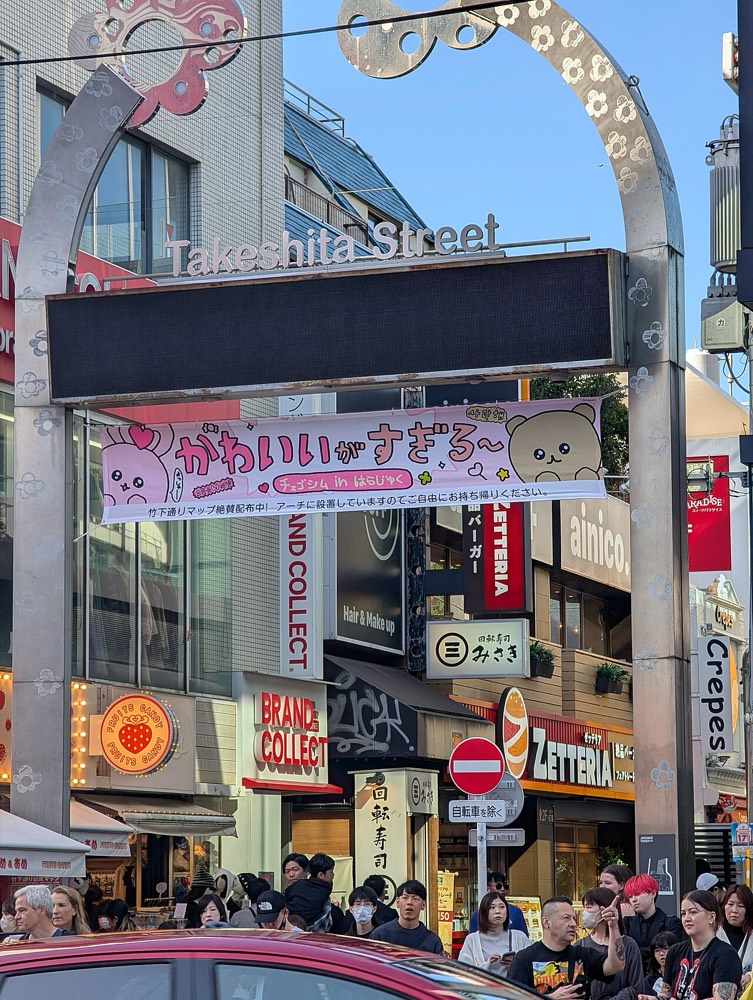
| 11:00-12:30 | Takeshita Street | Crepes, small goods and trendy shops; busiest at midday on weekends |
| 12:30-13:30 | Lunch | Around Harajuku and Omotesando |
| 13:30-15:30 | Omotesando and Cat Street | About 10 minutes on foot from Harajuku Station to the Omotesando area[13] |
| 15:30- | Walk to Shibuya | About 20 minutes on foot from Harajuku Station[13] |
In the evening, catch the sunset with the SHIBUYA SKY guide; between November 13, 2026 and January 11, 2027 you can also head back to Yoyogi Park next to the shrine for Yoyogi Forest of Lights 2026 (lights on from 17:30, advance tickets required).
A few planning tips:
- Do the shrine in the morning: In winter it closes around 16:00, and an afternoon visit can end up as a rushed bow.
- Avoid Takeshita Street on weekend afternoons: The pedestrian street is right in front of Harajuku Station[13]; weekend afternoons are usually the most crowded, and weekday mornings are easier.
- Harajuku's old station building is coming back: JR East plans to recreate the exterior of the 1924 wooden station building, retired in 2020, as part of a commercial complex on the original site, scheduled to open in winter 2026[14]; check official announcements for the exact date.
- The Outer Gardens are a different place: Meiji Jingu Gaien (the ginkgo avenue and Jingu Stadium) is in the Aoyama area, separate from the shrine grounds covered here, and redevelopment work is under way nearby. For ginkgo from late November to early December, see Tokyo ginkgo 2026.
Who is Meiji Jingu for, and who is it not for?
Good for:
- First-time visitors to Tokyo who want a shrine and a forest in the middle of the city. Harajuku, Shibuya and Shinjuku are all in the same area, easy to fit into the western Tokyo day in Tokyo attractions 2026.
- Budget travelers: visiting is free, and only the Inner Garden and the museum charge.
- Anyone wanting to experience Japanese New Year: its hatsumode is among the largest in Japan, with a unique atmosphere.
- Anyone who wants a quiet break before or after shopping: step out of Harajuku Station and you are on a forest approach, a quick change of pace.
Not ideal for:
- People who are only free in the evening or at night: in winter it closes around 16:00, and you cannot enter at night.
- Those expecting ornate buildings or lots of photo spots: Meiji Jingu is mainly forest and simple wooden architecture, very different from colorful Senso-ji. For a vermilion temple, plan the Senso-ji guide.
- Crowd-averse visitors who can only go on New Year's Day: better to visit from January 4 onward.
Before you go
- Check this month's closing time: It closes at 16:00 in December and 16:20 in January, so plan afternoons backward from that[2].
- The Inner Garden keeps different hours: It opens only at 9:00 and closes at 16:00 from November to February, so see Kiyomasa Well early[5].
- The museum is closed on Thursdays: On a Thursday, skip it and do the Inner Garden or Omotesando instead[6].
- Watch for December announcements on hatsumode: For 2027 hours and traffic restrictions, check the official Meiji Jingu site and Tokyo Metropolitan Police notices from December.
- Food etiquette: People generally do not eat while walking on shrine approaches; finish any crepes from Takeshita Street near the shop before heading to the shrine.
FAQ
What time does Meiji Jingu open and close? Can I visit at night?
Meiji Jingu opens and closes with sunrise and sunset, so hours change every month. The earliest opening is 5:00 from May to August, the latest closing is 18:30 in June, and in December it closes at 16:00. After closing you cannot enter the grounds, so night visits are not possible. The one exception is December 31, when the shrine has traditionally stayed open all night. Check the official monthly schedule before you go.
Is there an entrance fee for Meiji Jingu? What costs money?
Visiting Meiji Jingu is free, and you can walk freely along the approaches, through the great torii, to the front of the main shrine and the Meoto Kusu trees. The paid areas are the Meiji Jingu Inner Garden, with a 500-yen maintenance fee (Kiyomasa Well is inside it), and the Meiji Jingu Museum, at 1,000 yen for adults, 900 yen for high school students and younger, and free for preschool children.
What are the Meiji Jingu hatsumode hours for 2027?
As of November 19, 2026, the shrine has not announced 2027 hatsumode hours, and a Japanese weather news site says the information will be posted in December. For reference, in 2026 the shrine was open 0:00-19:00 on January 1 and 6:40-18:30 on January 2 and 3, closing a little earlier each day after that until it returned to 16:20 on January 8. In past years visitors could pray all night on New Year's Eve.
When is Meiji Jingu least crowded for hatsumode?
The busiest times on New Year's Day are 0:00-3:00 and 11:00-15:00. If you want to visit on January 1, early morning from 6:00 to 8:00 is easier. On January 2 and 3, go right at opening or before closing. The most relaxed option is a weekday from January 4 onward: the New Year atmosphere is still there, but the crowds are much smaller than in the first three days.
What is special about Meiji Jingu's omikuji and omamori?
Meiji Jingu's omikuji is called Omigokoro and does not tell good or bad luck. Instead it offers one of 30 waka poems selected from those written by Emperor Meiji and Empress Shoken, with an explanation and an English translation. There are many omamori, including the nishiki charm for health, study and exam charms, relationship charms and misfortune-warding charms, available at counters such as the Nagatono hall. The official site does not list prices, so check on site.
How long does it take to walk from Harajuku Station to the main shrine?
From JR Harajuku Station it is about 1 minute to the Harajuku entrance (South Approach), then about 10 minutes from the entrance to the main shrine, so about 10 to 15 minutes in total. From Sangubashi or Yoyogi Station it is about 3 to 5 minutes to the entrance, then about 10 minutes to the main shrine. During hatsumode the crowds make it take much longer.
Sources
- Meiji Jingu official website: Gate hours for the current month and latest news
- Meiji Jingu: Visiting information (gate hours, goshuin): Gate hours for every month, goshuin hours and names of the amulet counters
- Meiji Jingu: Access: Three entrances, about 10 minutes from each to the main shrine, cars only via the Yoyogi entrance
- Meiji Jingu: Precinct map: South, North and West approaches, great torii dimensions, facility locations, treasure hall closure
- Meiji Jingu: Meiji Jingu Inner Garden: Garden hours, maintenance fee, Kiyomasa Well flow and water temperature, number of iris varieties
- Meiji Jingu Museum: Opening hours, closing days and admission fees
- Meiji Jingu: Ofuda, omamori and omikuji: Origin of the Omigokoro omikuji and types of omamori
- GO TOKYO: Meiji Jingu Hatsumode: All-night worship on New Year's Eve, millions of visitors over the first three days, walking times from stations
- Rurubu & more: Meiji Jingu hatsumode information: 2026 hours for January 1-8, New Year's Day crowd peaks, no car access January 1-3
- Weathernews: Meiji Jingu hatsumode information: Typical crowd of about 3 million, 2027 information due in December
- Tetsudo Channel: Guide to Tokyo's three classic hatsumode spots: 2025-26 traffic restrictions around Harajuku Station, nearest stations for each entrance, recommended visiting times
- HugKum: Meiji Jingu highlights and walking tips: Meoto Kusu location and legend, origin of the sake and wine barrels, numbered tickets for Kiyomasa Well at peak times
- GO TOKYO: Harajuku area: Takeshita Street, Omotesando, Cat Street and walking times
- Time Out Tokyo: Harajuku's original wooden station building is making a comeback: Commercial complex recreating the old station building, planned to open in winter 2026
Fares, opening hours and event dates can change. Information checked on 2026.11.19; please confirm with official sources before you go.