Kurokawa Onsen Guide: Nyuto Tegata Bath Pass, Choosing a Ryokan, Access and the Winter Lantern Event
Kurokawa Onsen's Nyuto Tegata: 1,500 yen for 3 outdoor baths, valid 6 months. Choosing a ryokan, buses from Fukuoka, Kumamoto and Yufuin, and winter Yuakari lanterns.
Quick answer
Kurokawa Onsen is a hot spring village of about 30 ryokan at roughly 700 m in Minamioguni, Kumamoto. The Nyuto Tegata bath pass costs 1,500 yen for adults and 700 yen for children, gets you into 3 of about 25 outdoor baths, is valid for 6 months, and works 8:30–21:00. Public transport means reserved buses: about 3 hours and 4,000 yen from Fukuoka, about 2 hours 50 minutes and 3,400 yen from Kumamoto Station on the Kyushu Odan Bus, or about 1.5 hours and 2,700 yen from Yufuin. The Yuakari bamboo lantern lighting has run from late December to the end of March in past years.
Kurokawa Onsen (黒川温泉, くろかわおんせん) is a hot spring village in the mountains north of Aso in Kumamoto Prefecture. It is best known for the Nyuto Tegata, a wooden bath pass you use to stroll between the outdoor baths of different ryokan. This guide covers how much the Kurokawa Onsen Nyuto Tegata costs and how to use it, how to choose a ryokan, whether to day-trip or stay, how to get there by bus from Fukuoka, Kumamoto and Yufuin and what to reserve, plus past dates for Yuakari, the winter bamboo lantern lighting, so you can decide whether Kurokawa belongs on your Kyushu itinerary.
What is Kurokawa Onsen like?
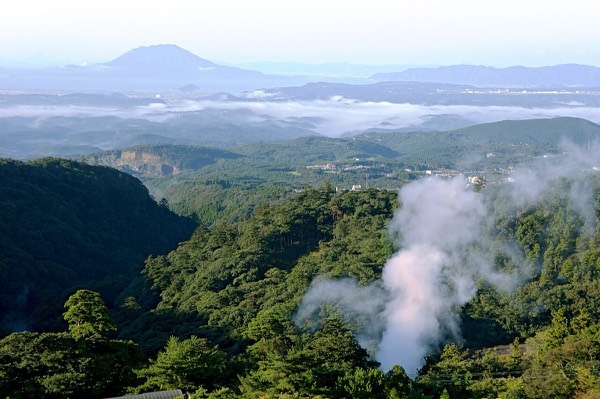
In short: Kurokawa Onsen is a mountain hot spring village of about 30 ryokan at roughly 700 m, run on the idea that the whole village is "one ryokan"[3].
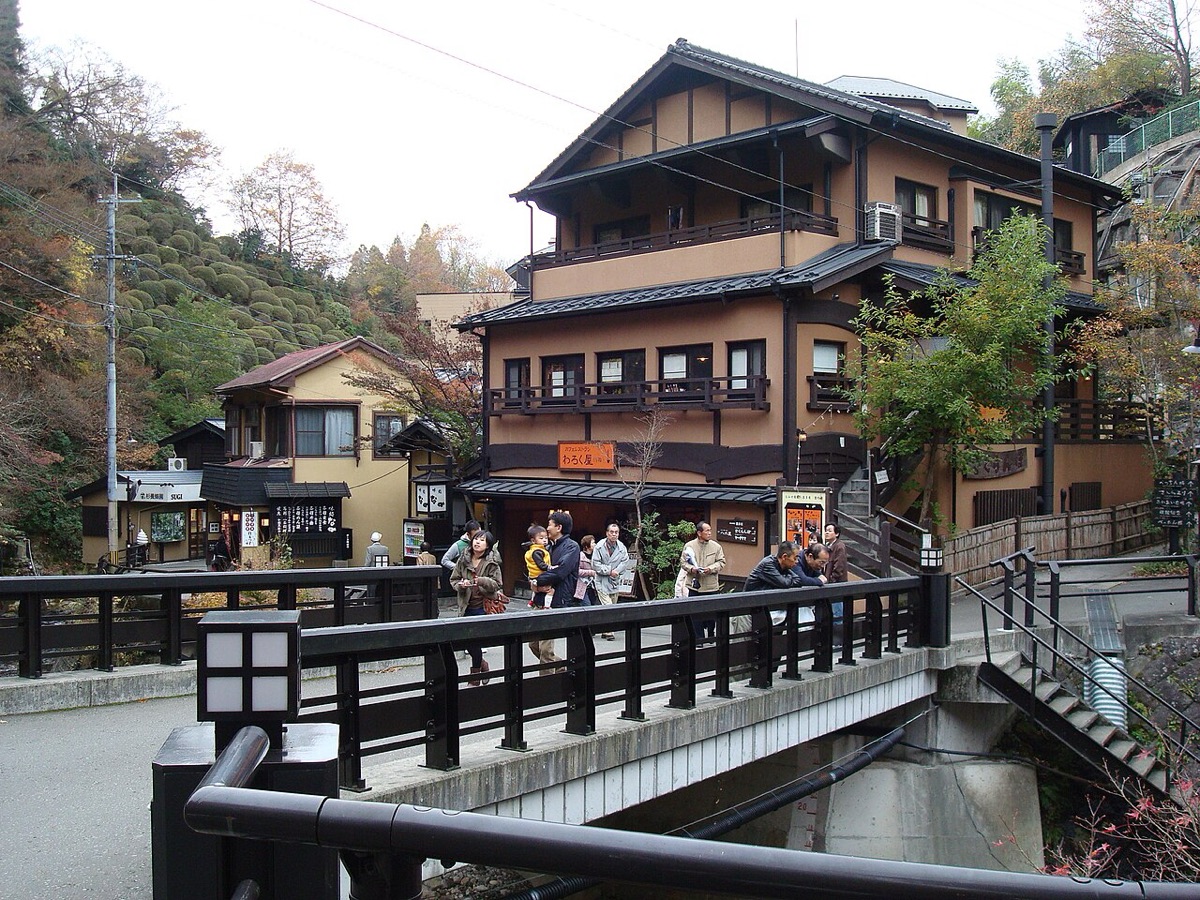
As the association puts it, each ryokan is like a detached room, the lanes linking them are the corridors, and the trees and flowers are the inner garden, so the whole village is one big inn[3]. Kurokawa was already a place for therapeutic bathing in the Edo period. After the war, six inns formed a ryokan association, and from the 1980s they reworked the landscape: about 200 mismatched signs were removed in favor of shared signage, and trees were planted to create a rural mountain scene. The Nyuto Tegata was born in this period, originally to help two inns that had no room for outdoor baths by letting guests use the outdoor baths across the whole village[3].
The village itself is small. The main streets run from Igo-zaka (いご坂) to Shimo-kawabata-dori, and a loop along the Tanohara River (田の原川) takes about 15–20 minutes[2]. It is far from expressways and train stations, and the association itself calls it a "countryside hot spring town." There is no big shopping area, so it suits travelers who come specifically to soak, stroll and switch off for a night.
How does the Kurokawa Onsen Nyuto Tegata work? Price and rules
In short: the Nyuto Tegata costs 1,500 yen for adults, gets you into 3 of about 25 outdoor baths, and is valid for 6 months. Bathing hours are roughly 8:30–21:00[1].
| Item | Details |
|---|---|
| Price | Adults 1,500 yen; children 700 yen (age 3 to sixth grade) |
| Baths | Choose 3 of about 25 ryokan outdoor baths |
| Alternative use | 1 of the 3 slots can be swapped for food or a souvenir at listed shops |
| Validity | 6 months from purchase; use leftover slots on a return visit |
| Bathing hours | 8:30–21:00 (varies by ryokan) |
| Where to buy | Kaze no Ya tourist information center (9:00–17:00), any ryokan |
| Rules | One per person, not shareable |
Details are from the Kurokawa Onsen Ryokan Association's official site[1][2]. The pass is a round slice of thinned cedar or cypress from Minamioguni with 3 stickers on the back. Show it at a ryokan's front desk and the staff peel off a sticker and stamp the pass with that inn's own design. After 3 baths you have 3 different stamps, and you can take the pass home as a souvenir or hang it as an offering at the Jizo-do shrine in the village[1].
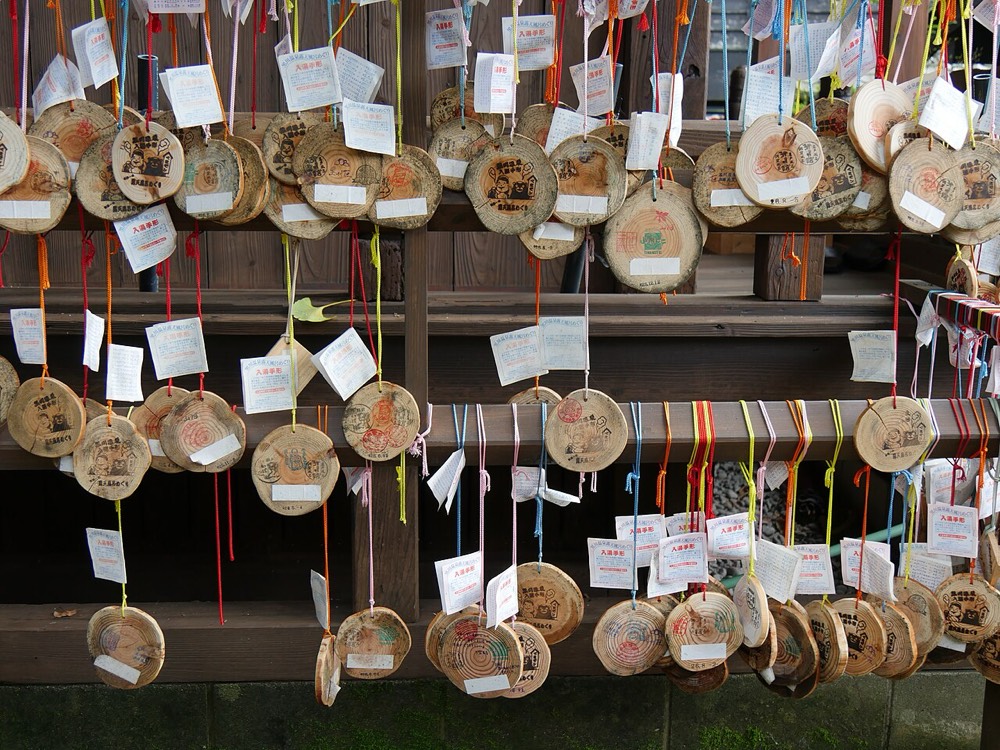
How to use it:
- Buy the pass at Kaze no Ya or a ryokan, and pick up a village map.
- Check each ryokan's hours for the day on the day-visitor bathing status page; the association suggests checking again around 9 a.m. on the day[10].
- At your chosen ryokan, show the pass at the front desk, get it stamped, then head to the outdoor bath.
- About an hour per bath is a good guide. Three baths take about 2–3 hours, and with strolling you can easily spend half a day[2].
You can also bathe without the pass: a single visit costs about 500–800 yen per ryokan[2]. If you only plan on 1–2 baths, or the bath you want is not part of the pass scheme, paying per visit works fine; for 3 or more, the pass is better value.
Rules to know before you bathe: mixed bathing, tattoos and toiletries
In short: mixed outdoor bathing has ended, tattoo policies vary by ryokan, and some ryokan provide no shampoo, so checking ahead saves wasted trips[2].
- Mixed bathing: the association says that after a revision to a Kumamoto Prefecture ordinance, outdoor baths are no longer mixed. To bathe with family or a partner, use a private bath (kashikiri-buro). Day-visitor private baths generally cannot be reserved, and from 15:00 overnight guests get priority[2].
- Tattoos: each ryokan handles this differently. The association asks guests with tattoos to inquire in advance through the official contact form, or to use a private bath[2]. For basic bathing etiquette, see our Japan travel etiquette guide.
- Shampoo and body wash: some ryokan provide none to protect the environment, and may not allow your own either. Check the information center's brochure or ask the ryokan[2].
- Water temperature: the source water is hot, and baths are about 40–43°C, so keep soaks short for small children[2].
- Cash: there is no ATM in the village (the nearest is about 15 minutes away by car), and many shops are cash only[2], so bring enough yen in cash.
How to choose a Kurokawa Onsen ryokan: day trip or overnight?
In short: stay a night if you want the evening atmosphere, the Yuakari lanterns or an unhurried soak. Ryokan fall into two groups: those within walking distance of the village center, and those farther out that need a pick-up.
| Compare | Day trip | Overnight |
|---|---|---|
| Best for | Limited time, or passing through by bus or car | Bathing into the evening, seeing the lanterns, ryokan dinner |
| Bathing time | Limited by bus times, about 2–3 hours | Evening to next morning, plus your own ryokan's baths |
| Transport | About 3 buses per route; plan your return | Most ryokan offer pick-up from the bus stop (book ahead) |
| Watch out for | Crowds after noon, some ryokan cap numbers | Weekends and peak season nearly sell out; book early |
Things to weigh when choosing a ryokan:
- Location: most ryokan are within walking distance, but some are more than 30 minutes from the center[2]. Staying in the center makes evening walks and pass bathing easy; outlying ryokan are usually quieter but depend on pick-ups or taxis, and taxis are very scarce in Kurokawa.
- Bath types: some ryokan have private baths or rooms with their own outdoor bath, good for families, couples or travelers with tattoos. When booking, check whether you are getting shared baths or a private one.
- Meals: Japanese onsen ryokan usually come with dinner and breakfast. Few restaurants in the village open in the evening, so a plan that includes dinner is the safer choice. For vegetarian or allergy needs, the association advises confirming with the ryokan directly before booking[2].
- Pick-up: most ryokan run pick-ups from the bus stop or Kaze no Ya, but these usually need to be booked in advance, and times generally cannot be changed at short notice[2].
When to book: the association says most ryokan open bookings 3–6 months ahead. Book even earlier for Golden Week, the September holidays, Obon, autumn leaves (October–November) and New Year. Same-day bookings are hard, and weekends and peak season are nearly always full[2]. The information center will not recommend specific ryokan but can help you weigh options by budget and needs[2]. The official site has availability search and booking, and you can also compare on general booking sites or ryokan websites.
Getting to Kurokawa Onsen: from Fukuoka, Kumamoto and Yufuin
In short: there is no direct rail line; public transport means reserved buses with about 3 runs a day per route, and you must book by the day before[2].
| From | Bus | Time | Fare (adult, one way) |
|---|---|---|---|
| Fukuoka (Tenjin, Hakata Bus Terminal, Fukuoka Airport International) | Fukuoka–Kurokawa Onsen route (Hita Bus, Kyushu Sanko) | About 3 hours | 4,000 yen |
| Kumamoto Station | Kyushu Odan Bus | About 2 hr 50 min | 3,400 yen |
| Aso Kumamoto Airport | Kyushu Odan Bus | About 2 hours | 2,600 yen |
| JR Aso Station | Kyushu Odan Bus | About 50 min | 1,600 yen |
| Yufuin Station Bus Center | Kyushu Odan Bus | About 1.5 hours | 2,700 yen |
Fares follow Kyushu Sanko Bus's published fare tables: the Fukuoka route as revised October 1, 2025 and the Kyushu Odan Bus as revised August 1, 2026[6][8]. Journey times are worked out from the timetables[7].
Departures for reference (timetables dated October 1, 2025; check again before you go)[7]:
- Fukuoka to Kurokawa: departs Nishitetsu Tenjin Expressway Bus Terminal at 9:30, 11:15 and 12:40, via Hakata Bus Terminal and Fukuoka Airport International Terminal, arriving at Kurokawa Onsen around 12:29, 14:14 and 15:39. Return departures from Kurokawa at 10:00, 11:00 and 14:00.
- Kumamoto to Kurokawa: departs Kumamoto Station at 7:23, 8:23 and 12:08, via Aso Kumamoto Airport and Aso Station, arriving at Kurokawa Onsen around 10:15, 11:15 and 15:00.
- Kurokawa to Yufuin: the same buses continue from Kurokawa Onsen at around 10:15, 11:15 and 15:00 toward Yufuin, with a roughly 20-minute break at Senomoto, arriving about 1.5 hours later. From Yufuin to Kurokawa, buses leave at 9:10, 13:50 and 14:50.
Booking: the association says the Kyushu Odan Bus (from Kumamoto and Yufuin) and the Fukuoka buses must be reserved by the day before, by phone or online[2]. The Fukuoka route opens bookings one month ahead, and departures from Kurokawa Onsen must be booked by the previous day[8]. From the Kurokawa Onsen bus stop it is about a 10-minute, 600 m walk to Kaze no Ya, with a slope[2].
The Kyushu Odan Bus links Kumamoto, Aso, Kurokawa Onsen, Yufuin and Beppu, which makes it ideal for a route across Kyushu: come from Kumamoto and Aso, then continue to our 2-day Yufuin and Beppu onsen trip. Rail passes and bus tickets for Kyushu are compared in our Kyushu transport guide.
Driving: Aso, Yufuin and Hita are each about an hour away by car, and the village has about 280 parking spaces, mostly free[2]. From December to March you must have winter tires or chains; see the next section.
Kurokawa Onsen's Yuakari lanterns and choosing a season
In short: the Yuakari bamboo lantern lighting has run from late December to the end of March in past years. The 2026–27 dates have not been announced; the following is past-year reference.
Yuakari uses bamboo lanterns handmade by the ryokan association and local residents. The official site describes about 300 bamboo lanterns hung along the Tanohara River and lit from dusk into the evening[4]. The 2025–26 season ran from December 20, 2025 to March 31, 2026. The press release summary gave lighting hours of 17:00–21:30, while its main text said dusk to 22:00[9], so the two differ slightly; the official FAQ says specific dates will be posted on the website once decided[2].
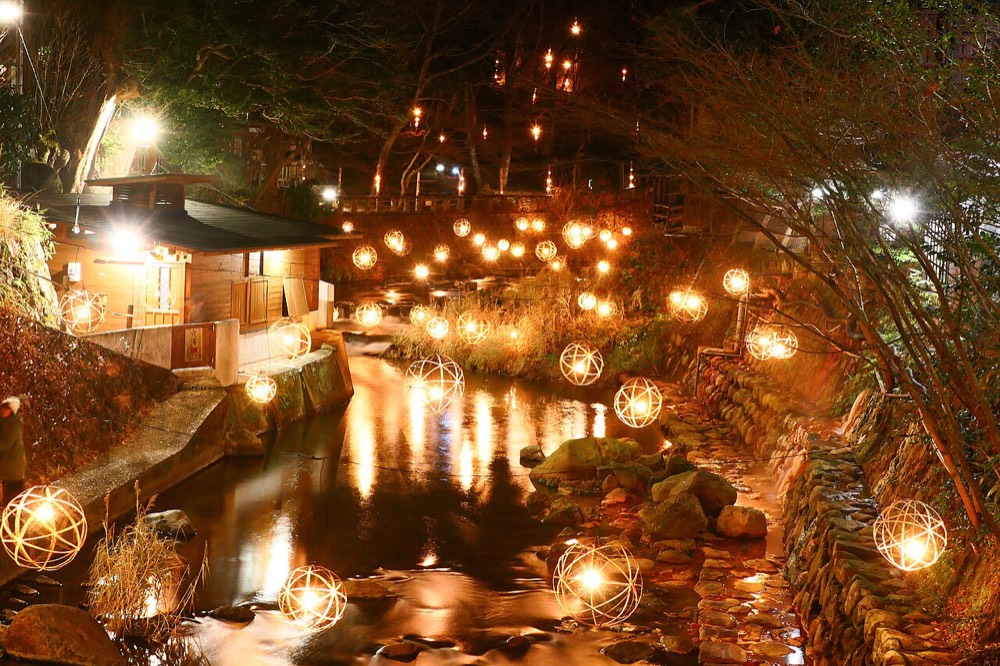
There are woven spherical "mari" lanterns and tube lanterns about 2 m tall, mainly from Marusuzu Bridge to Kawabata-dori and around the bus stop[9]. Seeing them means walking outside in temperatures around freezing, so the easiest way is to stay the night and head out in your coat after dinner.
| Season | Scenery and events (per the official site) | Notes |
|---|---|---|
| Spring (Mar–Apr) | Cherry blossoms in early April, controlled burning of the surrounding grasslands | Mornings and evenings still cold |
| Early summer (May–Jun) | Fresh greenery, Jizo Festival on May 8 | Rainy season |
| Summer (Jul–Sep) | Deep green and cool, a good escape from the heat | Rooms hard to get over September holidays |
| Autumn (Oct–Nov) | Autumn leaves late October to mid-November | Peak season, book early |
| Winter (Dec–Mar) | Snow scenes, Yuakari | Snow and ice; drivers need winter tires |
Seasonal information is based on the official annual schedule and FAQ[4][2]. Kurokawa is about 3–5°C cooler than the lowlands, and the association notes that cherry blossoms and autumn leaves arrive a little later than on the plains. For other Kyushu foliage spots at the same time, see Kyushu autumn leaves 2026.
Before you go
- Each bus route has only about 3 runs a day and must be reserved by the day before, so book your return first and plan your baths around it.
- There is no ATM in the village and many shops are cash only, so carry yen in cash for the pass, single baths and lunch.
- Day-visitor bathing hours are updated daily; the association suggests checking the website around 9 a.m. on the day. In rain or snow, day-visitor bathing may be suspended without notice if outdoor bath temperatures drop[2].
- Many shops and ryokan close on Tuesdays to Thursdays, so check before a weekday visit[2].
- Drivers need winter tires or chains from December to March; if you would rather not risk it, take the bus or use your ryokan's pick-up.
- To link Kurokawa Onsen with Kumamoto, Aso and Yufuin into one Kyushu onsen trip, start planning with our Kyushu travel overview.
FAQ
How much is the Kurokawa Onsen Nyuto Tegata, and how long is it valid?
1,500 yen for adults and 700 yen for children (age 3 to sixth grade), one per person and not shareable. Pick 3 outdoor baths at participating ryokan; one of the 3 slots can instead be swapped for food or a souvenir at listed shops. It is valid for 6 months from purchase, so you can use leftover slots on a return visit.
Where can I buy the Nyuto Tegata?
At the Kurokawa Onsen Ryokan Association's tourist information center, Kaze no Ya (風の舎, 9:00–17:00), or at the front desk of any ryokan. Ryokan sometimes run out, so the association recommends Kaze no Ya if you want to be sure. Bathing hours are roughly 8:30–21:00, but each ryokan sets its own day-visitor hours.
Can I visit Kurokawa Onsen as a day trip?
Yes, but buses are infrequent. The direct bus from Fukuoka runs 3 times a day and the earliest arrives after noon; the earliest Kyushu Odan Bus from Kumamoto arrives at 10:15. Three baths take about 2–3 hours, so after travel time a day trip is tight. To soak at a slower pace and see the village at night, stay one night.
Do I need to reserve the bus to Kurokawa Onsen?
Yes. The association says both the Kyushu Odan Bus and the Fukuoka buses must be reserved by the day before, by phone or online. The Fukuoka route opens bookings one month ahead, and departures from Kurokawa must be booked by the previous day. Each route has only about 3 runs a day and fills up in peak season.
When is Kurokawa Onsen Yuakari 2026–27?
As of October 2026 the 2026–27 dates have not been announced; the association will post them on its website once decided. For reference, the 2025–26 season ran from December 20, 2025 to March 31, 2026, with bamboo lanterns lit along the Tanohara River and the hot spring street from early evening until about 21:30–22:00.
What should I know about driving to Kurokawa Onsen in winter?
Kurokawa sits in the mountains at about 700 m, and the association warns that snow and icy roads are frequent from December to March, so winter tires or chains are a must; check the weather and road conditions before you set off. Streets in the village are narrow and most ryokan lots are for guests only, so use the public parking lots when strolling.
Sources
- Kurokawa Onsen official site: Nyuto Tegata: Pass price, number of baths, validity, bathing hours, children's pass and exchangeable items
- Kurokawa Onsen official site: FAQ: Bus reservations, ATMs, winter tires, single-bath fees, ryokan booking timing, Yuakari
- Kurokawa Onsen official site: About Kurokawa Onsen: About 30 ryokan, the 'Kurokawa Onsen as one ryokan' concept and history
- Kurokawa Onsen official site: Annual schedule: Seasonal scenery, Yuakari with about 300 bamboo lanterns and lighting hours
- Kurokawa Onsen official site: Access: Routes from Kumamoto, Fukuoka and Oita
- Kyushu Sanko Bus: Kyushu Odan Bus fare table (revised August 1, 2026): Fares to Kurokawa Onsen from Kumamoto Station, Aso Kumamoto Airport, Aso Station and Yufuin
- Kyushu Sanko Bus: Kyushu Odan Bus timetable (as of October 1, 2025): Kumamoto–Kurokawa Onsen–Yufuin/Beppu departures
- Kyushu Sanko Bus: Fukuoka–Kurokawa Onsen route timetable and fares: Fares from Fukuoka and booking rules (timetable at jikoku1.pdf on the same site)
- Kurokawa Onsen Ryokan Association 'Yuakari' 2025–26 press release (PR TIMES via ReseMom): 2025–26 Yuakari dates, lighting hours and locations
- Kurokawa Onsen official site: Day-visitor bathing status: Each ryokan's day-visitor hours and fees, updated daily
Fares, opening hours and event dates can change. Information checked on 2026.10.23; please confirm with official sources before you go.