Kagoshima Sightseeing Guide: Sakurajima Ferry, Volcanic Ash Tips, Tenmonkan and an Ibusuki Sand Bath Side Trip
Kagoshima sights: the 250-yen, 15-minute Sakurajima Ferry (no overnight sailings since Oct 2025), alert level 3 and ash tips, Shiroyama, Sengan-en, CUTE pass, Ibusuki.
Quick answer
Kagoshima's top sight is Sakurajima: the ferry from Kagoshima Port takes about 15 minutes and costs 250 yen for adults, and since 1 October 2025 there are no sailings from midnight through the 3 a.m. hour. Sakurajima remains at eruption alert level 3 (confirmed October 2026), which closes the area within about 2 km of the craters, while Yunohira Observatory and other sights stay open. The CUTE pass (1,400 yen for 1 day) covers trams, buses and the ferry; Sengan-en costs 1,600 yen; the Saraku sand bath in Ibusuki costs 1,500 yen and is about 51 minutes away on the Ibusuki no Tamatebako train.
Most things to do in Kagoshima revolve around one active volcano: Sakurajima, across the bay from the city, can puff smoke on any given day, and you can step onto it after a 15-minute ferry ride. This guide covers a recommended Kagoshima sightseeing route, including Sakurajima Ferry fares and the post-2025 schedule change, the volcano's current alert level and how to deal with ash, what to see at Shiroyama and Sengan-en, shaved ice in Tenmonkan, and how to use trams, the CUTE pass, the Kyushu Shinkansen and the trip to the Ibusuki sand baths, so you can plan two to three smooth days in Kagoshima.
Things to do in Kagoshima: the overview table
Kagoshima's city sights are compact: two days is enough for Sakurajima, Shiroyama, Sengan-en and Tenmonkan. Add half a day to a full day if you want the Ibusuki sand bath. The table below lists the main sights, how to get there, time needed and cost (confirmed October 2026).
| Sight | How to get there | Time needed | Cost (adult) |
|---|---|---|---|
| Sakurajima (Yunohira Observatory and more) | About 15 minutes by ferry from Kagoshima Port, then the loop bus | Half a day | Ferry 250 yen |
| Shiroyama Observatory | Sightseeing loop bus from the city, or walk up from Tenmonkan | 1 hour | Free |
| Sengan-en | Sightseeing loop bus, or about 20 minutes by car | 2 hours | 1,600 yen |
| Tenmonkan | Tenmonkan-dori tram stop | 1–2 hours | Depends on spending |
| Saraku, Ibusuki | About 1 hour by JR from Kagoshima-Chuo, then a bus | Half a day | 1,500 yen |
On a first visit, take the ferry to Sakurajima in the morning, return for Sengan-en in the afternoon, go up Shiroyama to see Sakurajima in the evening light, then eat in Tenmonkan. Give Ibusuki the whole second day. For linking Kagoshima with the rest of Kyushu, see our Kyushu transport guide.
How to take the Sakurajima Ferry: fares, frequency and the overnight break
The Sakurajima Ferry is run by the Kagoshima City Ship Bureau. Kagoshima Port to Sakurajima Port takes about 15 minutes, or around 20 in rough weather[4]. Adults pay 250 yen one way and children 130 yen, and each adult can bring one preschool child free[3].
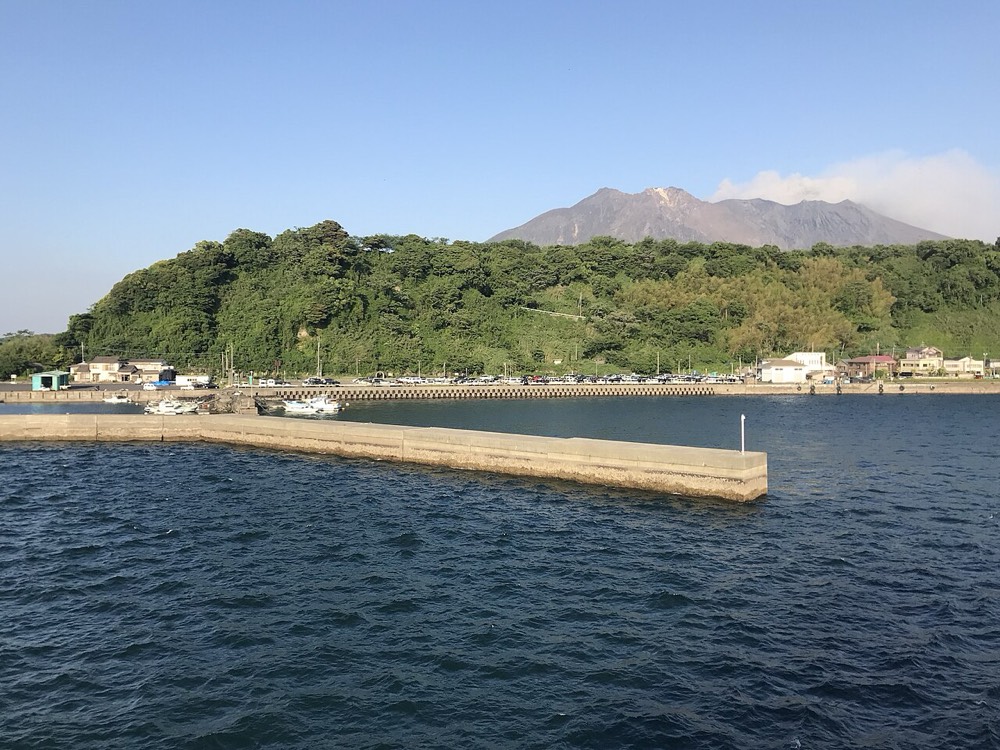
Many older articles say the Sakurajima Ferry runs 24 hours. That is out of date. From 1 October 2025, the Ship Bureau changed its late-night schedule: there are no sailings from midnight through the 3 a.m. hour, and after the last boat leaves, the terminals and toll booths on both sides close, so you cannot wait inside[2]. Daytime service is frequent, with about 94 sailings on weekdays and 104 on weekends and holidays[4]. No reservation is needed; just walk on.
Key points:
- Foot passengers leaving Kagoshima Port do not buy a ticket first; pay at the gate after arriving at Sakurajima Port.
- You can pay by cash, credit card (JCB, VISA, Mastercard and others) or transit IC cards such as Suica, ICOCA, SUGOCA and nimoca[3].
- There is a snack counter on board. Use the 15 minutes on deck to photograph Sakurajima, and the Kagoshima skyline on the way back.
- If you are returning from Sakurajima at night, check the last departure first. Timetables are on the official site and at the terminals[4].
The Kagoshima Port ferry terminal is a few minutes' walk from the Suizokukan-guchi tram stop and close to the Kagoshima City Aquarium; you can also take the sightseeing loop bus.
Is Sakurajima safe right now? Alert level and volcanic ash tips
The short answer: you can sightsee on Sakurajima as usual. According to the Japan Meteorological Agency's commentary of 23 October 2026, Sakurajima remains at eruption alert level 3 (entry restricted), with the warning zone covering roughly 2 km around the Minamidake summit crater and Showa crater, where large volcanic bombs and pyroclastic flows are a risk[1] (confirmed October 2026). That zone is closed to the public at all times, and the places visitors usually go, such as Yunohira Observatory, the Sakurajima Visitor Center and the lava coast trails, are outside it.
What to know:
- The level can change: if it rises to level 4 or 5, parts of the island are asked to evacuate and sights may close. Check the JMA volcano information the day before[1].
- Eruptions are routine: Sakurajima normally erupts many times a year, and a plume seen from the city is everyday scenery, not a disaster.
- Ash follows the wind: generally, summer winds tend to blow ash over Kagoshima city, while winter northwesterlies more often carry it to the southeast of Sakurajima. The JMA ashfall forecast is what to go by.
What to do when ash is falling
Volcanic ash is fine glassy grit, not smoke, and it is hardest on eyes and lenses. Carry a mask, glasses or sunglasses (ash easily gets under contact lenses), and a compact umbrella or hooded jacket. If ash lands on your camera lens, blow it off with a blower first rather than rubbing with a cloth or wet wipe. You may see yellow "kokuhai" bags along city streets; residents use them to collect ash, so do not put rubbish in them.
How to explore Sakurajima: Yunohira Observatory and the loop bus
The easiest way around the island is the city-run Sakurajima Island View loop bus. It leaves from Sakurajima Port, takes about 60 minutes per loop, runs 15 times a day and stops at Akamizu Observation Plaza and Yunohira Observatory[7]. The official page lists 230 yen per ride for adults and a 500-yen adult day pass (official information as of September 2024; check before riding)[7]. The CUTE pass also covers it.
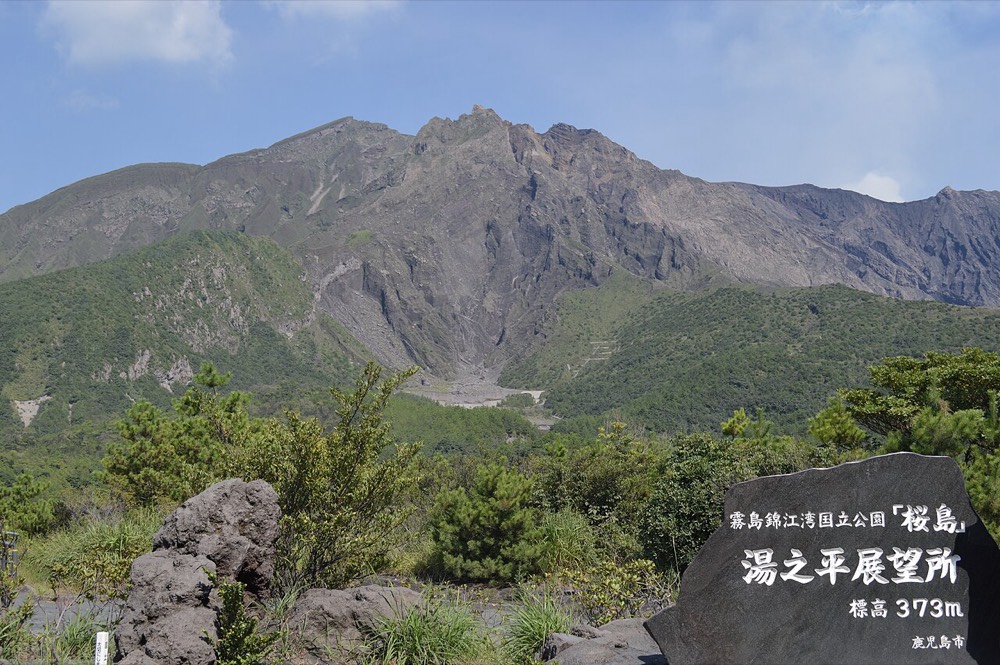
Yunohira Observatory sits at the fourth station of Kitadake at about 373 m, the highest point on the island open to the public. You get a close look at the scarred slopes of Kitadake, and Kinko Bay and the city behind you. With more time, learn about the volcano's history at the Sakurajima Visitor Center near the port, then walk part of the coastal lava trail past black blocks of cooled lava.
You can also drive or cycle around the island, but some roads get slippery after ashfall, so ride slowly.
Shiroyama, Sengan-en and Tenmonkan: planning the city sights
The theme in the city is seeing Sakurajima from different angles.
Shiroyama Observatory: the classic Sakurajima view
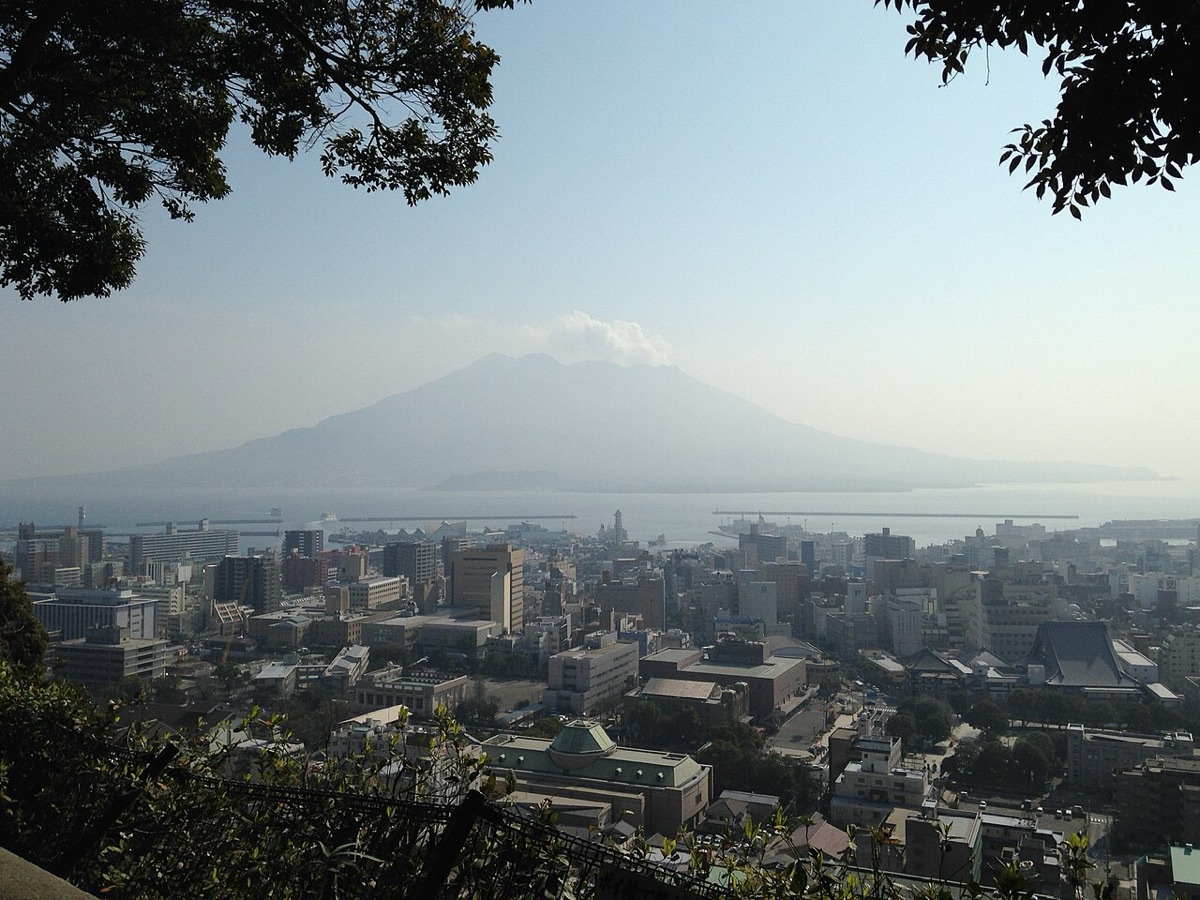
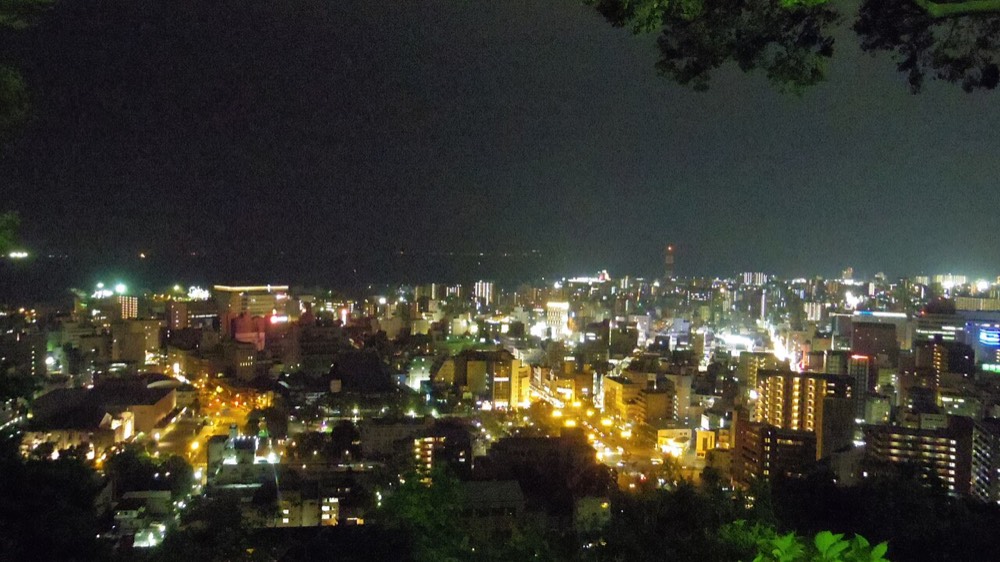
Shiroyama is a hill of about 107 m right next to downtown. Its observatory fits the city, Kinko Bay and Sakurajima into one frame; this guide's main photo was taken around here. Late afternoon or a clear winter morning is best. It is about a 20–30 minute walk up from the Tenmonkan area, or take the sightseeing loop bus to near the top.
Sengan-en: the Satsuma lords' seaside garden
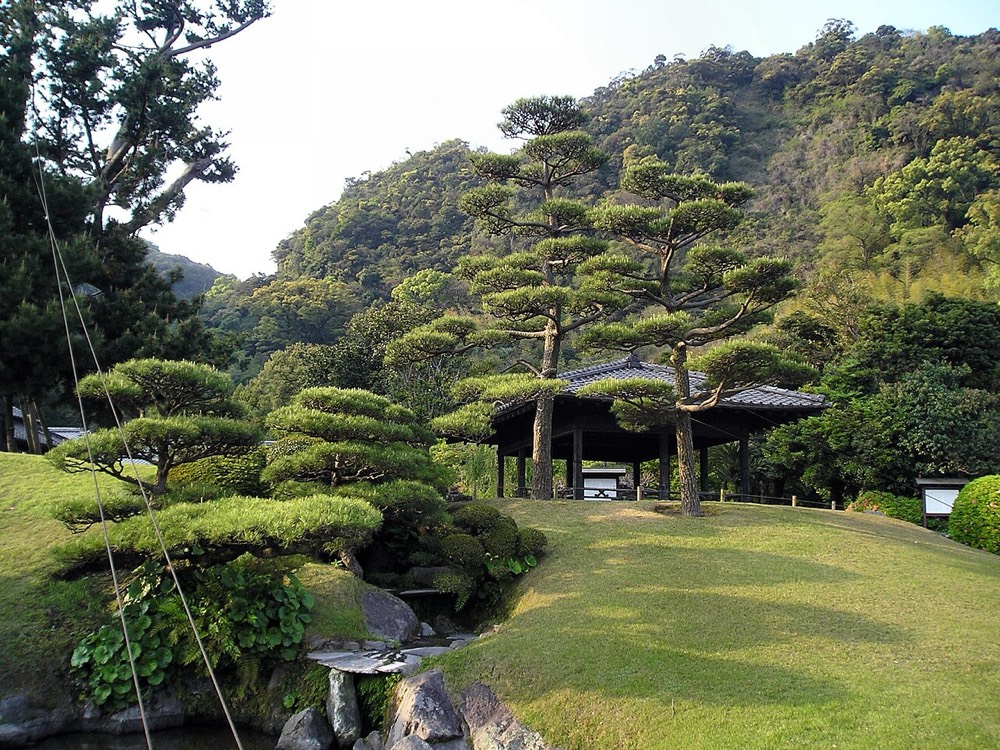
Sengan-en was a villa garden of the Shimazu family that borrows Sakurajima and Kinko Bay as its scenery, and it is a nationally designated Place of Scenic Beauty. Admission includes the residence and the Shoko Shuseikan museum: 1,600 yen for general visitors (15 and over) and 800 yen for elementary, junior high and high school students. It is open 9:00–17:00 (last entry 16:30) every day of the year[8].
There are coin lockers in front of the entrance, at 500, 400 and 300 yen for large, medium and small, payable by transit IC card; bags that do not fit can be left at reception for 500 yen each[8]. Parking for a standard car is 500 yen per day.
Tenmonkan: food, shopping and Shirokuma shaved ice
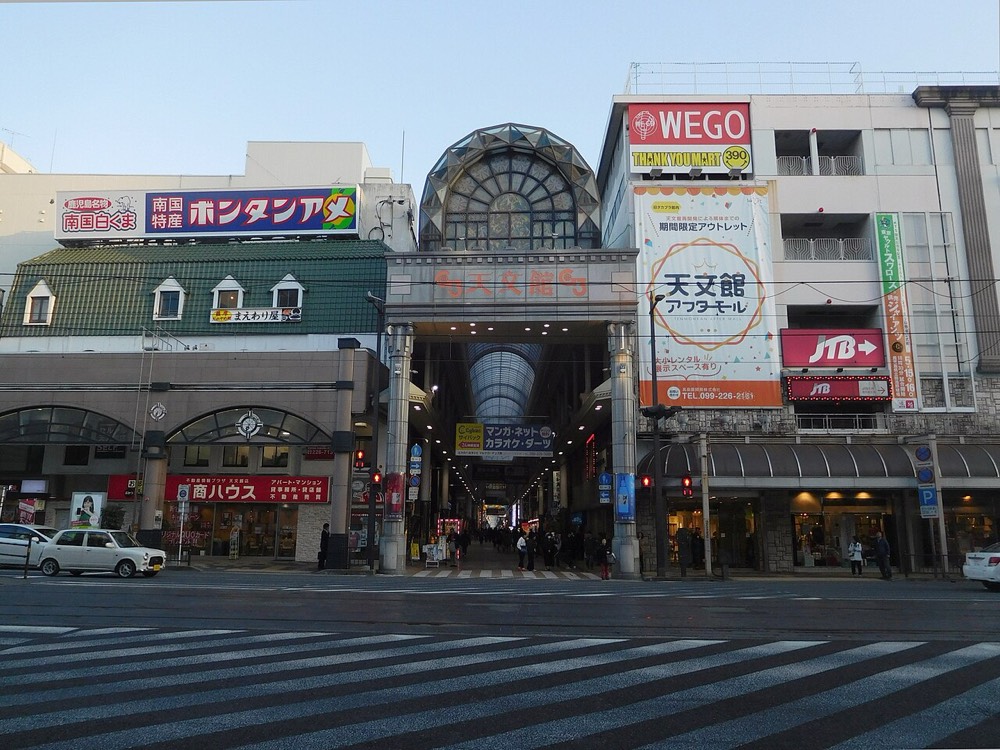
Tenmonkan is Kagoshima's liveliest shopping and dining district, right by the Tenmonkan-dori tram stop. Its famous dessert is Shirokuma, shaved ice topped with condensed milk, fruit and sweet beans that looks like a polar bear's face from above; it was created at Mujyaki in Tenmonkan. Check the shop's own notices for current prices and hours. For dinner, look for Kurobuta pork shabu-shabu, satsuma-age fish cakes or a shochu izakaya.
Kagoshima transport: trams, the CUTE pass and the Kyushu Shinkansen
Kagoshima's trams reach most city sights. From 1 August 2026, a single ride costs 200 yen for adults and 100 yen for children[6]. If you will ride the tram three or more times a day and also take the ferry and loop bus, consider the CUTE pass.
| Ticket | Adult | Child | Covers |
|---|---|---|---|
| CUTE 1-day | 1,400 yen | 700 yen | City trams, city buses, sightseeing loop bus, Sakurajima loop bus, Sakurajima Ferry |
| CUTE 2-day | 2,100 yen | 1,050 yen | Same, for 2 consecutive days |
CUTE prices rose on 1 August 2026, so the 1,200 or 1,300 yen figures in older articles no longer apply[5]. It is now mainly a digital ticket sold in the Kyushu MaaS app "my route", with paper tickets at designated counters; digital tickets cannot be changed or refunded after purchase, and you need an internet connection to use them[5]. CUTE also includes discounts at city tourist facilities.
Kyushu Shinkansen: coming south from Fukuoka or Kumamoto
The fastest way from Hakata or Kumamoto to Kagoshima-Chuo is the Kyushu Shinkansen. After the 28 July 2026 Kumamoto earthquake, the line was suspended, then resumed full service on 18 September, but with about 90% of the normal number of trains and a speed limit on a roughly 10 km section near Shin-Yatsushiro, making Hakata to Kagoshima-Chuo up to about 8 minutes longer than usual[12]. In mid-October it was briefly suspended for a day due to an equipment problem, so check JR Kyushu's service information before you travel. To combine Kagoshima with Kumamoto, see our Kumamoto and Aso guide.
How to get to the Ibusuki sand baths: Saraku and the Ibusuki no Tamatebako
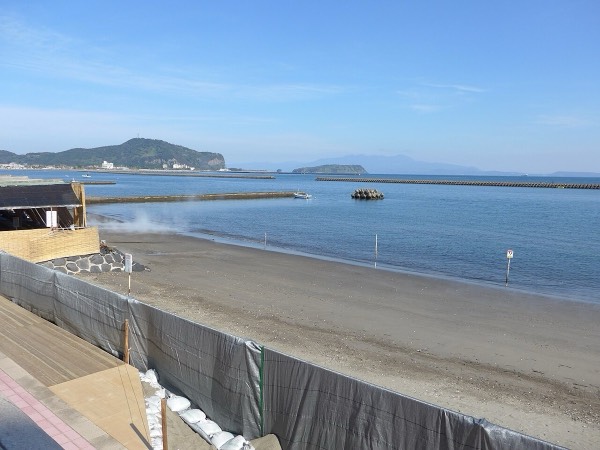
Ibusuki, at the southern tip of the Satsuma Peninsula, is known for its seaside sand baths: hot springs heat the black sand to about 50–55°C, and after you change into a yukata and lie down, staff shovel sand over you until only your head shows, for around 10 minutes[9].
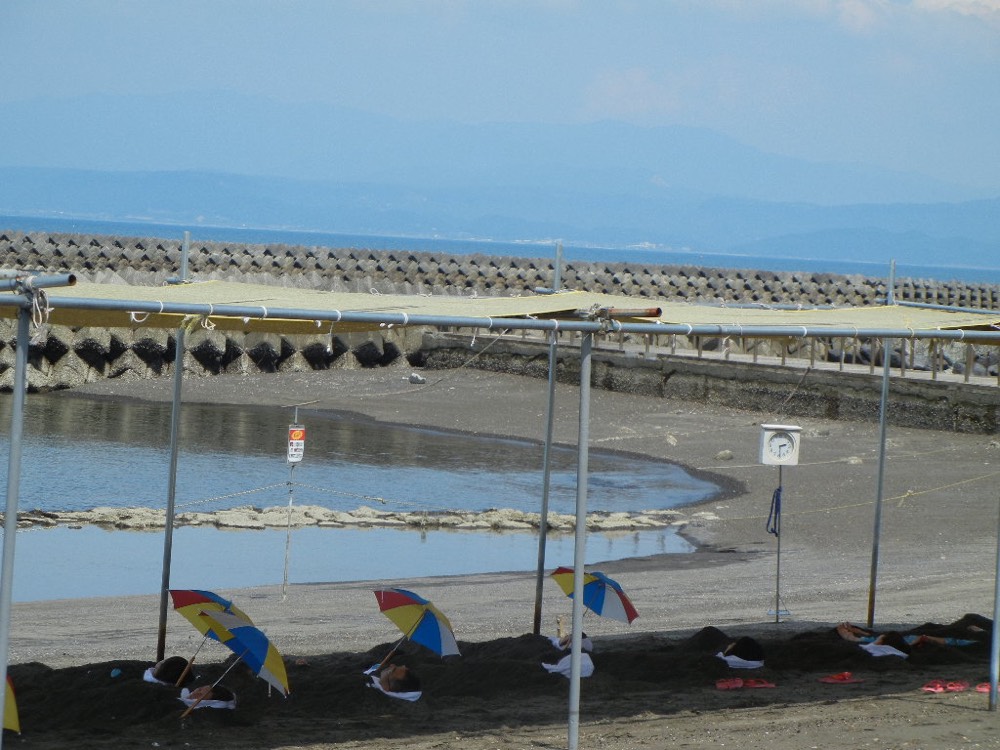
The most popular spot is the Saraku Sand Bath Hall. According to its listing, a sand bath with yukata costs 1,500 yen for adults and 800 yen for elementary school age and under; indoor hot spring only is 800 yen for adults; face towels and bath towels are 300 yen each. It is open 8:30–12:00 and 13:00–20:00 on weekdays and 8:30–20:00 on weekends and holidays, closing at 21:00, with separate prices during special periods[10]. From JR Ibusuki Station, take a bus toward Yamagawa for about 5 minutes and get off at Sunamushi Kaikan-mae[10]. Prices and hours can change, so confirm with Saraku before you go.
Ibusuki no Tamatebako: the black-and-white sightseeing train
From Kagoshima-Chuo to Ibusuki you can ride the Limited Express Ibusuki no Tamatebako ("Ibutama"), painted black on one side and white on the other, which releases a puff of mist when the doors open, a nod to the Urashima Taro legend of the treasure box. The trip takes about 51–53 minutes, with 3 round trips on operating days; all seats are reserved and bookings open at 10:00 one month ahead. The adult one-way fare is 2,950 yen, including the limited express fee, which varies by date[11]. It does not run every day; see JR Kyushu's operating calendar, and operating days from March 2027 are due to be announced around mid-January 2027[11]. If you miss it, local and rapid trains also run, just more slowly.
Kagoshima in winter: how to enjoy it
Winter has real advantages in Kagoshima: it is milder than northern Kyushu, the air is clearer, and you get more days with a sharp view of Sakurajima than in hazy summer; sand baths and onsen feel especially good in the cold; and winter is generally thought to bring less ash to the city. The downside is early sunsets, with light fading from a little after 4 p.m., so schedule Sakurajima and Shiroyama for the morning to midday.
If you are travelling in autumn, Kyushu's leaves usually peak from mid to late November; plan with our Kyushu autumn leaves 2026 guide. For another night in an onsen, head north to Kurokawa Onsen. For more destinations, see our Kyushu travel overview.
Before you go
- The Sakurajima Ferry no longer runs 24 hours; there are no sailings from midnight through the 3 a.m. hour, so check the last boat if returning at night.
- Check the JMA's Sakurajima volcano information and ashfall forecast the day before, and keep a mask and glasses in your bag.
- Tram fares and the CUTE pass both went up in August 2026, so prices in guidebooks or old web pages may be outdated.
- The Ibusuki no Tamatebako does not run daily and is all reserved, so book as soon as your dates are fixed.
- The Kyushu Shinkansen is running about 90% of its normal trains, so allow extra time for connections.
FAQ
How much is the Sakurajima Ferry, and do I need a ticket in advance?
250 yen one way for adults and 130 yen for children (age 1 to elementary school); each adult can bring one preschool child free. Foot passengers leaving Kagoshima Port do not buy a ticket first: you pay at the gate after landing at Sakurajima Port, by cash, credit card or transit IC cards such as Suica. Boats run frequently and need no reservation.
Does the Sakurajima Ferry still run 24 hours?
No. Since 1 October 2025, the Kagoshima City Ship Bureau has suspended sailings from midnight through the 3 a.m. hour, and both terminals and toll booths close after the last boat. There are about 94 sailings on weekdays and 104 on weekends and holidays, so check the last departure if you plan to return from Sakurajima in the evening.
Is it safe to visit Sakurajima right now?
Yes. As of 23 October 2026, the Japan Meteorological Agency keeps Sakurajima at eruption alert level 3 (entry restricted), covering roughly 2 km around the Minamidake summit crater and Showa crater, which is off-limits to the public anyway. Yunohira Observatory, the Sakurajima Visitor Center and the lava coast trails are outside that zone. Just check the JMA's latest volcano information before you go.
What should I bring for volcanic ash in Kagoshima?
Bring a face mask, glasses or sunglasses (ash easily gets under contact lenses), a compact umbrella or hooded jacket, and a cloth for your camera lens. Ashfall follows the wind, and the JMA publishes an ashfall forecast the day before. Ash shows up on clothes; pat it off, and do not rub your lens hard with wet wipes.
How much is the Ibusuki sand bath, and how long does it take?
At the Saraku Sand Bath Hall, a sand bath with yukata costs 1,500 yen for adults and 800 yen for elementary school age and under; indoor hot spring only is 800 yen for adults, and towels cost extra. The black sand is heated to about 50–55°C and you stay buried for around 10 minutes, then shower and soak. Allow about an hour in total.
Is Kagoshima worth visiting in winter?
Yes. Winters are milder than in northern Kyushu, the air is clearer, and Sakurajima's outline is often especially sharp from Shiroyama or the ferry; sand baths and onsen feel even better in the cold. Winter northwesterly winds generally carry ash toward the southeast of Sakurajima, so the city usually gets less ash than in summer, though the daily forecast is what counts.
Sources
- Japan Meteorological Agency: Sakurajima activity status: Alert level 3 (entry restricted) continuing and the roughly 2 km warning zone (commentary of 23 October 2026)
- Kagoshima City Ship Bureau: Review of 24-hour Sakurajima Ferry service: No sailings from midnight through the 3 a.m. hour from 1 October 2025; terminals close after the last boat
- Kagoshima City Ship Bureau: Sakurajima Ferry fares: Passenger fares and accepted credit and transit IC cards
- Kagoshima City Ship Bureau: Sakurajima Ferry timetable: About 15 minutes per crossing; 94 weekday and 104 weekend/holiday sailings
- Kagoshima City Ship Bureau: CUTE digital ticket: CUTE 1-day and 2-day prices from 1 August 2026 and covered transport
- Kagoshima City Transportation Bureau: Tram fares: Regular tram fare from 1 August 2026
- Kagoshima City: Sakurajima Island View loop bus: Daily runs, about 60 minutes per loop, fares and day pass
- Sengan-en: Visitor information: Opening hours, admission, lockers and parking
- Visit Kyushu: Ibusuki Onsen: Sand bath temperature and how it works
- Jorudan: Saraku Sand Bath Hall: Saraku prices, hours and access (listing updated March 2026)
- JR Kyushu: Limited Express Ibusuki no Tamatebako: Journey time, number of trains, all-reserved seating, fare and operating calendar
- Kumamoto Nichinichi Shimbun: Kyushu Shinkansen resumes full service after 52 days: Full Kyushu Shinkansen service and speed restrictions after the 2026 Kumamoto earthquake
- Visit Kyushu: Kagoshima: Overview of Kagoshima's main sights
Fares, opening hours and event dates can change. Information checked on 2026.10.24; please confirm with official sources before you go.