Tadami Line in Winter: Timetable, Routes from Aizu-Wakamatsu and the First Bridge Viewpoint
Riding the JR Tadami Line in winter: November 2026 timetable (3 through trains a day), day trips from Tokyo with fares, the First Bridge viewpoint and snow risks.
Quick answer
The Tadami Line is a JR East rural line linking Aizu-Wakamatsu in Fukushima with Koide in Niigata, about 135 km long and fully reopened in October 2022. Under JR East's November 2026 timetable there are only three through trains each way per day (leaving Aizu-Wakamatsu at 6:08, 13:05 and 17:00), taking about 4 h 15 min to 4 h 42 min for 2,750 yen. For winter scenery, take the early train; heavy snow can suspend the Aizu-Kawaguchi to Tadami section for long periods.
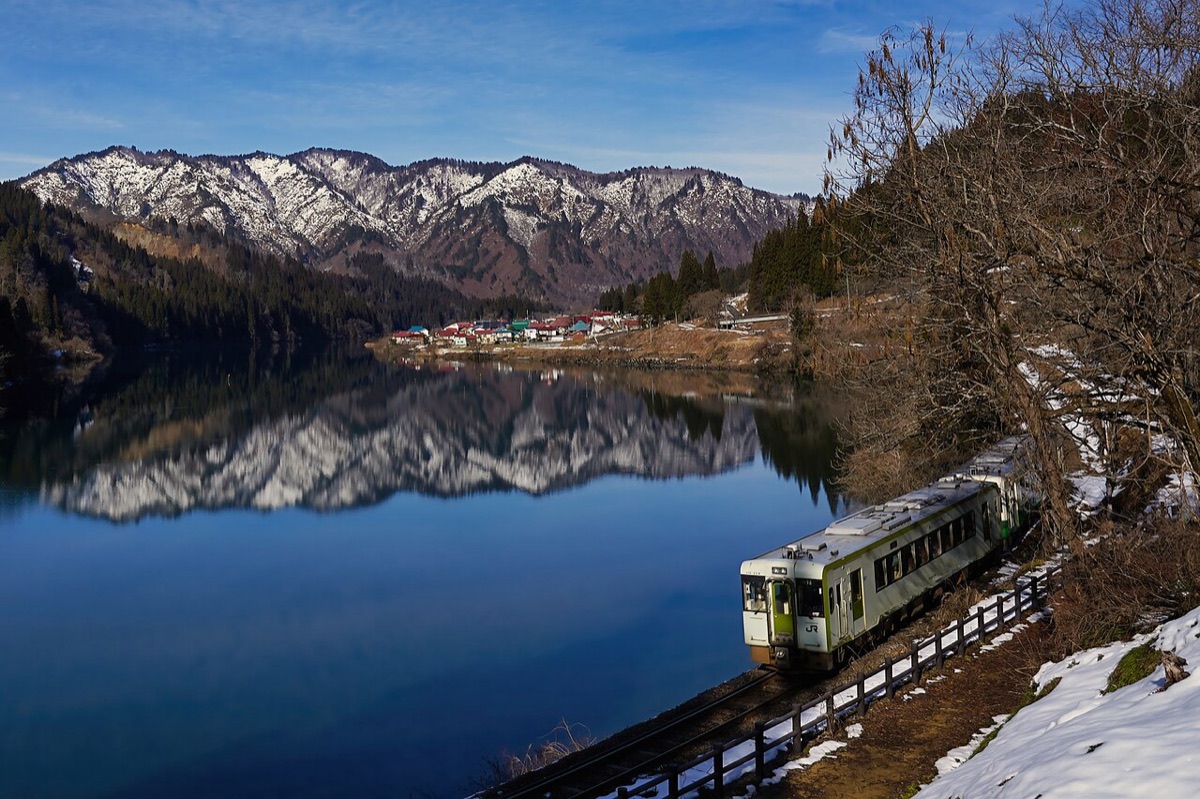
The biggest draw of the Tadami Line in winter is the sight of a diesel train running along the half-frozen Tadami River and through two-metre snow walls. It is also one of the least frequent JR lines in Japan: only three through trains run each way per day, so missing one can cost you most of the day. Using JR East's actual November 2026 timetable, this guide covers how to ride the Tadami Line in winter, three ways to plan it from Tokyo with fares, how to reach the First Tadami River Bridge viewpoint in snow, and what to do if heavy snow stops the trains.
What is the Tadami Line? 3 things to know before riding in winter
The Tadami Line (Tadami-sen) is a JR East rural line that runs from Aizu-Wakamatsu Station in Fukushima Prefecture through Aizu-Kawaguchi and Tadami, then over the Rokujurigoe mountains to Koide Station in Niigata Prefecture, a distance of about 135 km. After heavy rain in 2011 washed away bridges, the section between Aizu-Kawaguchi and Tadami was closed for 11 years. The whole line reopened in October 2022.
Before you ride in winter, remember these three things:
- Very few trains: The Aizu-Kawaguchi to Tadami section has only three trains each way per day. Your plans must fit the trains, not the other way round[1][2].
- Early sunset: From December to January, it gets dark around 4:30 pm in the Aizu area. To see the full snow scenery, take an early train or one that leaves before noon.
- Heavy snow stops trains: After the February 2025 snowstorm, the Aizu-Kawaguchi to Tadami section was closed for more than three months[5]. Always have a backup plan for winter trips.
All trains are local trains with unreserved seating, so there are no seat reservations; just board with a ticket or rail pass. Most stations along the line are unstaffed, so it is best to buy a paper ticket at Aizu-Wakamatsu or Koide Station beforehand, and you can ask station staff how to pay on board.
Tadami Line timetable: only 3 through trains a day
In short: through trains from Aizu-Wakamatsu to Koide leave at 6:08, 13:05 and 17:00; from Koide to Aizu-Wakamatsu they leave at 5:36, 13:12 and 16:12. A one-way trip takes about 4 h 15 min to 4 h 42 min[1][2]. The tables below are based on JR East's November 2026 timetable, and the times are the same on weekdays and weekends.
Outbound: Aizu-Wakamatsu → Koide
| Aizu-Wakamatsu | Aizu-Yanaizu | Aizu-Miyashita | Aizu-Kawaguchi | Tadami | Koide |
|---|---|---|---|---|---|
| 6:08 | 7:04 | 7:38 | arr 8:05 / dep 8:15 | arr 9:07 / dep 9:30 | 10:41 |
| 13:05 | 14:05 | 14:30 | arr 14:58 / dep 15:29 | arr 16:21 / dep 16:31 | 17:47 |
| 17:00 | 17:58 | 18:22 | arr 18:50 / dep 19:01 | arr 19:53 / dep 20:03 | 21:17 |
Inbound: Koide → Aizu-Wakamatsu
| Koide | Tadami | Aizu-Kawaguchi | Aizu-Miyashita | Aizu-Yanaizu | Aizu-Wakamatsu |
|---|---|---|---|---|---|
| 5:36 | arr 7:01 / dep 7:11 | arr 8:02 / dep 8:41 | 9:15 | 9:38 | 10:32 |
| 13:12 | arr 14:25 / dep 14:35 | arr 15:25 / dep 15:35 | 16:03 | 16:27 | 17:24 |
| 16:12 | arr 17:30 / dep 18:01 | arr 18:53 / dep 19:08 | 19:36 | 20:00 | 20:55 |
Besides the through trains, there are extra short-run trains between Aizu-Wakamatsu and Aizu-Kawaguchi (for example the train leaving Aizu-Wakamatsu at 7:41 and reaching Aizu-Kawaguchi at 9:43). On the Niigata side, some trains run only between Koide and Oshirakawa, and a few of these run on weekdays only[1][2]. Through trains wait 10 to 40 minutes at Aizu-Kawaguchi and Tadami, so you can get off to take photos or use the toilet, but keep an eye on the departure time.
How to plan it from Tokyo: 3 Tadami Line day-trip routes
In short: the simplest plan is Tokyo to Koriyama to Aizu-Wakamatsu, the 13:05 Tadami Line train to Koide, then back to Tokyo on the Joetsu Shinkansen via Urasa. To see the most snow scenery, stay in Aizu-Wakamatsu the night before and take the 6:08 first train[1][4]. All times below come from the November 2026 timetable and Yahoo! Transit searches, and the connections have been checked.
Route A: same-day return from Tokyo (in via Fukushima, out via Niigata)
- Take the Tohoku Shinkansen Yamabiko 55 from Tokyo at 9:40, arriving at Koriyama at 10:59.
- Change at Koriyama to the 11:15 Ban'etsu West Line local train, arriving at Aizu-Wakamatsu at 12:31 (this train also runs on weekends).
- Board the 13:05 Tadami Line train. After Aizu-Yanaizu around 14:05 the line follows the Tadami River, and the most beautiful stretch is around Aizu-Kawaguchi at about 15:00.
- Arrive at Koide at 17:47, then take the 18:32 Joetsu Line train to Urasa (arriving 18:41).
- Take the Joetsu Shinkansen Toki 338 from Urasa at 18:53, arriving in Tokyo at 20:12.
Downside: it gets dark around 4:30 pm in December, so you will see almost nothing of the Rokujurigoe mountains after Tadami. This suits people who just want to ride the line once and are short on time.
Route B: stay in Aizu-Wakamatsu and take the 6:08 first train (best snow scenery)
- Board the first train at Aizu-Wakamatsu at 6:08. Sunrise is roughly between 6:30 and 7:00, and snowfields appear after Aizu-Bange.
- Aizu-Yanaizu at 7:04 and Aizu-Miyashita at 7:38, followed by the Tadami River and a series of bridges.
- The train stops at Tadami for 23 minutes (9:07 to 9:30), then crosses Rokujurigoe, so the snowiest section is ridden in daylight.
- Arrive at Koide at 10:41, take the 11:10 Joetsu Line train to Urasa, then the Toki 318 at 11:59, arriving in Tokyo at 13:28.
The whole trip is in daylight, making this the most recommended way to ride in winter. It also leaves your afternoon free to return to Tokyo or continue around Niigata.
Route C: in via Niigata, out via Fukushima (reverse direction)
- Take the Joetsu Shinkansen Toki 67 from Tokyo at 10:56, arriving at Urasa at 12:20.
- Change to the 12:47 Joetsu Line train, arriving at Koide at 12:56.
- Board the 13:12 Tadami Line train, reaching Tadami at 14:25, Aizu-Kawaguchi at 15:25 and Aizu-Wakamatsu at 17:24.
- Take the 17:30 Rapid Aizu 6 from Aizu-Wakamatsu to Koriyama (arriving 18:36; this is only a 6-minute connection, so if you miss it take the 18:18 local), then the Tohoku Shinkansen back to Tokyo (for example leaving 19:00 and arriving 20:44).
The advantage of this plan is that you cross the Rokujurigoe mountains and the Tadami area in daylight, while the lower Tadami River is seen at dusk.
How much does the Tadami Line cost? Separate tickets vs rail pass
In short: the Tadami Line from Aizu-Wakamatsu to Koide costs 2,750 yen one way. A loop from Tokyo with separate tickets (unreserved Shinkansen seats) comes to about 19,800 yen[4]. The Tadami Line is a JR East line, so the JR EAST PASS also covers it[7].
| Section | Fare (unreserved) | Notes |
|---|---|---|
| Tokyo → Koriyama → Aizu-Wakamatsu | 9,130 yen (fare 5,390 + Shinkansen express fee 3,740) | Tohoku Shinkansen + Ban'etsu West Line |
| Aizu-Wakamatsu → Koide (Tadami Line) | 2,750 yen | Local trains only, no express fee |
| Koide → Urasa → Tokyo | 7,920 yen (fare 4,180 + Shinkansen express fee 3,740) | Joetsu Line + Joetsu Shinkansen |
| Total | About 19,800 yen | Reserved Shinkansen seats add a few hundred yen per leg |
| JR EAST PASS 5-day | 35,000 yen | 5 consecutive days, all JR East lines |
Fare source: Yahoo! Transit, searched section by section for Wednesday 9 December 2026[4]. Buying a single ticket for the whole loop may come out slightly cheaper than separate tickets, so ask at a JR ticket office.
Buying a 5-day pass just for a Tadami Line day trip does not pay off. It only makes sense if the same trip includes Yamagata, Sendai or Aomori, or if you plan to visit Ginzan Onsen in winter. For the pass's coverage, purchase and seat reservations, see the JR East Pass Tohoku and JR EAST PASS guide; for reserving Shinkansen seats, see the Shinkansen booking guide. Residents of Japan and other eligible travellers can also ride the Tadami Line with the Seishun 18 Kippu; see the Seishun 18 winter 2026 guide for the rules.
Which side should you sit on to see the Tadami River? Window and photo tips
In short: travelling from Aizu-Wakamatsu towards Koide, the Tadami River appears mostly on the right-hand side after Aizu-Bange, but the line crosses it many times so it switches sides. From Koide it is roughly the opposite[9].
- Best section: Aizu-Yanaizu to Aizu-Kawaguchi, about an hour, with a wide river and many bridges. This is the finest winter window view.
- First Tadami River Bridge: It lies between Aizu-Hinohara and Aizu-Nishikata stations. You cannot see the bridge itself from the train; for the classic shot of a train crossing it, go to the viewpoint described in the next section.
- Queue early at the start: Trains are busy on weekends and holidays. For a window seat, arrive on the platform at Aizu-Wakamatsu or Koide at least 20 to 30 minutes early.
- Windows fog up in winter: Bring a small towel to wipe the glass, and hold your lens close to the window to reduce reflections from inside the car.
How to reach the First Tadami River Bridge viewpoint in winter
In short: the viewpoint trail starts beside the Michi-no-Eki Oze Kaido Mishima-juku roadside station in Mishima Town. It is about 3.5 km and 45 minutes on foot from Aizu-Miyashita Station, so a taxi is recommended in winter. During the snow season you can usually only reach the lowest viewpoint, and the trail may close temporarily in heavy snow[3][8].
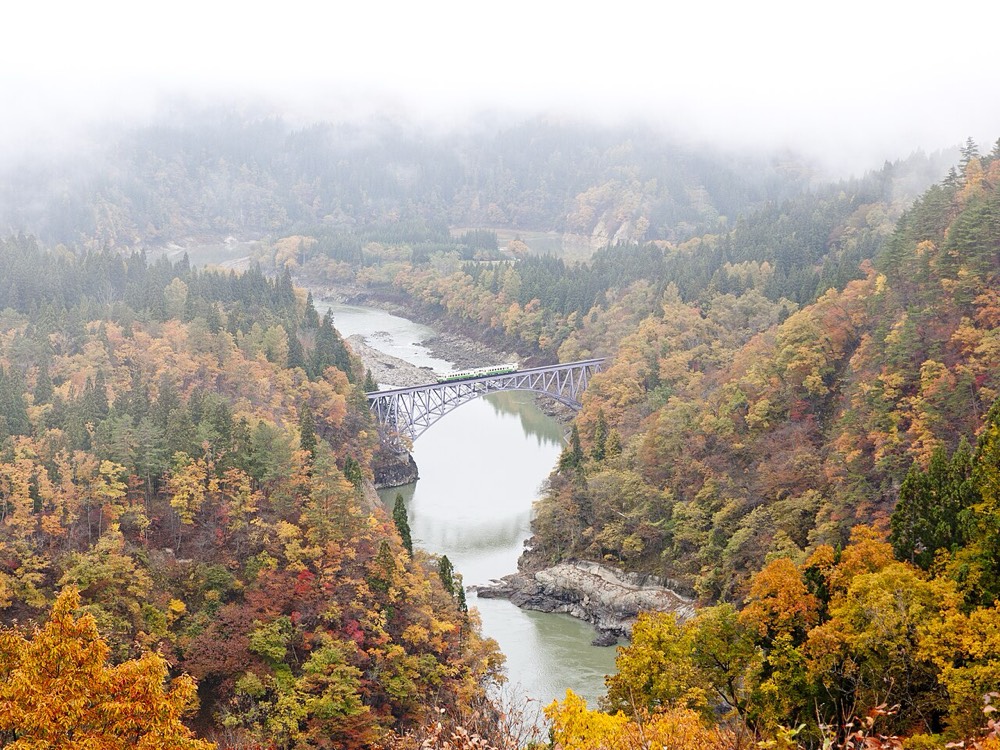
According to the official Tadami Line portal, the trail beside the roadside station climbs a ridge past three viewpoints, the top one about 10 minutes up, and sturdy shoes are recommended[3]. In winter the trail is covered in snow, and most photography guides advise going only as far as the first viewpoint. The slope can be icy, so wear snow boots with good grip and add crampons if needed; ordinary trainers are not suitable.
Getting there (based on the official site; confirm winter details with the Mishima Town Tourism Association first)[3]:
- Taxi: Yanaizu Taxi (0241-42-2120) reaches Aizu-Miyashita Station about 20 minutes after you call. This is the most reliable option in winter.
- Town bus: Leaves Aizu-Miyashita Station at 8:10 and takes about 5 minutes to the roadside station. The two return buses, at 10:20 and 13:20, must be booked in advance (by 9:00 and 12:00 respectively). One way is 500 yen for adults. No service on Sundays, public holidays or over the New Year.
- Walking: About 45 minutes, but mostly along the national road. In winter the shoulders are piled with snow and visibility is poor, so it is not recommended.
- Bike rental: Only available from April to late November, not in winter.
A half-day plan including the viewpoint
Stay in Aizu-Wakamatsu the night before, take the 7:41 short-run train, arrive at Aizu-Miyashita at 9:15 and take a taxi to the roadside station. Based on the timetable, the inbound train towards Aizu-Wakamatsu (leaving Aizu-Miyashita at 12:57) should cross the First Bridge shortly after 13:00, and the outbound 13:05 through train from Aizu-Wakamatsu at around 14:20[1][2]. After watching the 13:00 train, return to Aizu-Miyashita and board that through train at 14:30 to continue to Tadami and Koide. There is a long wait; the roadside station is a place to rest and eat, but waiting outdoors in winter is cold, so bring heat packs and warm layers (the Hokkaido winter clothing guide follows the same principles).
Winter suspension risk on the Tadami Line and backup plans
In short: heavy snow often suspends parts of the Tadami Line in winter, especially the mountain section from Aizu-Kawaguchi through Tadami to Koide. Check the service status the day before and the morning of travel.
The heavy snow that began on 4 February 2025 brought snow depth at Kaneyama to 235 cm on 7 February, a record for the station[6]. JR East suspended the Aizu-Kawaguchi to Tadami section and planned to restore the full line only on 16 May 2025, running replacement buses in the meantime[5]. During heavy snow in February 2026, JR East also announced fee-free refunds for unused tickets covering the Aizu-Kawaguchi to Koide section[10].
How to prepare a backup:
- Check JR East's service status (the Tohoku and Niigata area pages on traininfo.jreast.co.jp).
- Do not schedule the Tadami Line for the day before your flight home. If it is suspended, there are frequent trains back to Tokyo from Aizu-Wakamatsu (Ban'etsu West Line + Tohoku Shinkansen) and from Koide (Joetsu Shinkansen).
- Switch to a lowland route if suspended: From Aizu-Wakamatsu to Koide you can take the Ban'etsu West Line via Niitsu, then the Shin'etsu Main Line and Joetsu Line. One example from Yahoo! Transit leaves Aizu-Wakamatsu at 14:33 and reaches Koide at 19:36 for 3,520 yen[4], though you will not see the Tadami River.
- Luggage forwarding: If you do not want to drag big suitcases through transfers, send them ahead to the next night's hotel; see the Japan luggage delivery guide.
Can you go without the train? Buses, rental cars and tours
- Highway bus: Highway buses run from Tokyo to Aizu-Wakamatsu. One example found on Yahoo! Transit costs about 5,100 yen one way and takes a little over 4 hours[4]. It is cheaper than the Shinkansen but only reaches Aizu-Wakamatsu, so you still need the train for the Tadami Line. Buses also run from Koriyama Station to Aizu-Wakamatsu (about 1,400 yen).
- Rental car: You can stop freely at viewpoints such as the First and Second Bridges. However, National Route 252 over Rokujurigoe between Tadami and Koide closes for winter from early November each year (from 4 November in 2025) until the following spring, so you cannot drive over to Niigata in winter. Snow is deep and roads are icy in the Aizu mountains, so this is not recommended without snow-driving experience. For snow-driving risks and techniques, see the Hokkaido winter driving guide.
- Tours and day trips: Japanese travel agencies and platforms such as KKday and Klook occasionally offer bus tours that combine a Tadami Line ride with the First Bridge viewpoint. They suit people who do not want to work out the timetable themselves. Content and prices vary widely, so check before booking whether the tour actually rides the Tadami Line, which section, and what happens if snow suspends the trains.
Where to stay along the Tadami Line
- Aizu-Wakamatsu: The widest choice of accommodation, with business hotels by the station and onsen ryokan at Higashiyama Onsen on the south-eastern edge of the city. If you are taking the 6:08 first train, staying by the station is easiest.
- Aizu-Yanaizu: A small onsen town on the Tadami River, home to the Fukuman Kokuzo Bosatsu Enzoji temple. Staying here lets you enjoy snow views by the river and board the train the next day.
- Hayato Onsen: The day-use onsen Tsurunoyu near Hayato Station. According to Japanese travel media, it is about 10 minutes on foot from Hayato Station, but the walking route is not always cleared of snow in winter and opening days have changed, so phone ahead before going.
- Tadami Town: With so few trains, staying a night lets you photograph Tadami Station and nearby villages in the snow in the morning or evening. Good for photographers.
- Niigata side (Koide, Urasa, Yuzawa): Convenient for the Joetsu Shinkansen from Koide, and you can combine it with a GALA Yuzawa ski day trip.
Who is the Tadami Line in winter for, and who should skip it?
Good for:
- Rail fans and anyone wanting to see one of Japan's most iconic snow-country railway lines
- People happy to spend most of a day on a local train and plan around the timetable
- Travellers who already hold a JR EAST PASS and are moving around Tohoku or Niigata, who can use the Tadami Line as both transport and sightseeing
Not ideal for:
- People on a tight schedule with only one day left before flying home (the suspension risk is too high)
- Families with young children or older travellers with limited mobility: there is no on-board catering, most intermediate stations are unstaffed with few shops nearby, and waiting on platforms in winter is cold
- People who want to walk a lot in the snow and see many sights: you can only get off at one or two places in a day
Final tips: how to make it run smoothly
Put the Tadami Line in the middle of a Tohoku or Niigata trip and leave a spare day on either side. If you can stay in Aizu-Wakamatsu, take the 6:08 first train so that the whole snowy route is in daylight. Buy food and drinks at Aizu-Wakamatsu or Koide beforehand, as stations along the line have almost no shops. Check the service status again the night before and the morning of travel, and if the line is suspended, switch to the Ban'etsu West Line and Joetsu Line instead of waiting it out.
FAQ
How many trains run on the Tadami Line each day?
Under JR East's November 2026 timetable, there are three through local trains each way between Aizu-Wakamatsu and Koide per day. Extra short-run trains operate between Aizu-Wakamatsu and Aizu-Kawaguchi, but the middle section from Aizu-Kawaguchi to Tadami only has those three, so missing one usually means a wait of five to six hours.
Can I do the Tadami Line as a day trip from Tokyo?
Yes. For example, take the Tohoku Shinkansen from Tokyo at 9:40 to Koriyama, change to the Ban'etsu West Line for Aizu-Wakamatsu, catch the 13:05 Tadami Line train to Koide (17:47), then ride via Urasa on the Joetsu Shinkansen back to Tokyo by 20:12. The downside is that it is dark by about 4:30 pm in December.
Does the Tadami Line stop running in winter?
It can. Snow in the mountains is very deep, and parts of the line are often suspended or delayed during heavy snow. After the February 2025 snowstorm, the Aizu-Kawaguchi to Tadami section stayed closed until mid-May. Check JR East's service status the day before and the morning of travel, and have a backup route.
Do I need a reservation or a seat ticket for the Tadami Line?
Regular trains are local trains with unreserved seating only, so you cannot and do not need to reserve; just board with a ticket or rail pass. On weekends and holidays you may have to stand for a while, so queue early on the platform if you want a river-side seat. Special sightseeing trains have their own rules.
Can I use the JR EAST PASS on the Tadami Line?
Yes, the Tadami Line is a JR East line covered by the JR EAST PASS. However, the 5-day pass costs 35,000 yen, so it is not worth buying just for a Tadami Line day trip. It pays off when you also travel to places like Ginzan Onsen, Zao or Aomori on consecutive days.
Sources
- JR East timetable: Tadami Line outbound (Aizu-Wakamatsu to Tadami to Koide): November 2026 weekday and weekend times (checked 17 November 2026)
- JR East timetable: Tadami Line inbound (Koide to Tadami to Aizu-Wakamatsu): November 2026 inbound times and weekday-only trains
- Tadami Line Portal (Fukushima Prefecture): Scenic spots: First Bridge viewpoint location, walking times, town bus and taxi, no bike rental in winter
- Yahoo! Transit (Japan): Searched for 9 December 2026: Aizu-Wakamatsu to Koide 2,750 yen, Tokyo to Aizu-Wakamatsu and Koide to Tokyo fares and connections
- JR East: Outlook for Tadami Line operations after heavy snow (13 May 2025): Aizu-Kawaguchi to Tadami suspended from 4 February 2025, full-line resumption planned for 16 May
- Fukushima Local Meteorological Office: February 2025 heavy snow report: Snow depth of 235 cm at Kaneyama and 121 cm at Wakamatsu on 7 February 2025
- JR East | JR EAST PASS: 5 days 35,000 yen, 10 days 50,000 yen
- Tohoku Tourism Promotion Organization: First Tadami River Bridge viewpoint: About 40 minutes on foot from Aizu-Miyashita Station; about 15 minutes' climb from the roadside station
- Toretabi: Tadami Line window views: Description of the Tadami River appearing on the right side around Aizu-Yanaizu
- JR East notice on Tadami Line ticket refunds due to heavy snow (February 2026): Fee-free refunds for unused tickets covering the Aizu-Kawaguchi to Koide section during heavy snow
Fares, opening hours and event dates can change. Information checked on 2026.11.17; please confirm with official sources before you go.