Japan Power Bank Flight Rules 2026: Two per Person, No In-Flight Charging, Wh Limits, Insulation and Disposal
Japan power bank rules changed on 24 April 2026: two per person, 160 Wh max, carry-on only, no charging on board. Wh conversion, taping, PSE and disposal.
Quick answer
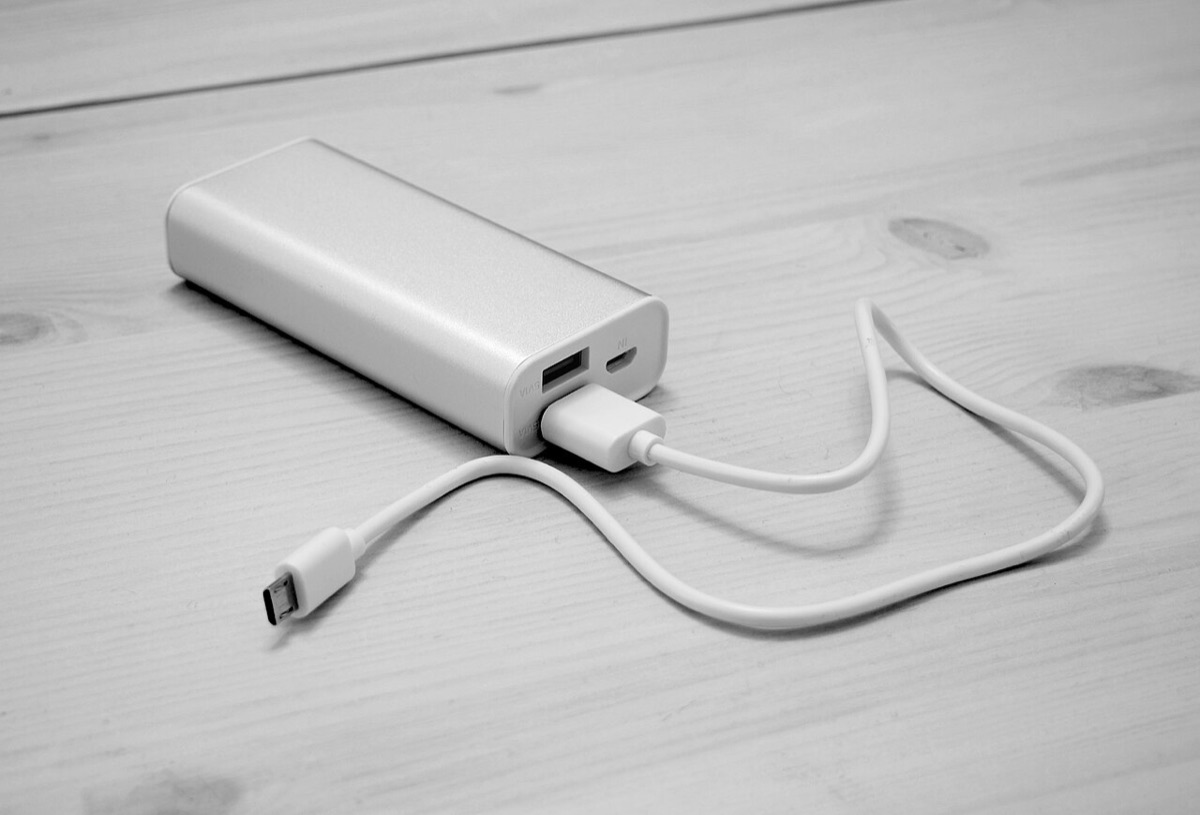
Japan's Ministry of Land, Infrastructure, Transport and Tourism introduced new power bank rules on 24 April 2026: a maximum of two per passenger, each 160 Wh or less, carry-on only and not in the overhead bin. You may not charge a power bank on board or use one to charge your phone. Wh = mAh × voltage ÷ 1,000, so 10,000 mAh at 3.7 V is 37 Wh and 20,000 mAh is 74 Wh. Spare camera batteries of 100 Wh or less do not count toward the two.
Japan's power bank flight rules changed on 24 April 2026, and the change is bigger than many travellers realise. Power banks of 100 Wh or less used to be unlimited in number. Now the limit is two per person whatever the capacity, and on board you may neither charge the power bank nor use it to charge your phone[1]. This guide turns the official Japanese text into comparison tables, then deals with the questions that come up when you actually pack: how to work out Wh, how much insulation is enough, whether camera batteries and earbud cases count, whether the rules differ at the other end of your trip, and what to do if a power bank fails while you are in Japan.
What are Japan's power bank rules now? The summary table
On flights departing Japanese airports, power banks go in carry-on baggage only, with a maximum of two per person at 160 Wh or less each, and on board they must stay out of the overhead bin and may not be charged or used for charging. Japan's Ministry of Land, Infrastructure, Transport and Tourism (MLIT) set this standard after the International Civil Aviation Organization (ICAO) approved an emergency amendment on 27 March 2026. It was announced on 14 April and applies from 24 April[1]. Security screening at Narita and other airports follows the same standard[5].
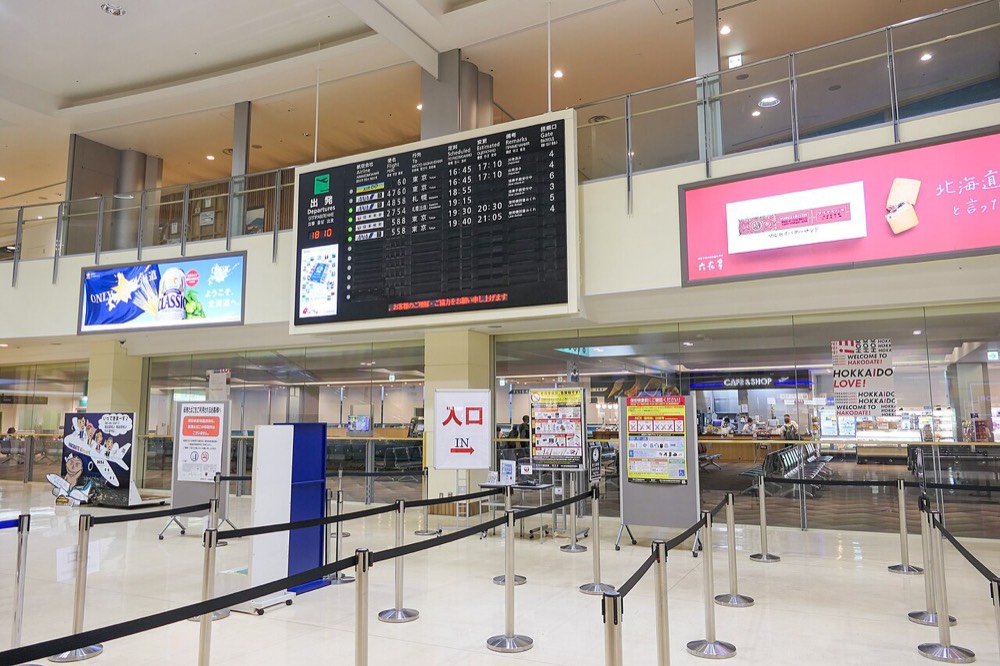
MLIT's notice to passengers lists seven points. The table below sorts them by when each began and whether a breach can be penalised[2]:
| Item | Current rule | Since when | May be penalised under the Civil Aeronautics Act |
|---|---|---|---|
| Checked baggage | Never allowed; always carry on | Existing rule | Yes |
| Capacity | 160 Wh or less each; larger units cannot be carried | Existing rule | Yes |
| Short-circuit prevention | Protect each unit individually (tape, pouch or case) | Existing rule | Yes |
| Number | Two per person, regardless of capacity | 24 April 2026 | Yes |
| Charging the power bank | No charging it from aircraft outlets or USB ports | 24 April 2026 | Yes |
| Charging a phone from the power bank | Do not use it; charge your phone from seat power | 24 April 2026 | Not listed among the penalised items |
| Storage | Not in the overhead bin; keep it in the seat pocket or within reach | Requested since 8 July 2025[6] | Not listed among the penalised items |
Two points are easy to misread. First, the "two" is each passenger's own allowance, and you cannot carry extras for a companion. Family members should each keep their own power banks in their own carry-on bag. Second, this is the minimum standard set by the Japanese government. MLIT states that airlines may set stricter rules, and on a foreign carrier you follow that airline's instructions[2].
Do camera batteries, laptops, earbuds and hair irons count toward the two?
No. The limit of two covers power banks only, meaning products with a built-in lithium battery whose purpose is to charge other devices. Spare camera batteries fall under a separate "spare battery" category, and laptops, phones and earbuds are "electronic devices", each with their own rules[2][4].
| Item | Carry-on | Checked | Number and conditions |
|---|---|---|---|
| Power bank | Yes | No | Two per person, 160 Wh or less each |
| Spare lithium batteries for cameras etc. (100 Wh or less) | Yes | No | No limit under MLIT rules; ANA allows up to 20 per person[4] |
| Spare lithium batteries (over 100 Wh, up to 160 Wh) | Yes | No | Up to two, counted together with large power banks (see below) |
| Phones, laptops, tablets, cameras, handheld game consoles | Yes | Yes | Battery 160 Wh or less; if checked, switch off completely (not sleep mode) and protect with clothing or a hard case; ANA allows up to 15 devices per person[4] |
| Wireless earbuds | Yes | Conditional | In checked baggage, lithium-ion battery of 2.7 Wh or less only[3] |
| Cordless (rechargeable) hair irons and heated brushes | Conditional | Conditional | The battery must be removable, or the product must have a "flight mode" that cuts the heating circuit; switching off or locking it is not enough. A removed battery is carry-on only[3] |
| Plug-in hair irons | Yes | Yes | No battery, no restriction |
The combinations for large batteries are less obvious. MLIT's diagram works like this[2]:
- Two power banks of 100 Wh or less: you may also carry up to two spare batteries in the "over 100 Wh, up to 160 Wh" class.
- One power bank of 100 Wh or less and one over 100 Wh: only one more spare battery in that large class.
- Two power banks over 100 Wh: no spare batteries in that large class.
- In every case, spare batteries of 100 Wh or less are unaffected.
A typical camera battery is only a dozen or so Wh and most laptop batteries are within 100 Wh, so for most travellers this section matters only if you carry large video camera batteries.
Handheld fans, heated clothing batteries and earbud charging cases are not named item by item in the official Japanese sources checked for this guide. By definition, a handheld fan with a built-in battery is an electronic device. A battery removed from heated clothing is a spare battery, and if it also has a USB output that can charge a phone, it fits the definition of a power bank, so count it toward your two. Put any item you are unsure about in your carry-on bag and confirm with your airline before you travel. That is the approach least likely to go wrong.
Converting mAh to Wh: what are 10,000 and 20,000 mAh?
The formula is mAh × voltage (V) ÷ 1,000 = Wh, and if Wh is already printed on the unit, use that figure[2]. The lithium cells inside a power bank are usually 3.6 to 3.7 V, and MLIT's own example uses 3.7 V: 27,000 mAh × 3.7 V ÷ 1,000 = 99.9 Wh.
| Labelled capacity (3.7 V) | Wh | Allowed? |
|---|---|---|
| 5,000 mAh | 18.5 Wh | Yes |
| 10,000 mAh | 37 Wh | Yes |
| 20,000 mAh | 74 Wh | Yes |
| 27,000 mAh | 99.9 Wh | Yes (just within 100 Wh) |
| About 43,000 mAh | About 160 Wh | The limit; anything above cannot be carried |
Note that the calculation uses the cell voltage, not the 5 V USB output. Some products print only the output rating on the back, and multiplying by 5 V overstates the Wh: 20,000 mAh becomes 100 Wh. That is still within 160 Wh, but an airline with extra requirements above 100 Wh may ask more questions.
No capacity printed, or the label has worn off
Narita Airport's guidance is to ask airline staff or security officers about lithium batteries with unknown Wh[5]. Government of Japan Public Relations Online suggests checking with the manufacturer in advance[3]. In practice, security staff can only judge by the markings on the unit, so an unreadable label carries the risk of being asked to give the item up. Turn your power bank over and check before you leave. An old unit whose print has worn away is best left at home.
Where does the insulation tape go? Three ways to prevent short circuits
Short-circuit prevention means keeping the battery's metal contacts from touching other metal (keys, coins, another battery) at the same time. It does not mean tape is compulsory. MLIT lists these methods: tape over the terminals, put the battery in a case or pouch, and do not put it in the same bag as other batteries or metal objects[2]. ANA's wording is similar: keep it in the original retail packaging, or cover exposed terminals with tape, or place each battery in its own plastic bag or protective pouch[4].
By battery type, the practical approach is:
- Ordinary power banks (USB ports only): the metal contacts are recessed, so put each unit in its own small cloth bag, zip bag or original sleeve. Do not stuff two power banks, cables and keys into one small pouch.
- Camera batteries, and batteries removed from heated clothing or hair irons: the contacts are exposed, so refit the supplied cap or use a battery case. Without a cap, stick a strip of insulation tape over the contacts and bag each one separately.
- Magnetic power banks or units with exposed metal contacts: tape over the contacts or use the original cover.
Ordinary electrical (insulation) tape is fine. If the battery will later go for recycling, Japan's collection body JBRC recommends transparent vinyl tape so staff can read the battery type and brand, and says not to use cellophane tape[14].
Are the rules the same at the other end? Taiwan, Hong Kong, South Korea and China
Since spring 2026, the main departure points in East Asia have followed ICAO and moved to two per person, but the start dates and details are not identical. The table lists only what could be confirmed from official announcements or a clearly identified source. For other countries, check your airline's notice directly.
| Departure point | Main rules | Effective date and source |
|---|---|---|
| Japan | Two per person, 160 Wh or less, no checked baggage, not in the overhead bin, no charging or use on board | 24 April 2026, MLIT[1] |
| Taiwan | Two per person, no checked baggage, no charging during flight; the Civil Aviation Administration also reminds passengers not to use power banks on board and to protect each one against short circuits | 8 April 2026, Civil Aviation Administration[7] |
| Hong Kong | Maximum of two per passenger on flights departing Hong Kong International Airport; recharging a power bank on board is strictly prohibited | Effective immediately on 28 March 2026, Civil Aviation Department[8] |
| South Korea | Two per person, 160 Wh or less each, no charging or use on board | 20 April 2026 (Korean media citing the transport ministry's announcement)[9] |
| China (domestic flights) | Besides capacity and number, power banks with no 3C mark, an unclear 3C mark, or from a recalled batch cannot be taken on domestic flights | 28 June 2025, Civil Aviation Administration of China[10] |
Two things matter in practice. First, pack for "two units, not used on board" in both directions and you will not be stopped at either end. Second, if your itinerary includes a domestic flight within China, a power bank bought in Japan usually has no 3C mark and may not be allowed on that leg, so check with the airline before you connect.
Within the limit of two: what size and how many?
One 10,000 mAh unit is enough for most people, with the second slot kept for heavy users or long travel days. Because power banks cannot be used on board, their job is limited to daytime sightseeing after you land, so you can size them by how many times a day you need to top up your phone.
- Ordinary sightseeing, charging at the hotel each night: one 10,000 mAh unit (37 Wh). It is light and tops up a phone once or twice during the day.
- All-day navigation, photos and video, or sharing a hotspot: one 20,000 mAh unit (74 Wh), or two 10,000 mAh units kept in different bags.
- Working on a laptop and powering it from a power bank: choose a model within 100 Wh (about 27,000 mAh). The rules allow up to 160 Wh, but some airlines have extra requirements for the range above 100 Wh, so check the airlines you fly most before buying.
- Families and groups: the allowance is two per person. Adults and children each carry their own; do not pool them in one person's bag.
- Lots of camera gear: spare camera batteries (100 Wh or less) do not use up the power bank allowance, but each one needs individual short-circuit protection.
Charge your phone fully before boarding and use the seat USB port or outlet in flight. On aircraft without seat power, download offline maps and save a screenshot of your boarding pass to reduce the risk of landing with a dead phone. For mobile data after you land, see the Japan eSIM guide. Other documents and apps to prepare are in the Japan trip checklist.
What is the PSE mark? Buying or renting a power bank in Japan
PSE is the mark required under Japan's Electrical Appliance and Material Safety Act. It governs power banks sold in Japan, not the one a traveller brings in. According to the Ministry of Economy, Trade and Industry (METI), power banks without a PSE mark have been barred from sale in Japan since 1 February 2019, and the obligation falls on manufacturers, importers and retailers. Power banks carry the round PSE mark on the outside of the unit, with the name of the notifying business beside it[11]. Japan's flight rules do not list PSE as a condition for carrying one.
Buying in Japan
Electronics chains, convenience stores and Don Quijote all sell power banks, and those sold through regular retailers carry the round PSE mark. Prices vary widely by brand and capacity, so go by the shelf price. Check two things when you buy: that the unit clearly shows Wh, or mAh and voltage (security will look on your way home), and that together with what you brought you still have no more than two. For Don Quijote's opening hours and tax-free procedure, see the Don Quijote shopping guide.
Renting: ChargeSPOT prices
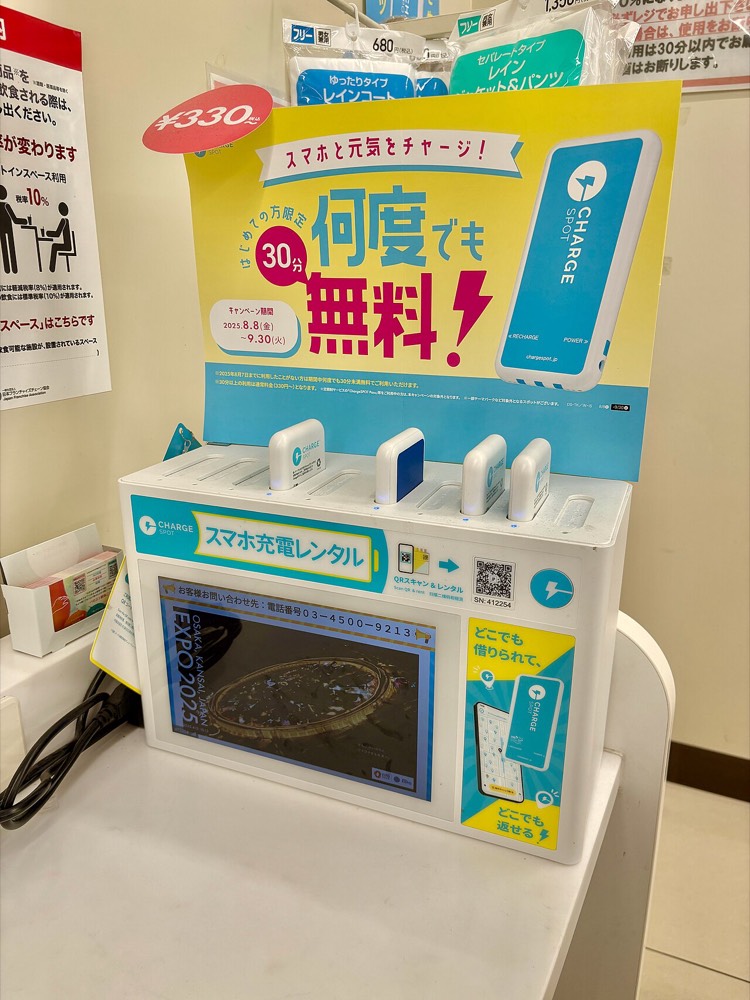
If you simply run out of power one day, renting is cheaper than buying and does not leave you with an extra power bank for the flight home. ChargeSPOT is Japan's largest power bank rental network. Its website gives 64,414 stands nationwide (September 2026), in convenience stores, stations, drugstores and elsewhere, and you can return a unit to any stand with a free slot[12].
| Rental time | Price |
|---|---|
| Under 30 minutes | 165 yen |
| 30 minutes to under 1 hour | 330 yen |
| 1 hour to under 3 hours | 430 yen |
| 3 hours to under 6 hours | 500 yen |
| 6 hours to under 12 hours | 570 yen |
| 12 hours to under 24 hours | 640 yen |
| Each further 24 hours | 360 yen more |
| Not returned after 120 hours | 4,080 yen in total (including a 2,000 yen penalty) |
These are the standard prices on the official website as of November 2026. Some stands have special pricing, so go by the price shown on screen when you rent. Loss or damage is also charged at 4,080 yen[12].
Renting requires the ChargeSPOT app, the LINE official account, or the mini apps inside PayPay, d-Barai or au PAY. The app accepts credit cards, Apple Pay and other methods. With a debit card, prepaid card or Apple Pay, a temporary hold is placed first, and after you return the unit only the actual fee is charged and the rest is released[12]. The website does not say case by case whether cards issued outside Japan can be registered, so download the app and try adding your card before you travel. Also remember that a rented ChargeSPOT unit is a power bank: return it before you fly out of Japan. Otherwise it uses up one of your two, and an overdue unit costs 4,080 yen.
Are there power bank rules on the Shinkansen and other trains?
There is no limit on number or capacity and the JR companies do not ban carrying them, but after incidents of power banks smoking and catching fire on board, Shinkansen trains gained new emergency equipment in 2026. JR Hokkaido, JR East, JR Central, JR West and JR Kyushu announced on 26 June 2026 that fire blankets would be placed in the deck area (vestibule) of every Shinkansen car, next to the fire extinguisher, with buckets kept in crew areas, to be completed by August. A 16-car Tokaido Shinkansen train carries 32 fire blankets and 4 buckets[13]. The procedure is to put out the fire with the extinguisher, cover the item with the blanket, and then submerge it in water to stop it reigniting.
What you can do on the train is simple:
- Do not leave a power bank at the bottom of a suitcase or wedged into a seat gap. Crushing is a common cause of fires.
- Keep it where you can see it while charging, not deep in a coat pocket or bag.
- If it gets hot, swells or smokes, stop using it at once, move away from your seat and tell the conductor. On the Shinkansen, the fire blanket is beside the extinguisher in the deck area.
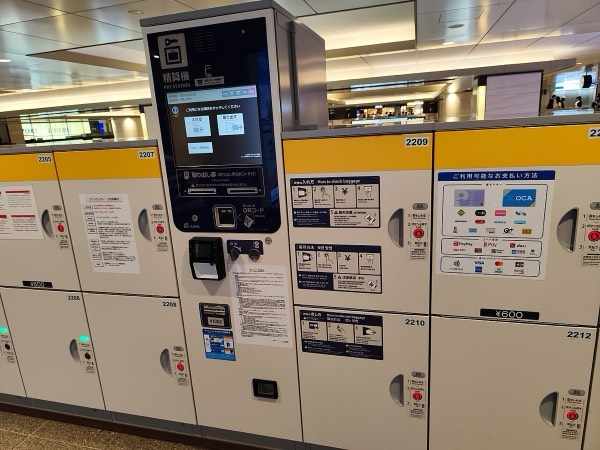
It is also best not to put power banks in luggage you send ahead or in a suitcase locked in a coin locker for a long time. If a courier uses air transport, power banks cannot be sent in the first place[15]. When you use luggage delivery in Japan or station coin lockers, keeping the power bank in your day bag is the simplest option. For tickets and oversized baggage rules, see the Shinkansen booking guide.
How do you dispose of a broken, swollen or unwanted power bank in Japan?
You cannot put it in a hotel room bin, a station bin or a street bin. Lithium batteries catch fire when compressed in collection trucks or crushed at processing plants, and every part of Japan requires them to be handled separately from general waste. A traveller's realistic options are limited and depend on the situation:
| Situation | What you can do | Notes |
|---|---|---|
| Works normally, you just do not want it | Take it home and recycle it under your local rules | It can fly as usual as long as you have no more than two |
| Made by a Japanese brand or a JBRC member company, and undamaged | Take it to a JBRC partner shop (electronics chains and others) and hand it to staff | Speak to staff first rather than dropping it into the box yourself; find locations with the JBRC partner shop search |
| Swollen, damaged, water-damaged, or made by a non-member company | Ask the manufacturer, the shop where you bought it, or the hotel front desk | JBRC does not accept it; do not take it on a plane either |
JBRC is the Japanese body that collects small rechargeable batteries. It has three conditions, all of which must be met: the product is made by a JBRC member company (unknown brands and non-members are not accepted), the battery type is clearly marked, and there is no damage, water exposure or swelling[14]. Power banks are collected whole, so do not open one to remove the cells. Before handing it over, insulate the metal terminals with transparent vinyl tape.
Municipal collection points (city office counters, waste management offices and so on) mainly serve local residents and the rules differ from place to place, so short-term visitors cannot always use them. An unbranded power bank bought overseas is usually not a JBRC member product either, and it is hard to find anywhere that will take it. The practical conclusion is to retire old power banks, or any with a bulging case, before you leave home, and not to bring one that is close to failing to Japan.
Things you must never do:
- Put it in a general waste bin, a convenience store bin or the bin in your hotel room.
- Puncture it, take it apart or try to "release the gas".
- Force a swollen power bank onto a plane in checked or carry-on baggage.
- Leave it in your hotel room and check out without telling anyone.
For a power bank that airport security will not allow, MLIT's instruction is to tell a nearby staff member[15]. There is no single published explanation of what each airport then does with surrendered items, so follow the instructions of staff on site.
Pre-departure checklist
Run through this once before each flight, out and back. It comes down to three things: number, labelling and location.
- The total number of power banks is two or fewer (including any bought in Japan and any rental not yet returned).
- Every unit shows Wh, or mAh and voltage, and the formula confirms it is 160 Wh or less.
- The case is not bulging, cracked, hot or smelly. If it is, do not bring it.
- Everything is in your carry-on, and you have checked the suitcase again for strays (old coat pockets and camera bag compartments are the usual culprits).
- Each unit is in its own bag or case, with tape over any exposed terminals. Treat spare camera batteries the same way.
- On board, keep them in the seat pocket or a small personal bag, not in the overhead bin.
- Charge your phone fully before boarding. If you need to charge in flight, use seat power and leave the power bank unplugged throughout.
- For cordless hair irons and heated brushes, confirm that the battery can be removed or that there is a flight mode. If not, leave it at home.
- When connecting or returning on a different airline, check each one's requirements for power banks above 100 Wh.
- If a power bank heats up, swells or smokes during the flight, tell the cabin crew immediately and do not deal with it yourself.
The rules are still changing. Japan's latest amendment came less than a year after the previous one (July 2025), and countries and airlines are still adjusting. Once your flights are booked, check your airline's baggage page again a week before departure. That is more reliable than memorising any table.
FAQ
How many power banks can I take on a flight to or from Japan?
On flights departing Japanese airports, the limit since 24 April 2026 is two per passenger, each 160 Wh or less, in carry-on baggage only. Flights departing Taiwan, Hong Kong and South Korea also moved to two per person in March and April 2026, so packing for a limit of two in both directions is the safe approach.
Can I bring a 20,000 mAh power bank to Japan?
Yes. At the usual 3.7 V, 20,000 mAh equals 74 Wh, well under the 160 Wh limit. A 27,000 mAh unit is about 99.9 Wh, still within 100 Wh. Anything above roughly 43,000 mAh exceeds 160 Wh and cannot be carried. A unit with no printed capacity, or a worn-off label, may not be allowed through security.
Can I use a power bank to charge my phone on the plane?
Japan's new rules ask passengers not to charge phones or other devices from a power bank on board, and they prohibit charging the power bank from the aircraft's outlets. Use the seat USB port or power outlet instead. On aircraft without seat power, charge your phone fully at the gate before boarding.
Do I have to put insulation tape on my power bank?
Tape is not mandatory. The requirement is that each battery is individually protected against short circuits. Japan's transport ministry lists three ways: tape over the terminals, put it in a case or pouch, or keep it out of a bag shared with other batteries or metal objects. A power bank with only recessed USB ports is fine in its own small pouch.
Can I bring a power bank without a PSE mark into Japan?
The PSE mark is a requirement for power banks sold in Japan and applies to manufacturers, importers and retailers. Japan's flight rules do not list PSE as a condition for passengers. A power bank for your own use only needs to meet the aviation rules: two units, 160 Wh or less, clearly labelled.
My power bank broke or swelled up in Japan. Can I throw it in the hotel bin?
No. Lithium batteries in ordinary rubbish can catch fire in collection trucks and processing plants. Japan's JBRC collection boxes only accept undamaged batteries made by member companies. Do not fly with a swollen power bank or discard it yourself; hand it to the hotel front desk or ask the shop or manufacturer how to dispose of it.
Sources
- MLIT: New rules for carrying mobile batteries on board (press release, 14 April 2026, in Japanese): Applies from 24 April; two per person; no charging on board; ICAO emergency amendment approved 27 March
- MLIT: Notice to passengers on carrying mobile batteries (press release attachment, in Japanese): The seven points, which ones carry penalties, the Wh formula, and how power banks combine with spare batteries
- Government of Japan Public Relations Online: Items you cannot take on aircraft (2026 edition, in Japanese): Carry-on and checked conditions for power banks, spare batteries, wireless earbuds and cordless hair irons
- ANA: Restricted baggage, lithium batteries and mobile batteries (international flights, in Japanese): Definition of a mobile battery, 20 spare batteries, 15 devices, short-circuit prevention methods
- Narita International Airport: Carrying batteries on board aircraft (in Japanese): Screening standard at the airport; ask airline or security staff about batteries with unknown Wh
- MLIT: Do not put mobile batteries in the overhead bin (press release, 1 July 2025, in Japanese): Request from 8 July 2025 to keep power banks out of overhead bins
- Civil Aviation Administration, Taiwan: Two power banks per passenger from 8 April (press release, in Chinese): Taiwan's rules from 8 April 2026
- Hong Kong SAR Government press release (28 March 2026): Civil Aviation Department's new rules on power banks: Maximum of two per passenger on flights departing Hong Kong International Airport; no recharging on board
- The Korea Times: Korea's in-flight battery rules set global standard (8 April 2026): South Korea: two per person from 20 April, no charging or use on board (media report)
- Xinhua (26 June 2025): CAAC rule on 3C marks for power banks on domestic flights (in Chinese): The 3C mark rule for flights within mainland China
- METI: FAQ on mobile batteries under the Electrical Appliance and Material Safety Act (in Japanese): Who the PSE mark applies to, where it is displayed, how rental operators are treated
- CHARGESPOT: Rental prices (in Japanese): Price by duration, 120-hour limit, 4,080 yen charge, payment methods (checked November 2026)
- Joint press release by five JR companies: Additional safety equipment on Shinkansen trains (26 June 2026, in Japanese): Where fire blankets and buckets are placed on Shinkansen trains, and how many
- JBRC: How to hand in unwanted batteries, accepted and non-accepted items (in Japanese): The three conditions for collection; transparent insulating tape recommended
- MLIT: Items restricted in carry-on and checked baggage (in Japanese): What to do with items brought to the airport that cannot be carried
Fares, opening hours and event dates can change. Information checked on 2026.11.12; please confirm with official sources before you go.