Biei Blue Pond Light-Up 2026-27: Winter Illumination Hours, Access from Asahikawa and Shirahige Falls
Biei Blue Pond light-up runs Oct 22, 2026 to Apr 21, 2027, free, until 21:00. Monthly start times, the last bus, Shirahige Falls, driving and cold-weather tips.
Quick answer
The Biei Tourist Association has announced that the Shirogane Blue Pond light-up runs from October 22, 2026 to April 21, 2027, every night until 21:00. Start times change by month: 17:00 in October–November and January, 16:30 in December, 17:30 in February, 18:00 in March and 18:30 in April. Viewing is free; parking at the Blue Pond lot costs 1,000 yen per car. Shirahige Falls is lit year-round from sunset to 21:00. By bus, the last departure from Blue Pond Entrance to Biei Station is at 18:05.
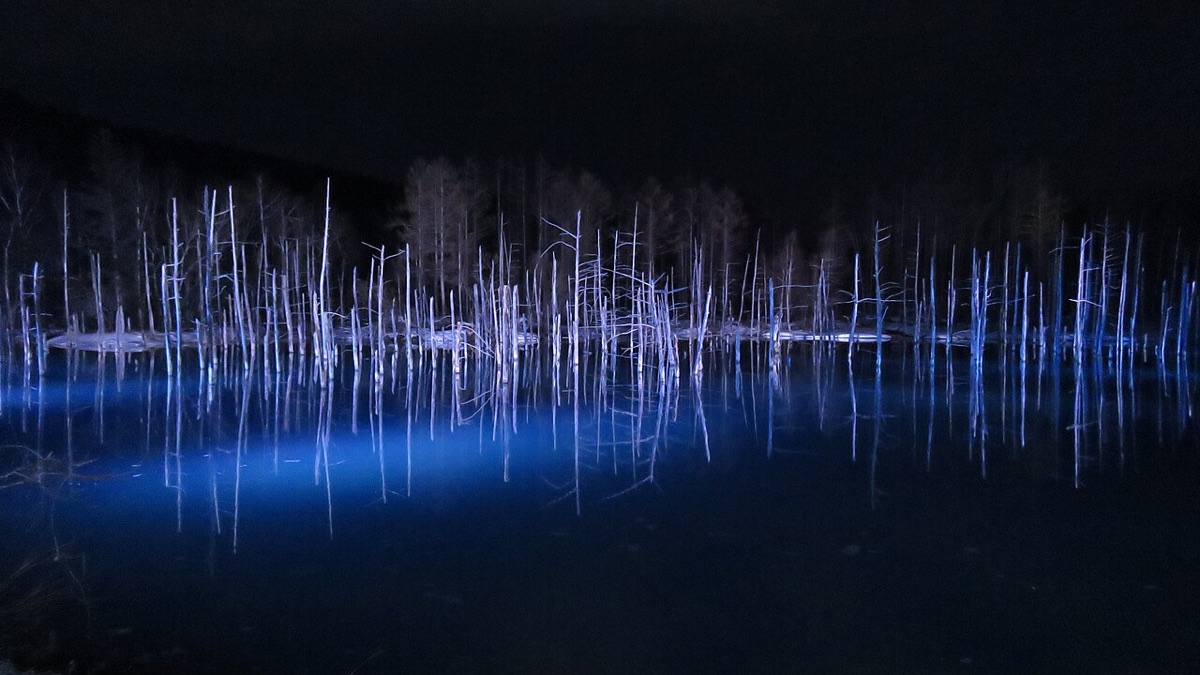
The Blue Pond light-up is the most popular winter night event in Biei, Hokkaido: the snow-covered Shirogane Blue Pond (Shirogane Aoiike) is bathed in blue light after dark, and the standing dead larch trees emerge one by one from the darkness. The Biei Tourist Association has announced the 2026-27 season, which runs from October 22, 2026 to April 21, 2027, free of charge. This guide covers the light-up hours for each month, what you will actually see in winter, how to get there from Asahikawa and Sapporo (including whether the last bus allows a same-day return), the nearby Shirahige Falls illumination, and tips for driving and staying warm.
When is the Blue Pond light-up 2026-27? Hours by month
In short: the 2026-27 Blue Pond light-up runs from October 22, 2026 to April 21, 2027, every night until 21:00, but the start time moves month by month with sunset[1]. Some articles online say it "starts October 24 and ends April 22"; those are last season's (2025-26) dates, which still appear on the Biei Tourist Association's Blue Pond page[2]. Go by the light-up announcement published on October 22, 2026.
| Month | Light-up hours | Notes |
|---|---|---|
| October 22–November 2026 | 17:00–21:00 | The pond may not be frozen yet |
| December 2026 | 16:30–21:00 | Earliest start of the season |
| January 2027 | 17:00–21:00 | The coldest month |
| February 2027 | 17:30–21:00 | — |
| March 2027 | 18:00–21:00 | — |
| April 1–21, 2027 | 18:30–21:00 | Last night is April 21 |
The light-up is free and needs no reservation; only drivers pay for parking. The lot next to the Blue Pond has 220 spaces for regular cars and 20 for large vehicles[1]. From July 1, 2026, fees per visit are 1,000 yen for regular cars, 300 yen for motorcycles and 6,000 yen for large vehicles, paid at a pre-payment machine before you enter[3].
Last season the lights stayed on until 2:00 the next morning from December 31 to January 3[2], but the 2026-27 announcement does not mention a New Year extension. If you plan to go on New Year's Eve, check the official news closer to the date rather than assuming it will be extended.
What can you see at Biei's Blue Pond in winter?
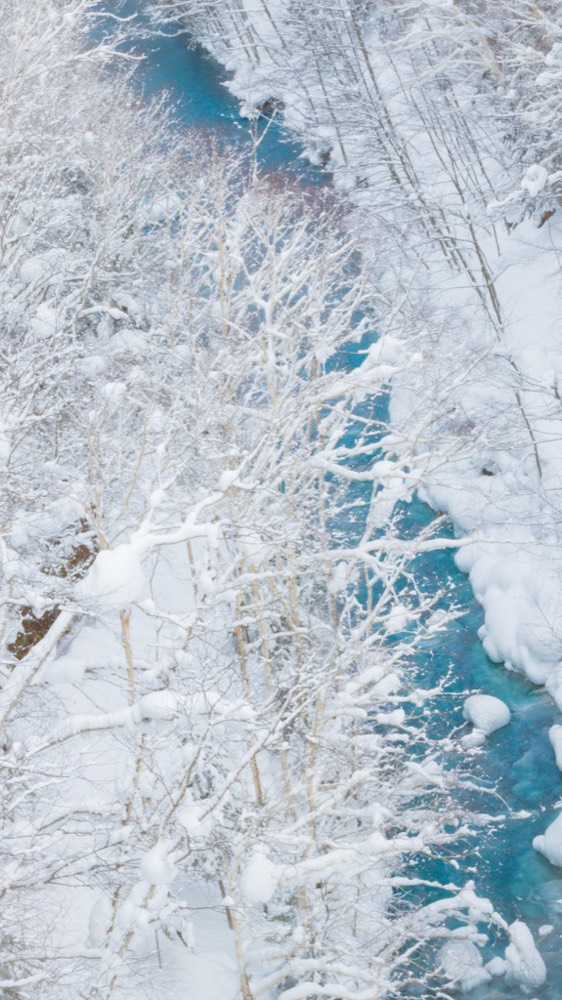
Set your expectations first: in winter you usually cannot see blue water at the Blue Pond. The official site explains that once snow falls, it covers the pond surface[2], and Japanese travel media note that the pond is almost entirely frozen from December to early April[6]. So the star of the show shifts from the water to the snow and trees: the lights fall on the snow and the dead trees, creating gradients of blue and white.
According to the Biei Tourist Association, the light-up is a roughly 15-minute story told in light, and once the pond freezes or is covered in snow it switches to a winter version focused on gradients of light, stars, falling snow and the shadows of the larch trees[1]. In practice the scene falls into roughly two periods:
- Late October to November: If the pond has not frozen, the lights reflect on the water and create a mirror image, closest to the "blue pond" most people picture.
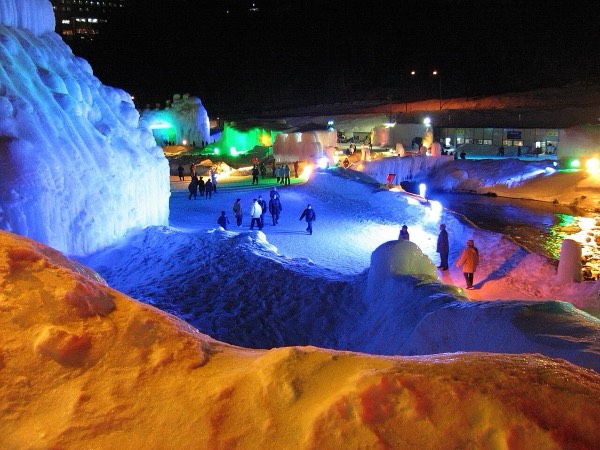
- December to March: Everything is white, the dead trees and the forest behind are outlined in blue light, and on snowy nights flakes drift through the beams for a fairy-tale mood.
- April: The snow starts melting and the pond may be half ice, half water, so the scenery is less predictable.
The pond itself formed from water collecting behind an erosion-control dam built as part of disaster-prevention work around Mt. Tokachi. Aluminium and other substances in the water, together with the way light scatters, make it look blue on sunny days[2]. Stay on the designated footpath; the official site specifically warns visitors never to enter the pond[2]. In winter, the snow beside the path may look flat but could be hiding the pond surface or a slope, so never step past the fence for a photo.
How to combine the Shirahige Falls light-up and Shirogane Onsen
The best combination is to see Shirahige Falls and the Blue Pond together. Shirahige Falls (Shirahige no Taki) is next to Shirogane Onsen, upstream of the Blue Pond, and the Biei Tourist Association says it is lit year-round from sunset to 21:00, with the start time shifting with sunset[1].
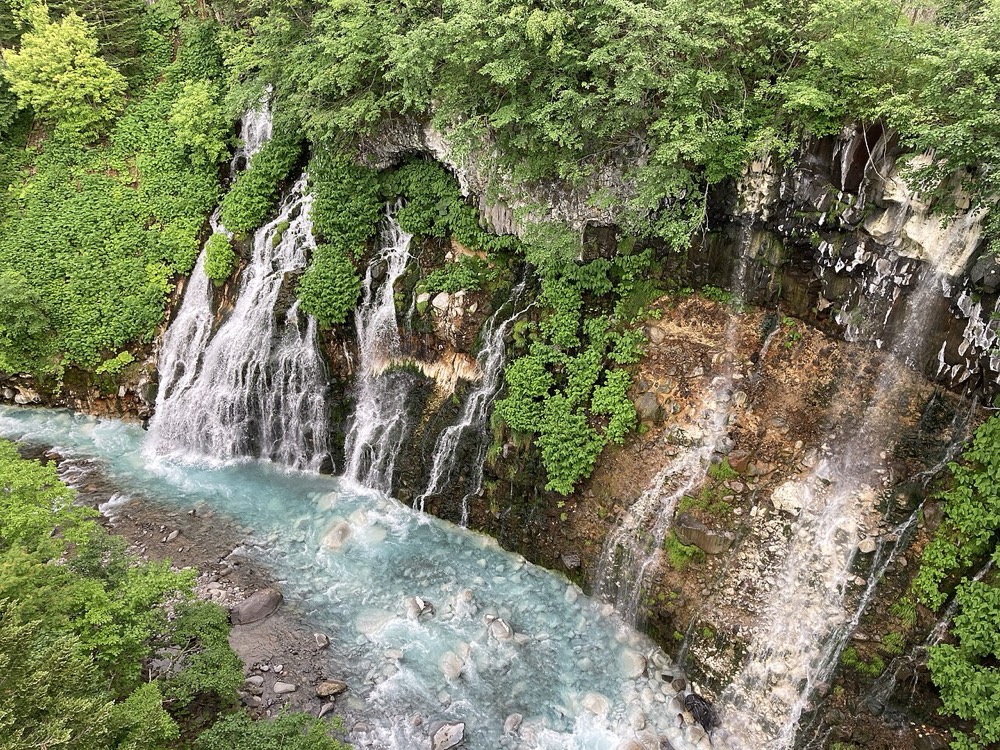
Shirahige Falls is groundwater seeping out between rock layers, dropping about 30 meters straight into the Biei River[6]. In winter the banks are covered in snow and icicles hang from the cliff, while the river below stays a milky, slightly blue color that looks atmospheric when lit at night. The viewing spot is the Blue River Bridge over the Biei River, and drivers can park at the public lot in front of the Shirogane Tourist Center[1].
This season the Biei Tourist Association is also lighting up Birke Forest (Birke no Mori) next to the Michi-no-Eki roadside station "Shirogane Birke," with the same period and hours as the Blue Pond; parking is at the roadside station's public lot[1]. All three are on the same road, so drivers can see them in one evening in the order Shirahige Falls → Blue Pond → Birke Forest.
For a relaxed visit, staying at Shirogane Onsen is the easiest option: soak in the hot spring, then walk out to the falls without racing the last bus. Shirogane Onsen has several hot-spring inns, which often fill up early on winter weekends and holidays, so book ahead. For check-in etiquette and what to expect from half-board stays, see how to choose a Japanese ryokan.
Getting to the Blue Pond light-up: can you do it by bus from Asahikawa or Biei Station in one day?
In short: yes, but it only really works from late October to January, and you get roughly an hour with the lights. The key is the last return bus: the final Dohoku Bus from Blue Pond Entrance to Biei Station leaves at 18:05 and arrives at Biei Station at 18:30, and it does not continue to Asahikawa Station[4].
Two Dohoku Bus routes serve the Blue Pond: the "39 Shirogane Line" from Asahikawa Station via Biei Station, and the "42 Biei-Shirogane Line" from Biei Station. From October 1, 2026 some times were revised and an evening return service was added[4]. The services that suit the light-up are below (based on the timetable revised October 1, 2026):
| Direction | Route | Asahikawa Sta. | Biei Sta. | Blue Pond Entrance | Shirogane Onsen |
|---|---|---|---|---|---|
| Outbound | 39 | dep. 14:40 | 15:34 | 15:56 | 16:00 |
| Outbound | 42 | — | dep. 17:15 | 17:37 | 17:41 |
| Return | 42 | — | arr. 17:00 | dep. 16:35 | dep. 16:32 |
| Return (last) | 42 | — | arr. 18:30 | dep. 18:05 | dep. 18:02 |
One-way fares are 1,600 yen from Asahikawa Station to Blue Pond Entrance, 800 yen from Biei Station to Blue Pond Entrance and 580 yen from Asahikawa to Biei. You can pay in cash or by tapping a contactless credit card such as Visa[4]. Dohoku Bus also sells a mobile one-day pass for the Biei and Shirogane area; check the Dohoku Bus website for the price.
Here is how practical the bus is month by month:
- Late October–November and January (lights at 17:00): Take the 14:40 Route 39 bus from Asahikawa, arrive at Shirogane Onsen at 16:00 and see Shirahige Falls first (from late November to January the sun sets early, so it is usually lit by then; in late October it is still light), then take the 16:32 return bus three minutes down to Blue Pond Entrance and stay until the last bus at 18:05, giving you about an hour.
- December (lights at 16:30): The same plan gives you about an hour and a half, making this the best month for bus travelers.
- February (lights at 17:30): Only about 35 minutes, enough for roughly two runs of the show.
- March–April (lights at 18:00 and 18:30): You will barely see anything by bus; use the taxi, tour or overnight options below instead.
After arriving back at Biei Station at 18:30, the JR Furano Line local train to Asahikawa takes about 32 minutes[5]. Evening trains are infrequent and you may have to wait at the station, so check your connection on the JR Hokkaido timetable in advance. If the last bus is delayed by heavy snow you could miss your planned train, so build in extra time in winter.
From Sapporo, by taxi or on a day tour: which should you choose?
From Sapporo, take a JR limited express to Asahikawa (about 90 minutes; about 120 minutes by highway bus), then the Furano Line local train to Biei Station (about 32 minutes). By car it is about 166 km, or two and a half hours[5]. To see the light-up and return to Sapporo in one day, you are limited to the few bus connections above, which is very tight, so staying a night in Asahikawa or Biei is more realistic. For a comparison of Sapporo neighborhoods, see where to stay in Sapporo.
A comparison of common options:
| Option | Pros | Things to watch |
|---|---|---|
| Dohoku Bus + JR | Cheapest, 1,600 yen one way from Asahikawa | Last bus 18:05; almost no light-up in March–April |
| Taxi | No time limit, can include Shirahige Falls | Fares not published; book ahead in winter and confirm the return |
| Evening bus tour | Direct pick-up from Asahikawa or Sapporo, no transfers | Fixed stop time, advance booking needed |
| Stay at Shirogane Onsen | No bus to catch, hot spring plus light-up | Few rooms on winter weekends, book early |
| Self-drive | See all three light-ups in one evening | Snow-driving experience needed, 1,000 yen parking |
Taxis can start from Biei Station or central Asahikawa, but there are few taxis at Biei Station and you may not find one after dark, so ask your accommodation to book one and agree on waiting or return times in advance. For using taxi apps in Japan, see the Japan taxi guide. Platforms such as KKday and Klook, as well as local Japanese travel companies, also run winter Blue Pond light-up bus tours from Asahikawa and Sapporo. These suit travelers who do not want to plan transfers; before booking, check the meeting point, stop time and refund rules if the tour is cancelled for weather.
If you want to see more during the day, Asahiyama Zoo is in Asahikawa and its winter penguin walk is usually held in the daytime, so you can plan "zoo in the morning, Blue Pond in the evening." See the Asahiyama Zoo winter guide for times. For overall transport planning without a car, see Hokkaido without a car.
What should you watch out for when driving to the Blue Pond light-up in winter?
Driving is the most flexible way to see the Blue Pond light-up, but Hokkaido's snowy roads at night are risky if you are not used to them. It is about 26 km, or 40 minutes, from Asahikawa to Biei by car[5], followed by a stretch of mountain road to the Shirogane Onsen area, and it is fully dark by the time the lights come on.
- Drive part of the way in daylight: If it is your first time on snow, drive to Biei during the day, get used to the conditions, then wait for the light-up instead of setting off for the first time in the dark.
- Be gentle on the controls: On icy roads avoid sudden acceleration, braking and sharp turns, and keep at least twice your usual following distance. Bridges and shaded spots are especially prone to black ice.
- Watch for animals: Deer often appear suddenly on mountain roads at night, and if you see one there are usually others nearby.
- The parking lot is slippery too: The path from the Blue Pond parking lot to the footpath is often icy, so walk slowly. Parking is 1,000 yen for a regular car, paid at a pre-payment machine[3].
- Check the weather: The light-up may be cancelled in a snowstorm[2]. Do not push on in poor visibility; it is better to go another day.
Travelers from Taiwan driving with a Taiwanese license must carry the original license and an official Japanese translation; travelers from other countries and regions should check whether an International Driving Permit or other rules apply to them.
What to wear for the Blue Pond light-up: preparing for -10°C
Watching the light-up means standing still outdoors, which feels much colder than walking around in the daytime. Biei lies in inland Hokkaido, where nighttime temperatures below -10°C are not unusual in midwinter, and you will stand in the snow for 30 minutes or more, so dress more warmly than you would for walking around central Sapporo.
- Head, hands and feet matter most: Wear a hat that covers your ears, and layer thin inner gloves under waterproof outer gloves so you only remove the outer pair for photos.
- Non-slip snow boots: The footpath is icy, so wear snow boots with grippy soles, or add simple ice cleats over your shoes.
- Layer up: A thermal base layer, a fleece mid-layer and a windproof, waterproof down jacket; take a layer off on the bus or indoors.
- Hand warmers and spare batteries: Phone and camera batteries drain quickly in the cold, so keep spares in an inside pocket to stay warm.
- Photo etiquette: Do not hog a spot on a crowded footpath, and follow on-site rules about tripods.
For a full Hokkaido winter clothing list, see the Hokkaido winter clothing guide.
Before you go: how to plan it smoothly
- Choose your month: For reflections on the water, go from late October to November; for snow scenes, go from December to February. December has the earliest light-up and is the friendliest month for bus travelers.
- Mind the last bus: If you travel by bus, the 18:05 departure is your only return; miss it and your only option is a taxi.
- Order: See Shirahige Falls first and the Blue Pond second, which matches the direction of the bus route.
- Check before you leave: On the day, check whether the Biei Tourist Association has announced a cancellation and whether Dohoku Bus services are suspended or delayed by snow.
FAQ
When is the Blue Pond light-up 2026-27, and is there an admission fee?
According to the Biei Tourist Association, it runs from October 22, 2026 to April 21, 2027, every night until 21:00, with start times ranging from 16:30 in December to 18:30 in April. There is no ticket and no reservation. If you drive, the Blue Pond parking lot costs 1,000 yen per visit for a regular car.
Can you still see blue water at the Blue Pond in winter?
Usually not. The official site explains that snow covers the pond in winter, so the blue water disappears, and the light show switches to gradients of light, stars, falling snow and larch silhouettes. For blue water, visit in daytime from late spring to autumn. In late October and early November, if the pond has not frozen yet, you may still see reflections on the water.
Can I see the light-up and return to Asahikawa the same day by bus?
Yes, but it is tight. The last Dohoku Bus from Blue Pond Entrance to Biei Station leaves at 18:05 and arrives at 18:30, after which you take the JR Furano Line to Asahikawa. In October–November, December and January the lights come on early enough for about an hour of viewing. In March (18:00) and April (18:30) you will barely see anything by bus, so use a taxi, an evening bus tour, or stay at Shirogane Onsen.
Is Shirahige Falls lit up at night too?
Yes. The Biei Tourist Association says Shirahige Falls is lit year-round from sunset to 21:00, so the start time shifts with sunset. The falls are next to Shirogane Onsen and are viewed from the Blue River Bridge. Parking is at the public lot in front of the Shirogane Tourist Center, a few minutes' drive from the Blue Pond.
Is it a good idea to drive to the Blue Pond light-up? What should I watch out for in winter?
Driving gives you the most freedom, but winter roads are often icy and it gets dark early. Drive to Biei in daylight first to get used to the conditions, avoid sudden braking and sharp turns, keep a long following distance, and watch for deer at night. The parking lot and footpath also ice over, so wear non-slip footwear and walk slowly.
Sources
- Biei Tourist Association | Night light tour of Biei (Blue Pond, Shirahige Falls, Birke Forest light-ups): 2026-27 light-up period, monthly hours, parking spaces and fees, Shirahige Falls and Birke Forest light-ups
- Biei Tourist Association | Shirogane Blue Pond: How the pond formed, no blue water in winter, previous (2025-26) season dates and New Year extension, possible cancellation in bad weather
- Biei Tourist Association | Blue Pond parking fee change: Parking fees revised from July 1, 2026
- Dohoku Bus | Shirogane Line and Biei-Shirogane Line timetable revision and added services: Timetable revised October 1, 2026, one-way fares, payment methods
- Biei Tourist Association | Access: Travel times to Biei from Sapporo, Asahikawa and Asahikawa Airport
- GLTJP | How to get to Biei's Shirogane Blue Pond and highlights: Winter freezing period, Shirahige Falls height and winter scenery
Fares, opening hours and event dates can change. Information checked on 2026.10.27; please confirm with official sources before you go.