Tokyo Night Views: Free vs Paid Observation Decks Compared, With Timing, Prices and Photo Spots
Tokyo night views compared: free decks like the Metropolitan Government Building vs SHIBUYA SKY, Roppongi Hills, Tokyo Tower and Skytree, plus sunset times.
Quick answer
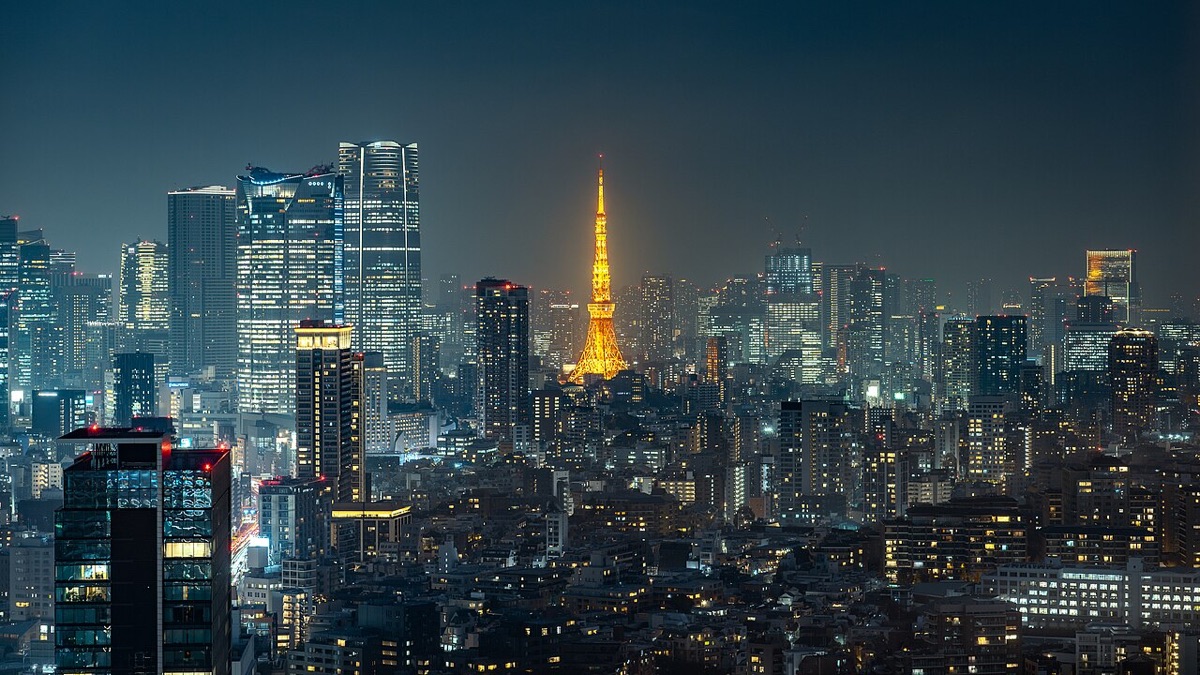
For a free Tokyo night view, go to the Tokyo Metropolitan Government Building's South Observatory (202m, entry until 21:30, closed 1st and 3rd Tuesdays), and catch the free projection mapping on the building outside. For the classic Tokyo Tower shot, pick Roppongi Hills' Tokyo City View (¥2,200 online) or Tokyo Tower's Main Deck (¥1,500); for an open-air 360° rooftop, SHIBUYA SKY (¥3,400 online from 15:00). Sunset is around 16:28 from late November to mid-December.
Tokyo has plenty of night view options, but only four things really shape your experience: whether you pay, whether Tokyo Tower is in the frame, when the sun sets, and whether you need to book. This guide puts the free decks, such as the Tokyo Metropolitan Government Building, in the same table as paid ones like SHIBUYA SKY, Roppongi Hills, Tokyo Tower and Skytree, then recommends options by budget, first-timers, photographers and couples, and ends with a sample winter evening route. Each deck's ticketing details have their own dedicated article; here we focus on how to choose and link to those guides.
Tokyo night view decks compared: free and paid at a glance
Bottom line: go to the Tokyo Metropolitan Government Building for free, Roppongi Hills to photograph Tokyo Tower, SHIBUYA SKY for an open-air feel, and Skytree for maximum height. Here is the current status of the main spots:
| Spot | Height / floor | Adult price | Evening hours | Tokyo Tower in view | Mt. Fuji (clear evenings) | Booking |
|---|---|---|---|---|---|---|
| Tokyo Metropolitan Government Building, South Observatory | 45F, 202m | Free | Until 22:00 (entry until 21:30) | Far, not the focus | Possible, weather permitting | Not needed |
| Yebisu Garden Place Tower SKY LOUNGE | 38F | Free | Per facility notice | Possible, depending on the side | — | Not needed |
| Caretta Shiodome SKY VIEW | 46F | Free | Per facility notice | Mainly faces Tokyo Bay | — | Not needed |
| Bunkyo Civic Center Observation Lounge | 25F | Free | 9:00–20:30 (reopens November 30) | — | — | Not needed |
| Roppongi Hills Tokyo City View | 52F | ¥2,200 online | 10:00–22:00 (entry until 21:30) | Right in front, the best | Possible, weather permitting | Timed entry |
| SHIBUYA SKY | About 229m, incl. rooftop | ¥3,400 online from 15:00 | Until 22:30 (entry until 21:20) | Visible, farther away | Possible, weather permitting | Timed entry, book ahead |
| Tokyo Tower Main Deck | 150m | ¥1,500 | 9:00–23:00 (entry until 22:30) | You're on it | Possible, weather permitting | Not needed |
| Skytree Tembo Deck | 350m | From ¥1,800 | Until 22:00 (entry until 21:00) | Very far | Possible, weather permitting | Online booking recommended |
| Ikebukuro Sunshine 60 Tenbo Park | 251m (above sea level) | From ¥700 on weekdays | 11:00–21:00 (entry until 20:30) | Far | — | Not needed |
A "—" means the official sources don't specifically mention it, not that it's definitely not visible. Prices and hours are based on: Tokyo Metropolitan Government Building[1], Bunkyo City[3], GO TOKYO[4], Roppongi Hills[5], SHIBUYA SKY[6], Tokyo Tower[7], Skytree[8], and Sunshine 60[9].
A few points the table doesn't show:
- Roppongi Hills' Tokyo City View reopened on November 13 and is open daily 10:00–22:00 (entry until 21:30) through February 14, 2027, priced at ¥2,200 online and ¥2,400 at the counter; until December 25 there are also online-only Christmas tickets, such as an adult ticket with one non-alcoholic drink for ¥2,700 and a pair ticket for ¥3,000[5]. Whether the rooftop Sky Deck is open, and whether it costs extra, depends on that day's official notice.
- Skytree prices vary by date; the official site lists only starting prices, and popular dates cost more. Counter tickets carry an extra ¥500 each. Details in the Tokyo Skytree tickets guide.
- SHIBUYA SKY has two price tiers split at 15:00. Winter sunset slots are all after 15:00, and buying online is ¥300 cheaper than the counter. Booking steps are in the SHIBUYA SKY guide.
- To go up to 250m at Tokyo Tower you need the Top Deck Tour, ¥3,300 online or ¥3,500 at the counter[7]; see the Tokyo Tower guide.
Where can you see Tokyo's night view for free? Beyond the Metropolitan Government Building
Bottom line: the Tokyo Metropolitan Government Building's South Observatory is the most reliable free night view. The other free spots are small and worth visiting only if you're nearby.
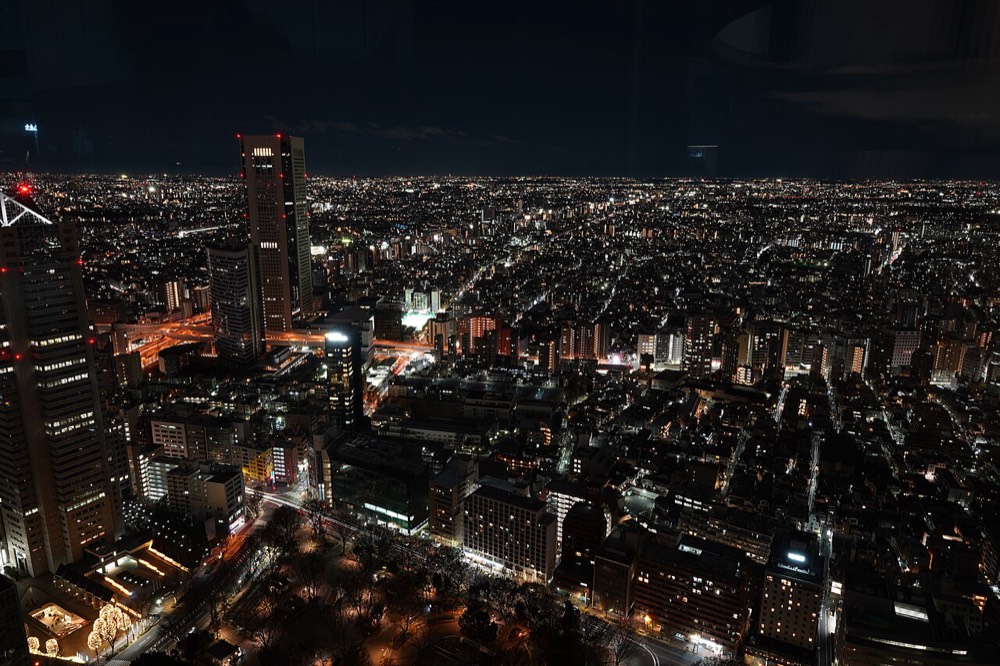
Tokyo Metropolitan Government Building observatory: free, open late, good for sunset
The Tokyo Metropolitan Government Building (東京都庁) has North and South observatories on the 45th floor of Main Building No. 1, about 202m up, both free[1]. Note the current arrangements:
- South Observatory: 9:30–22:00, entry until 21:30; closed on the 1st and 3rd Tuesdays of each month[1].
- North Observatory: currently open only until 17:30, extended to 22:00 only on days the South Observatory is closed; closed on the 2nd and 4th Mondays[1].
- On national holidays they open as usual and close the next weekday instead. Both close December 29–31 and January 2–3, plus irregular building inspection days[1].
- There is a bag check at the entrance and tripods are not allowed. The South Observatory has a piano anyone can play, also open for playing 19:00–21:00, so you may hear music in the evening[1].
On clear winter evenings, you may see Mt. Fuji's silhouette from the observatory[4]; to the east are Shinjuku's skyscrapers. The official site also notes that some lights are switched off for energy saving, so the room is fairly dark, which actually means fewer reflections.
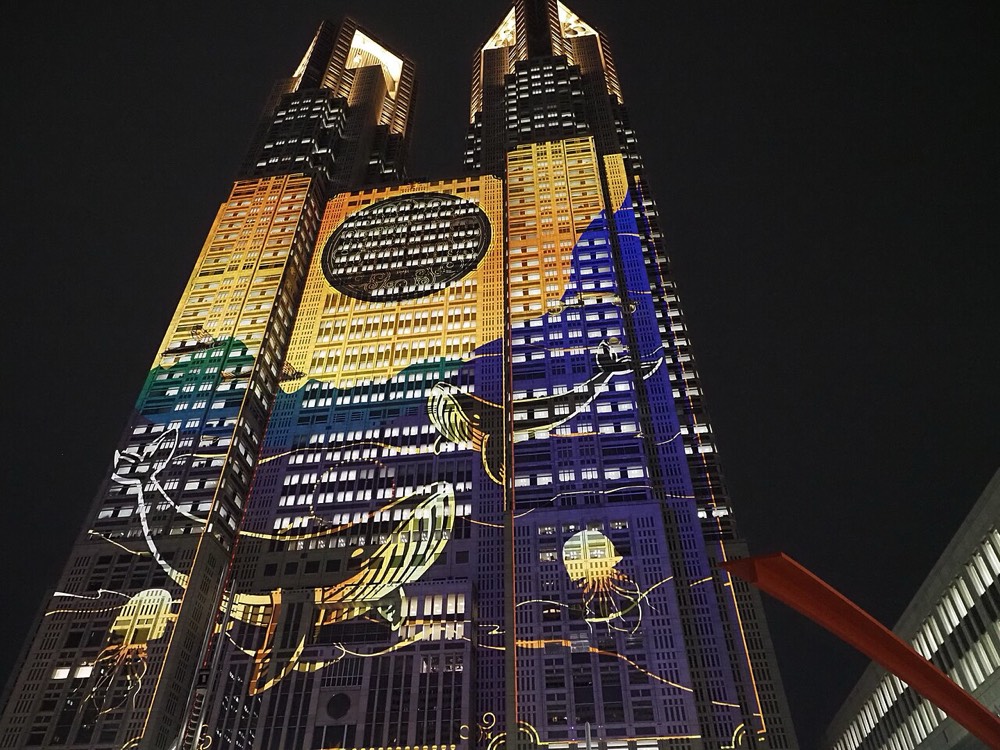
Projection mapping at the Metropolitan Government Building: TOKYO Night & Light
Don't rush off after coming down: the east wall of Main Building No. 1 hosts a free projection mapping show, "TOKYO Night & Light", viewed from the Tokyo Citizens' Plaza (都民広場) in front of the building[2]. From October 2026 it screens a new work made by students of Tokyo Metropolitan Arts High School; October showtimes were 18:00 and 19:00 on weekdays and 18:00 on weekends and holidays. Showtimes change by month, the government says to check the dedicated website for other months, and shows may be cancelled in bad weather[2]. Check the current month's times first, then plan the observatory before or after.
Current status of other free viewpoints
- Bunkyo Civic Center 25F Observation Lounge (文京シビックセンター): a great angle on Skytree, and after renovation it reopens on Monday, November 30, 2026, open 9:00–20:30, free; it is closed on Sunday, December 20 and over the year-end holidays from December 29 to January 3[3].
- Yebisu Garden Place Tower 38F SKY LOUNGE (恵比寿ガーデンプレイスタワー): a free viewing area next to the restaurant floor[4], easy to combine with dinner in Ebisu. Media sources list different hours, so follow the facility's notices.
- Caretta Shiodome 46F SKY VIEW (カレッタ汐留): a free viewing area beside the restaurant floor, facing Tokyo Bay; GO TOKYO notes you can't enter the restaurants just to look at the view[4].
- Sangenjaya Carrot Tower observation lobby (スカイキャロット展望ロビー): listed by GO TOKYO as a free viewpoint[4], but far from the main sightseeing areas; only convenient if you're staying around Setagaya.
Which paid deck should you choose? Whether Tokyo Tower is in the frame is the key
Bottom line: if you want a night photo with Tokyo Tower in it, don't go up Tokyo Tower; choose Roppongi Hills. For maximum height and distance, choose Skytree; for an open-air rooftop with a 360° view, choose SHIBUYA SKY.
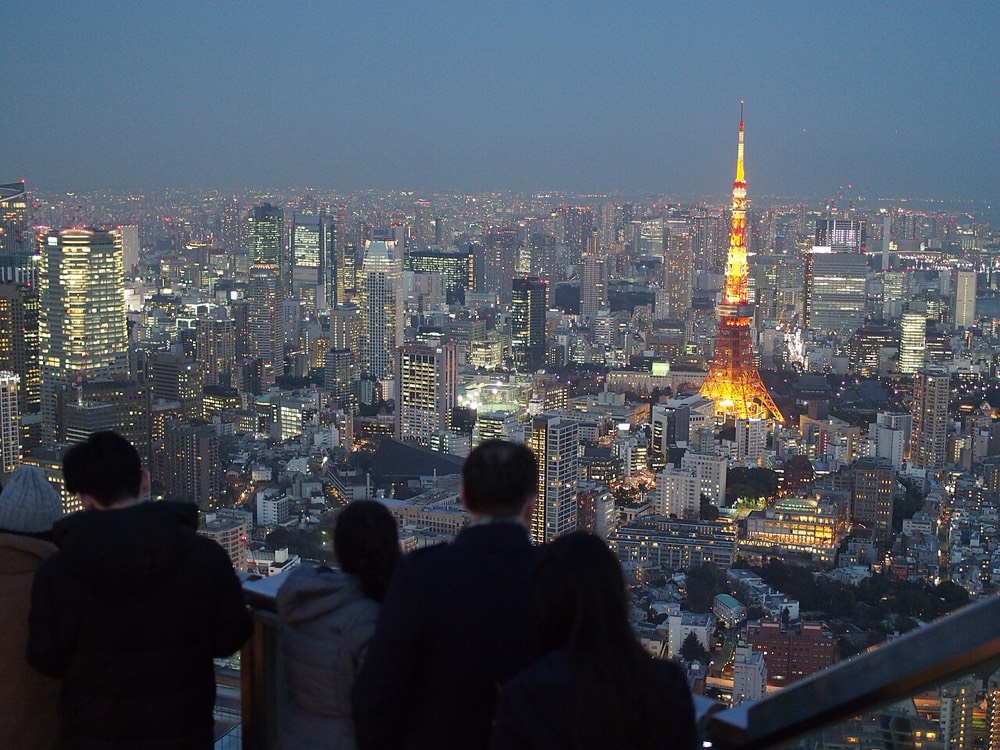
- Roppongi Hills Tokyo City View: an indoor deck on the 52nd floor with Tokyo Tower right in front, giving the most recognizable night shots. It uses timed entry; you can buy on the spot if slots remain, but online is ¥200 cheaper than the counter[5]. Some combo tickets don't apply from December 18, 2026 to January 3, 2027, so check valid dates before buying.
- SHIBUYA SKY: an open-air rooftop with no glass reflections, where you can see Shibuya Crossing, Tokyo Tower and Skytree at once, and Mt. Fuji on clear days[4]. The downsides: sunset slots are the most competitive, and the rooftop closes in strong wind or rain.
- Tokyo Tower: the Main Deck costs ¥1,500 whether online or at the counter and stays open until 23:00, the latest of all the decks[7]. Good if you're only free after dinner.
- Skytree: the Tembo Deck at 350m and Tembo Galleria at 450m are the highest observation decks in Japan[4]. The view is wide but buildings become tiny, so the night view looks like a sea of lights; best if you're staying around Asakusa or Ueno.
- Ikebukuro Sunshine 60 Tenbo Park: an indoor deck with artificial turf where you can sit and relax, from ¥700 for adults on weekdays[9]. It's the cheapest, but closes early at 21:00.
When to go in winter? Tokyo sunset times and the blue hour
Bottom line: from late November to mid-December, Tokyo's sunset is around 16:28, so enter by 15:50. The National Astronomical Observatory of Japan's 2026 sunset times for Tokyo[10][11]:
| Date | Sunset | Suggested entry | Approx. blue hour |
|---|---|---|---|
| November 10 | 16:39 | Before 16:00 | 16:40–17:10 |
| November 20 | 16:32 | Before 15:55 | 16:35–17:05 |
| November 30–December 15 | 16:28–16:29 | Before 15:50 | 16:30–17:00 |
| December 25 | 16:33 | Before 15:55 | 16:35–17:05 |
| December 31 | 16:37 | Before 16:00 | 16:40–17:10 |
The blue hour (when the sky is still deep blue after sunset and the city lights are already on) is the easiest time to get a good night photo. It lasts about 30 minutes; the times in the table are estimates and vary with weather. The ideal plan is to enter 30–40 minutes before sunset and stay until about 17:15, catching the sunset, Fuji's silhouette, the blue hour and full darkness in one visit.
Winter air is dry, so Fuji is more likely to be visible than in summer. But the Metropolitan Government Building, SHIBUYA SKY and Roppongi Hills all lie east of Fuji, so the sun sets toward the mountain. Shooting into the light, phones easily turn everything into a silhouette; lock exposure on the bright part of the sky.
Who is each option for? Recommendations by budget and purpose
| Your priority | Recommended | Less suitable |
|---|---|---|
| Tight budget, just want the view | Metropolitan Government South Observatory + projection mapping (¥0) | Skytree (high prices on popular dates) |
| First time in Tokyo | SHIBUYA SKY at sunset | Bunkyo Civic Center (closes at 20:30) |
| Photographing Tokyo Tower | Roppongi Hills Tokyo City View | Tokyo Tower itself |
| Tripods, long exposures | Outdoor spots are freer, but tripods are also banned on the Rainbow Bridge promenade | Metropolitan Government Building (tripods banned) |
| Couples, anniversaries | Roppongi Hills + Keyakizaka illuminations, or SHIBUYA SKY | Small free viewing areas |
| Kids, avoiding queues | Tokyo Tower Main Deck, Sunshine 60 | SHIBUYA SKY (child tickets sold only at the counter on the day) |
| Only free after 21:30 | Tokyo Tower Main Deck (entry until 22:30) | Metropolitan Government Building, Skytree |
Photo tip: glass reflections are the biggest problem at indoor decks. Wear dark clothing and press your phone or lens close to the glass to cut most reflections. Most decks restrict tripods; the Metropolitan Government Building explicitly bans them[1]; check each facility's rules for the others.
Outdoor night views: Odaiba and Rainbow Bridge
Bottom line: for a waterfront night view, go to Odaiba Seaside Park in the evening. No ticket needed, and Rainbow Bridge and the skyline across the water reflect on the bay.
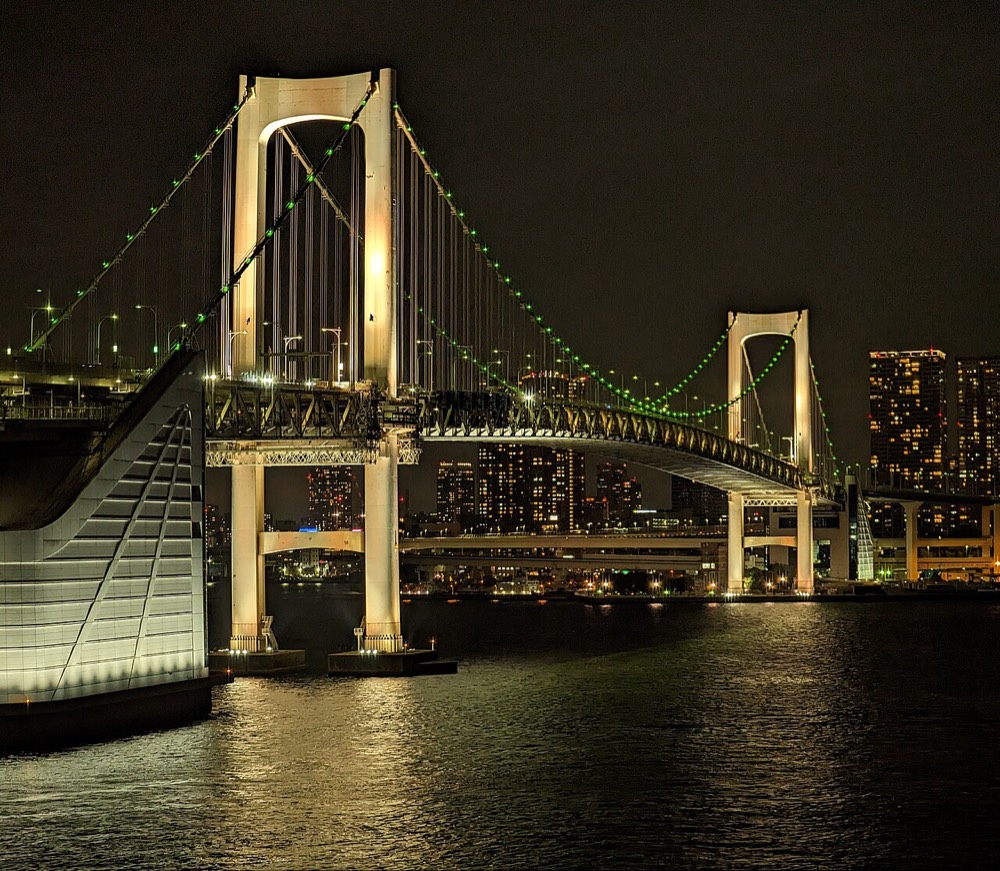
Odaiba Seaside Park (お台場海浜公園) is recommended by GO TOKYO for night views and sunsets[4]. If you want to walk the Rainbow Bridge (レインボーブリッジ) promenade, note that from November to March it's open only until 18:00, with last entry at 17:30; April to October it's 9:00–21:00. It closes on the 3rd Monday of each month (the next day if that's a holiday). Tripods, drinking and cycling are banned on the bridge, and it may close in strong wind or heavy snow[12]. In other words, in winter you can catch sunset and the blue hour from the bridge but not full darkness; for the night view, stay on the Odaiba shore. For getting to Odaiba and nearby sights, see the Odaiba day trip guide.
How to choose a night view restaurant
Bottom line: visit a free deck first, then eat on a high restaurant floor; it's better value than paying a premium for a "night view restaurant".
- Caretta Shiodome 46–47F and Yebisu Garden Place Tower 38–39F are restaurant floors next to free viewing areas[4], so you can see the view before or after your meal.
- For a window seat, add "窓側席希望" (window seat requested) when booking. Most restaurants only guarantee the time slot, not the window; only plans marked "窓側確約" on booking sites guarantee a window seat.
- In winter, a 17:00–18:00 seating shows the sky changing, but it's also the most popular slot; book early for weekends and the run-up to Christmas in December.
- Prices, service charges and minimum spends vary widely; follow the restaurant's official site or booking platform.
Sample winter evening route: Shibuya sunset to Shinjuku night view
This plan is for a December weekday and costs about ¥3,400 per person (SHIBUYA SKY). To make it completely free, replace steps 1 and 2 by going straight to the Metropolitan Government Building for sunset:
- 15:40: Enter SHIBUYA SKY (book a slot around 15:40 on the official site about two weeks ahead), and head to the west side of the rooftop to wait for sunset.
- Around 16:28: Sunset, followed by the blue hour; stay until about 17:10.
- 17:30: JR Yamanote Line from Shibuya to Shinjuku, about 7 minutes, then roughly a 10-minute walk from the west exit to the Metropolitan Government Building.
- Around 18:00: Watch the TOKYO Night & Light projection mapping from the Citizens' Plaza (check that month's showtimes)[2].
- 18:30: Go up to the 45F South Observatory for the full night view, free; remember entry closes at 21:30[1].
- After 19:30: Dinner in Shinjuku, or take the Marunouchi Line to Tokyo Station for the Marunouchi illuminations.
Roppongi version: go up Tokyo City View at 16:00 for sunset and Tokyo Tower, walk the Keyakizaka illuminations after 17:00 (November 5 to December 25 in 2026), and after dinner walk or ride to Tokyo Tower for a close-up; the Main Deck is open until 23:00. For illumination dates across Japan, see Japan Christmas illuminations 2026.
Before you go
- Check dates first: Bunkyo Civic Center only reopens on November 30 and is closed on December 20 and from December 29 to January 3[3], and the Metropolitan Government South Observatory closes on the 1st and 3rd Tuesdays and from December 29 to 31 and January 2 to 3[1]. These are the two most common ways to be caught out.
- Book sunset slots early: SHIBUYA SKY and Roppongi Hills both use timed entry, and in winter the 15:30–16:30 slots sell out fastest.
- Decide on paid decks after checking the weather: on overcast days or with low clouds, a paid deck may show you nothing; on those days, the free Metropolitan Government Building costs you nothing to try.
- Stay near the Yamanote Line so getting back to your hotel after the night view is easy; see where to stay in Tokyo. To fit night views into your whole trip, see Tokyo attractions.
FAQ
Where can I see Tokyo's night view for free?
The most reliable option is the South Observatory on the 45th floor of the Tokyo Metropolitan Government Building: free and open until 22:00 (entry until 21:30). Yebisu Garden Place Tower (38F) and Caretta Shiodome (46F) also have small free viewing areas; check each facility for hours. Bunkyo Civic Center's 25F lounge reopens on November 30, 2026, open 9:00–20:30 and free. Outdoors, Odaiba Seaside Park faces Rainbow Bridge.
What time does the Tokyo Metropolitan Government Building observatory close? Do I need a reservation?
The South Observatory is open 9:30–22:00 with entry until 21:30. The North Observatory currently closes at 17:30, staying open to 22:00 only when the South side is closed. The South side closes on the 1st and 3rd Tuesdays, the North on the 2nd and 4th Mondays (moved to the next weekday if a holiday). No reservation, no fee; there is a bag check and tripods are not allowed.
Which Tokyo observation deck has the best view of Tokyo Tower?
To make Tokyo Tower the star of your photo, choose Tokyo City View at Roppongi Hills, where the tower stands close in front of you. You can also see it from SHIBUYA SKY and Skytree, but it looks small at that distance. And when you are on Tokyo Tower itself, you obviously can't photograph it.
What time should I arrive for sunset at a Tokyo observation deck in winter?
In 2026, Tokyo's sunset is about 16:39 on November 10, around 16:28 from late November to mid-December, and 16:33 in late December. Enter 30–40 minutes before sunset to get a window spot, and stay about 30 minutes after for the blue hour. At timed-entry decks such as SHIBUYA SKY, slots around sunset sell out first.
How should I choose a Tokyo night view restaurant?
On a budget, visit a free deck first, then eat on a high restaurant floor in the same building, such as Caretta Shiodome 46–47F or Yebisu Garden Place Tower 38–39F. When booking, request a window seat (窓側席); most restaurants only guarantee the time slot, not the window.
Sources
- Tokyo Metropolitan Government Bureau of Finance: Observatory visitor information: Hours, closing days, free admission, tripod ban for the North and South observatories (checked November 2026)
- Tokyo Metropolitan Government press release: new TOKYO Night & Light projection mapping (October 2026): Projection on the east wall of Main Building No. 1, viewing spot and October showtimes
- Bunkyo City: Bunkyo Civic Center Observation Lounge: Reopening November 30, 2026, 9:00–20:30, free; temporary closure December 20 and year-end closure
- GO TOKYO: Guide to Tokyo's observation decks: Free viewing spots in Ebisu, Shiodome and Sangenjaya, and features of each deck
- Roppongi Hills Museum & Observatory: Visitor information: Tokyo City View hours, online and counter prices, Christmas limited tickets (checked November 2026)
- SHIBUYA SKY official: Tickets: Online and counter prices, timed entry
- Tokyo Tower official: Prices and hours: Main Deck and Top Deck Tour prices, hours and last entry (checked November 2026)
- Tokyo Skytree official: Tickets and prices: Date-based pricing and starting prices
- Sunshine City official: Sunshine 60 Observatory Tenbo Park: Hours 11:00–21:00, last entry 20:30
- National Astronomical Observatory of Japan: Tokyo sunrise and sunset, November 2026: Tokyo sunset times in November
- National Astronomical Observatory of Japan: Tokyo sunrise and sunset, December 2026: Tokyo sunset times in December
- Tokyo Metropolitan Government Bureau of Port and Harbor: Rainbow Bridge promenade: Regular promenade hours, closing day and prohibited items
Fares, opening hours and event dates can change. Information checked on 2026.11.26; please confirm with official sources before you go.