Sumiyoshi Taisha Guide: Access, Sorihashi Bridge, Godairiki Stones, Lucky Cats, Omamori, Goshuin and Hatsumode Crowds
Sumiyoshi Taisha is 9 min from Namba by Nankai local train (¥240). Visiting order, Godairiki stones, the 48-month lucky cat ritual, charm hours and New Year crowds.
Quick answer
Sumiyoshi Taisha is the head shrine of over 2,000 Sumiyoshi shrines across Japan; its four main sanctuaries are National Treasures and entry is free. From Namba, a Nankai Main Line local train takes about 9 minutes (¥240) to Sumiyoshitaisha Station, then 3 minutes on foot; from Tennoji, the Hankai Tramway (¥240) stops right at Sumiyoshi-toriimae. Don't miss the Sorihashi bridge, the Godairiki stones at Gosho Gozen (charm bag ¥500), and the monthly lucky cats at Nankun-sha, completed after 48 months. Over 2 million people visit in the first three days of the year; in past years the gates opened at 22:00 on December 31.
Sumiyoshi Taisha (住吉大社) draws more New Year visitors than any other shrine in Osaka and is the head shrine of all Sumiyoshi shrines in Japan. Entry is free on ordinary days, and it's under 10 minutes by train from Namba. This guide helps you decide three things: whether to take the Nankai line or the Hankai Tramway from Namba, Tennoji or Shinsekai; how to walk the Sorihashi bridge, the four main sanctuaries, Gosho Gozen and the four Hattatsu shrines once inside; and when you can get omamori, goshuin and lucky cats, plus how to avoid the New Year crowds. Hours and fares were checked in November 2026; New Year details not yet announced are marked as past-year references.
What is Sumiyoshi Taisha? Key facts before you go
Bottom line: Sumiyoshi Taisha enshrines the Sumiyoshi deities of the sea and purification. All four main sanctuaries are National Treasures, and the grounds cover about 100,000 square meters with 27 auxiliary shrines. Praying at the main sanctuaries alone takes about 20 minutes; add the Godairiki stones and the four Hattatsu shrines and allow about an hour[5].
According to the shrine, the First to Fourth Main Sanctuaries were all built in 1810 in the Sumiyoshi-zukuri style, one of the oldest forms of shrine architecture, and were designated National Treasures in 1953[4]. OSAKA-INFO says more than 2 million people visit during the first three days of each year[6].
| Item | Details |
|---|---|
| Admission | Free |
| Gates open | Apr–Sep 6:00; Oct–Mar 6:30 (6:00 on the 1st of each month and on Hattatsu days) |
| Gates close | Inner precinct (main sanctuaries) 17:00; outer gates 16:00 |
| Charm office | 9:00–17:00 |
| Nearest stations | Nankai Main Line Sumiyoshitaisha (3 min east), Hankai Tramway Sumiyoshi-toriimae (right outside), Nankai Koya Line Sumiyoshi-higashi (5 min west) |
| Address | 2-9-89 Sumiyoshi, Sumiyoshi-ku, Osaka |
(Checked November 2026; hours differ during New Year and the late-July summer festival[1])
Sumiyoshi Taisha access: how to get there from Namba, Tennoji or Shinsekai
Bottom line: if you're staying around Namba or Shinsaibashi, the Nankai Main Line local train is fastest. If you're based in Tennoji or Abeno, or want to ride a streetcar, take the Hankai Tramway to Sumiyoshi-toriimae, which stops right at the great torii.
| From | Line | Get off at | Ride | Fare (adult) | To the main gate |
|---|---|---|---|---|---|
| Namba | Nankai Main Line "Local" | Sumiyoshitaisha | About 9 min | ¥240 | About 3 min east |
| Shin-Imamiya | Nankai Main Line "Local" | Sumiyoshitaisha | About 7 min | ¥240 | About 3 min east |
| Tennoji-ekimae | Hankai Tramway Uemachi Line (for Abikomichi or Hamadera-ekimae) | Sumiyoshi-toriimae | About 20 min | ¥240 | Right outside |
| Ebisucho (Shinsekai) | Hankai Tramway Hankai Line | Sumiyoshi-toriimae | See timetable | ¥240 | Right outside |
| Namba | Nankai Koya Line local | Sumiyoshi-higashi | — | See Nankai | About 5 min west |
(Nankai times and fares from a route planner, Hankai fares from the official site, checked November 2026[11][9].)
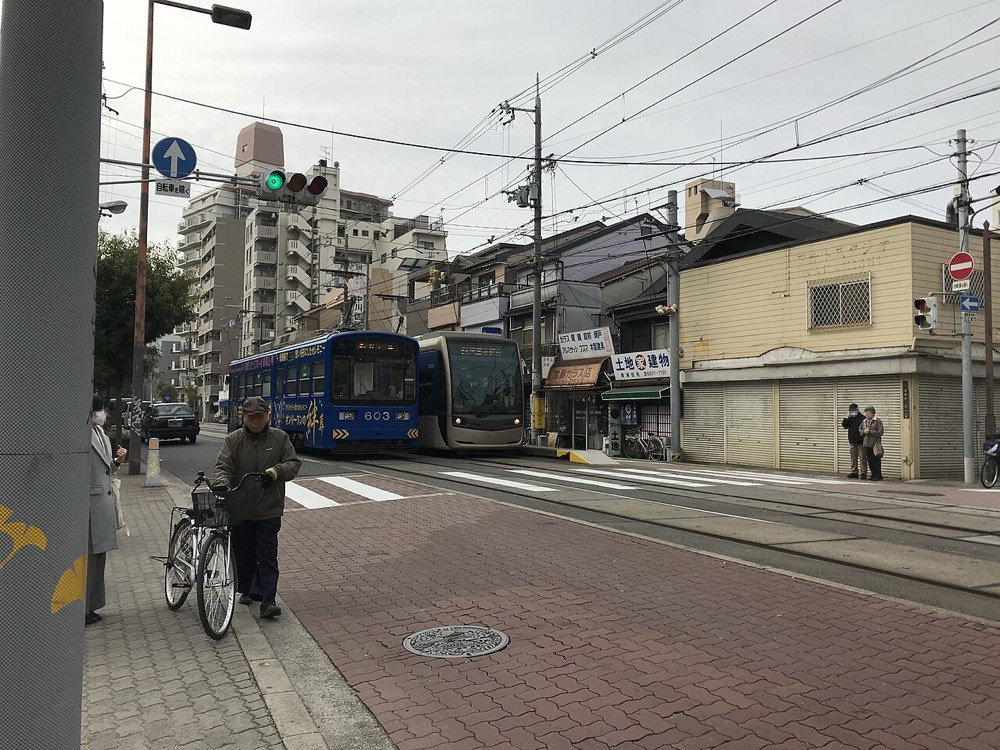
Nankai Main Line: step by step from Namba
- At Nankai Namba Station, tap in with a transit IC card such as ICOCA or Suica, or buy a ¥240 ticket.
- Check the departure boards and board a "Local" (Futsu) train that stops at every station. Regular Express, Airport Express and Limited Express trains skip Sumiyoshitaisha, and the wrong train will carry you past Sakai.
- After about 9 minutes, get off at Sumiyoshitaisha Station, walk about 3 minutes east and cross the streetcar tracks to reach the great torii and main approach.
In past years, between about 10:00 and 16:20 from January 1 to 4, Nankai had Airport Express and Sectional Express trains make extra stops at Sumiyoshitaisha[8]. Check Nankai's announcements to see whether this applies in 2027.
Hankai Tramway: step by step from Tennoji
The Hankai Tramway is Osaka's last surviving streetcar line. Every single ride costs ¥240 (children ¥120), paid when you get off; if you need to change trams, pay at the designated transfer stop (Sumiyoshi or Abikomichi) and take a transfer ticket[9]. From Tennoji-ekimae, trams bound for Abikomichi or Hamadera-ekimae both pass Sumiyoshi-toriimae.
If you'll ride several times in a day, the Tekuteku Kippu one-day ticket costs ¥700 for adults (scratch card, sold at Tennoji-ekimae and other ticket offices and on board), or the digital one-day ticket ¥680[10]. A simple round trip is only ¥480, so it's not worth it unless you ride at least three times.
Sumiyoshi Taisha visiting order: Sorihashi, the main sanctuaries and Gosho Gozen
Bottom line: the shrine's recommended formal route is to enter from the main approach, cross the Sorihashi bridge, purify your hands at the water basin, then pray at the First to Fourth Main Sanctuaries, about 20 minutes in all. The shrine notes there is no set order for the four sanctuaries, so start wherever the line is shortest[5].
Sorihashi (Taikobashi): crossing it is a purification
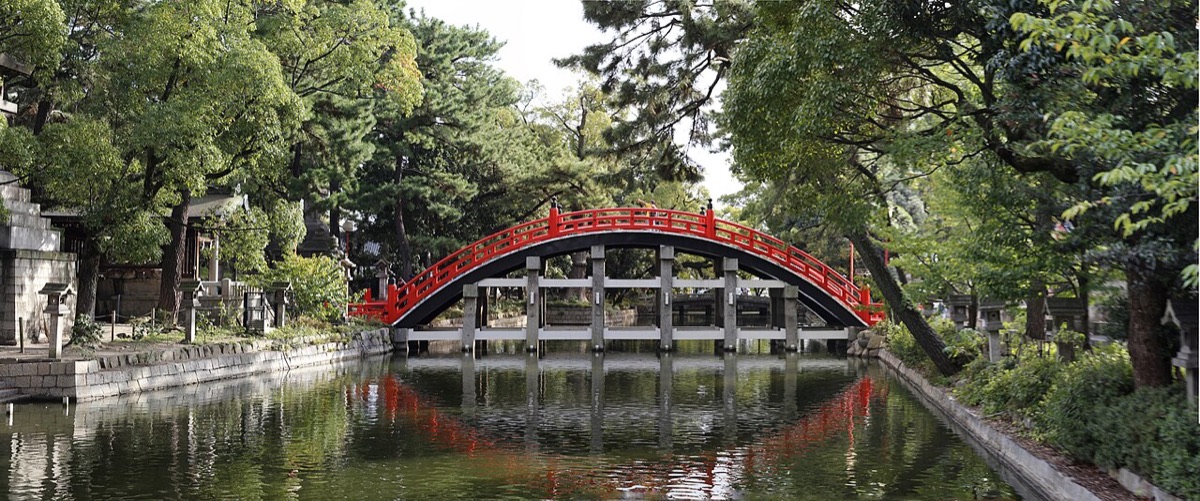
The Sorihashi (反橋) is the symbol of Sumiyoshi Taisha. It spans the sacred pond and is about 20 m long and 3.6 m high, with a maximum slope of about 48 degrees[3]. According to the shrine, simply crossing the bridge is believed to purify you, and the current stone piers are said to have been donated by Yodo-dono to pray for the growth of Toyotomi Hideyori[3].
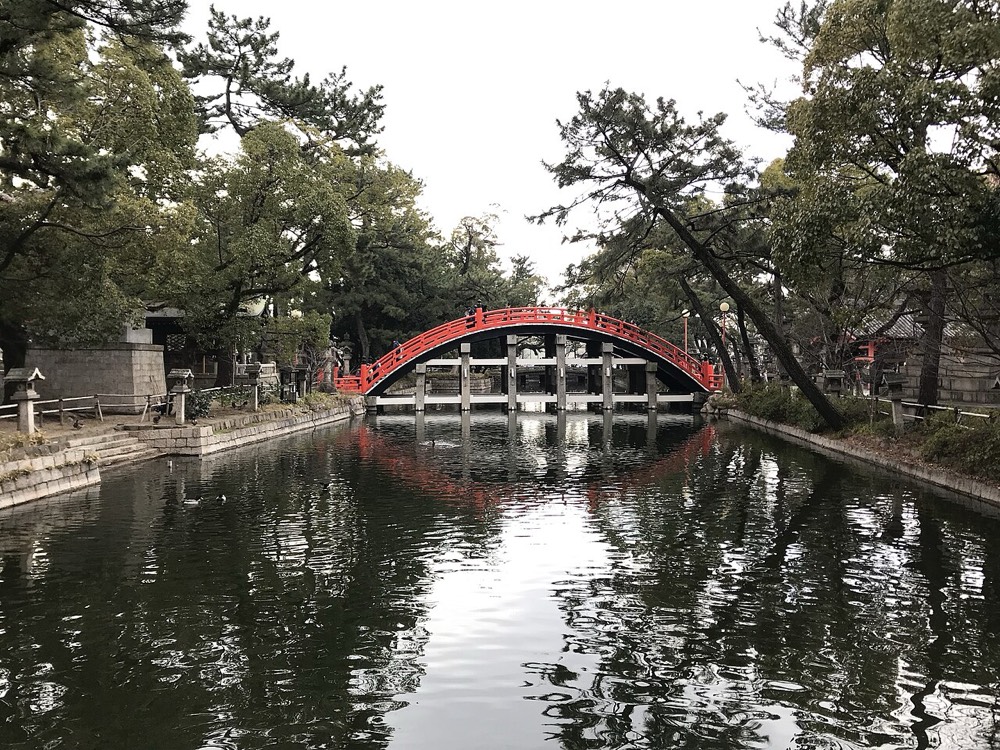
The bridge has footholds, but going down is scarier than going up and it gets slippery in the rain; the shrine also reminds visitors to hold both handrails. It's steep and stepped, so if you have a stroller, limited mobility or luggage, don't force it; ask staff on site for another route to the main sanctuaries. From the pond's edge you can photograph the bridge and its reflection forming a full circle.
First to Fourth Main Sanctuaries: National Treasure Sumiyoshi-zukuri
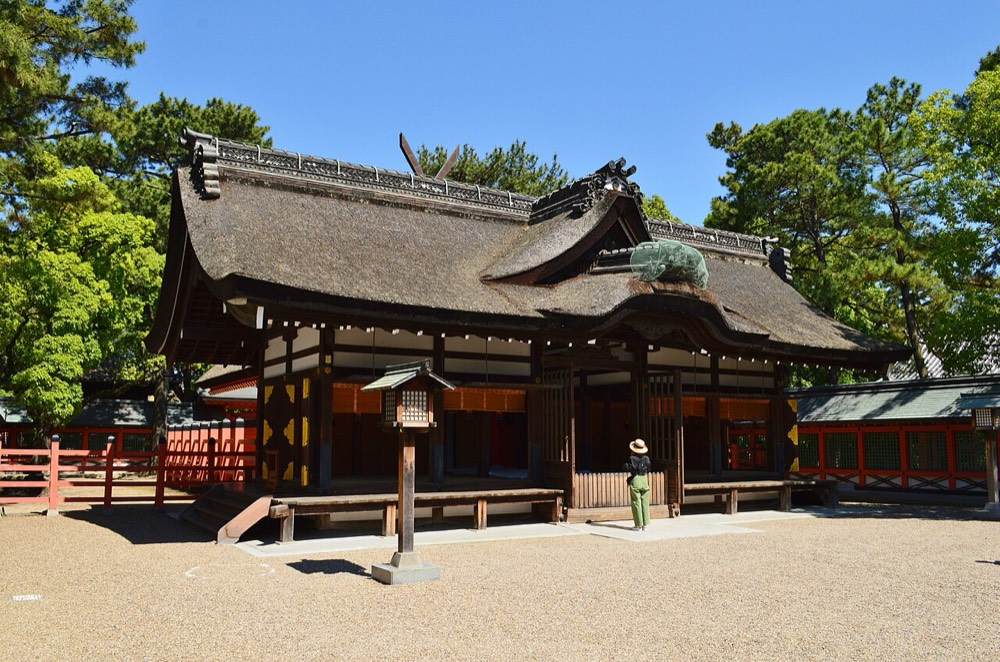
All four main sanctuaries face west toward Osaka Bay. The First to Third stand in a straight line, one behind the other, while the Fourth stands beside the Third, a layout rare anywhere in Japan[4]. Sumiyoshi-zukuri is known for straight cypress-bark roofs, entrances on the gable end, vermilion pillars and walls painted with white gofun.
| Sanctuary | Deity | Common prayers |
|---|---|---|
| First | Sokotsutsu-no-o-no-mikoto | Purification, safe voyages |
| Second | Nakatsutsu-no-o-no-mikoto | Purification, safe voyages |
| Third | Uwatsutsu-no-o-no-mikoto | Purification, safe voyages |
| Fourth | Empress Jingu | Safe childbirth (noted by the shrine) |
In front of the Fourth Main Sanctuary is the "Nade-usagi" (stroking rabbit). Because the shrine was founded in a year, month and day of the Rabbit, rabbits are considered divine messengers, and visitors stroke its body to pray for good health[3]. Pray in the usual way: bow twice, clap twice, bow once.
Gosho Gozen: find the three stones marked "go, dai, riki"
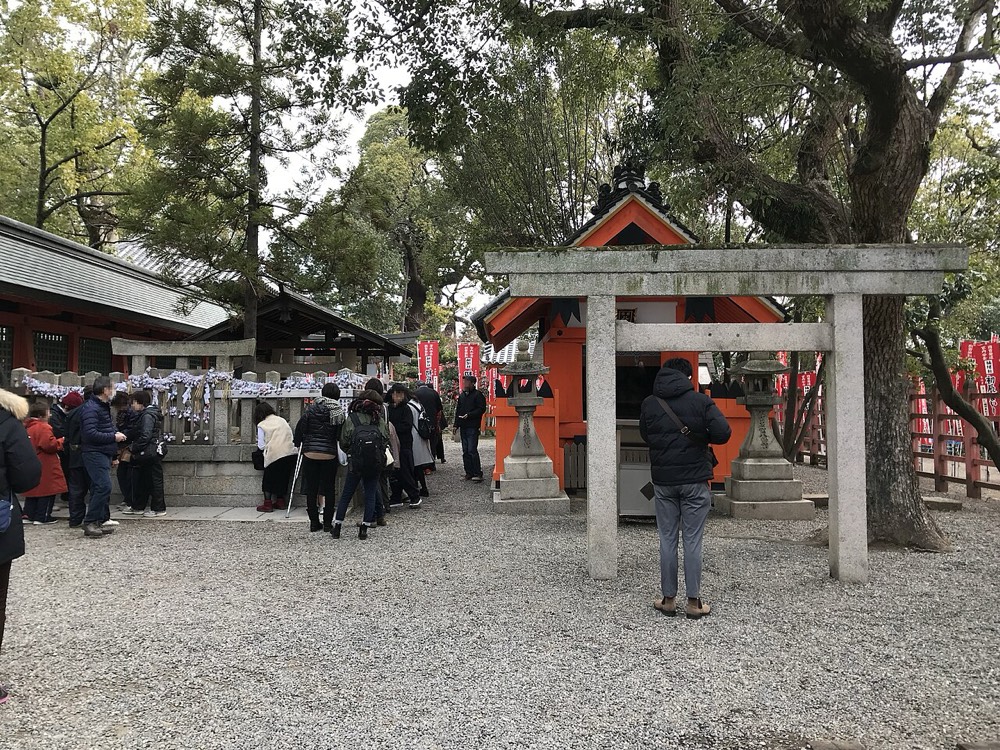
Gosho Gozen (五所御前) lies just south of the First Main Sanctuary and is said to be where the Sumiyoshi deities were first worshipped about 1,800 years ago[3]. The ground inside the stone fence is covered with pebbles, some marked with the characters 五, 大 and 力. Find one of each, put them in a charm bag, and you have a Godairiki stone charm, said to grant five powers: strength, wisdom, wealth, fortune and longevity.
How to do it:
- Pray at the main sanctuaries first, then go to Gosho Gozen (open from gate opening until 16:00).
- Gently look for marked pebbles and take just one for each character. Don't scoop up handfuls or disturb the ground; this is a sacred spot.
- Get a Godairiki charm bag at the charm office (from 9:00, offering ¥500)[5][1]. Since January 2026 the bag comes in 10 colors[13].
- When your wish comes true, buy "thank-you pebbles" at the charm office and return them to Gosho Gozen together with the stones you picked; the shrine asks you to give back double.
Hattatsu mairi and lucky cats: the 48-month rule at Nankun-sha
Bottom line: on the first Dragon day of each month (Hattatsu day), visit Tanekashi-sha → Nankun-sha → Asazawa-sha → Otoshi-sha in that order and receive one small lucky cat at Nankun-sha. Keep it up for four years, 48 visits, and you complete the vow; "48 Dragons" (shiju-hattatsu) is a pun on "prospering from start to finish"[2].
The shrine's lucky cat upgrade rules[2]:
| Stage | Condition | You receive |
|---|---|---|
| Every month | One small cat on Hattatsu day (left paw in odd months, right paw in even months) | 1 small cat |
| Year 4 | 48 small cats collected | 1 medium cat |
| Year 12 | 2 medium cats + 48 small cats | 1 large cat |
| Year 24 | Both left-paw and right-paw large cats | Great wish fulfilled |
A left-paw cat beckons people and family safety; a right-paw cat beckons money and business prosperity. The shrine's website does not list the offering for the cats and media reports give different amounts, so check the notice on site.
The remaining Hattatsu day in 2026 is December 8 (Tue). In January 2026 the shrine used the second Dragon day (January 18) instead, so January may be adjusted for the New Year crowds; wait for the official 2027 schedule[2]. You can also visit on other days: Nankun-sha accepts visitors 9:00–16:00 on ordinary days and handles prayers for Tanekashi-sha and Otoshi-sha too[1].
Tanekashi-sha: first stop, receive the "seed" of your wish
Tanekashi-sha (種貸社) enshrines Ukanomitama-no-mikoto. The faith began with granting rice seed and praying for harvests, and later grew into prayers for business capital, funding and children[2]. Those who receive a prayer here (¥1,500) are given "otanesen" seed coins to add to their business funds.
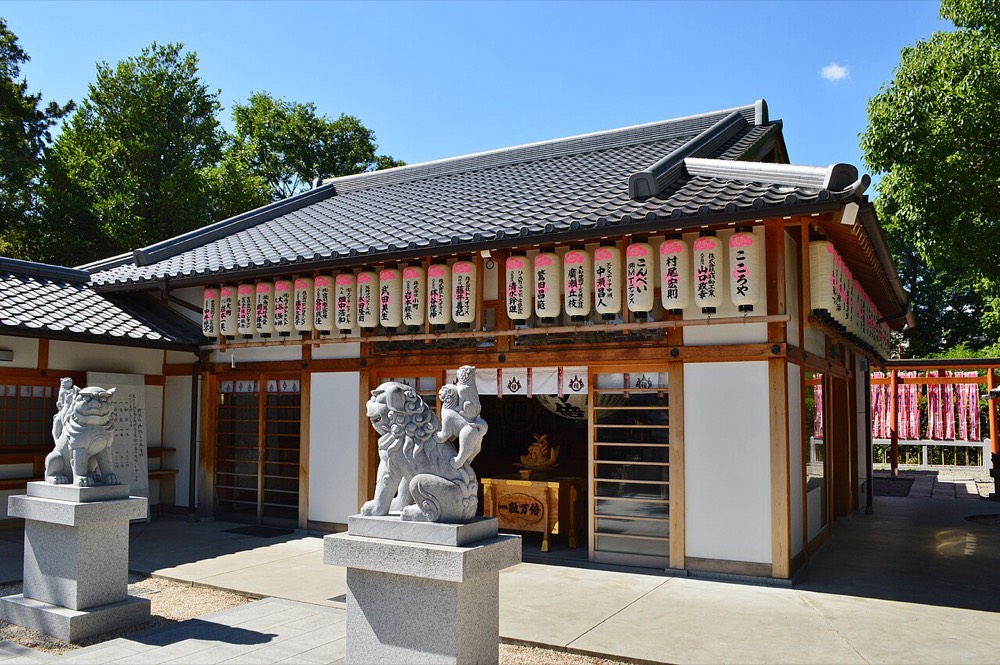
The Tanekashi-sha grounds also hold "Issun-boshi's bowl". In the folk tale, Issun-boshi was a child granted to an elderly couple who prayed to the Sumiyoshi deities, and you can sit in this bowl boat for photos[3].
Nankun-sha: home of the lucky cats, "Hattatsu-san"
Nankun-sha (楠珺社) is the heart of Hattatsu mairi, nicknamed "Hattatsu-san", and enshrines Ukanomitama-no-kami. According to the shrine, a camphor tree over 1,000 years old stands here; in the Edo period people built a small shrine at its roots, which became Nankun-sha[2].
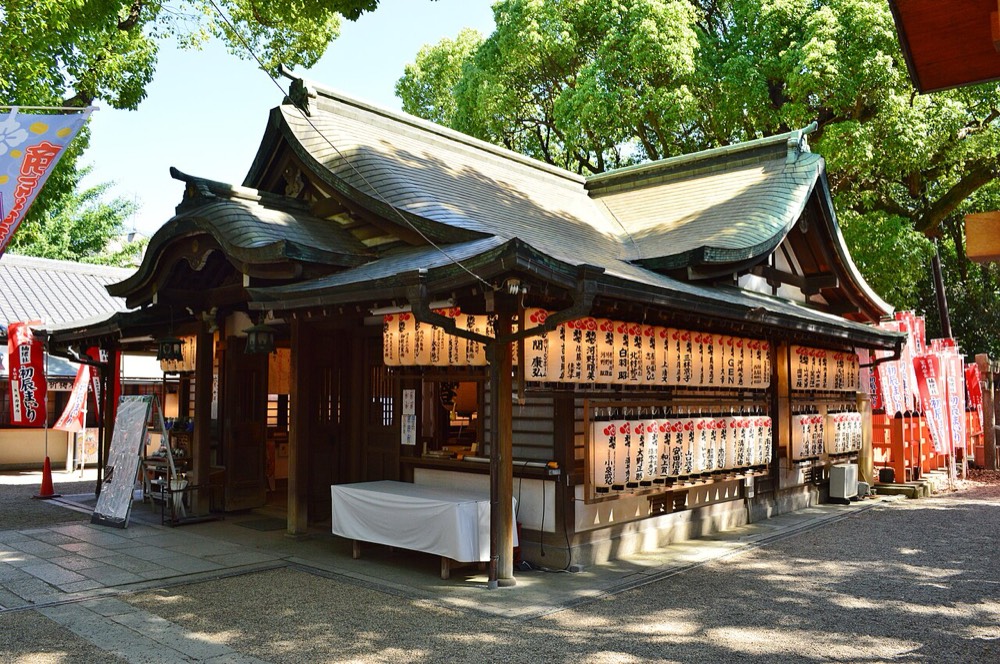
On Hattatsu days, Nankun-sha accepts visitors 6:00–15:45, and prayers cost ¥2,000. Besides lucky cats, it offers items such as the Hattatsu treasure ship and a New Year-only Hattatsu rake[2][12]. The shrine notes that business owners travel from afar from early morning on Hattatsu days, so if you want to take your time, avoid those days.
Asazawa-sha: guardian of women and the arts
Asazawa-sha (浅澤社), known as "Sumiyoshi's Benten-san", enshrines Ichikishimahime-no-mikoto and is prayed to for beauty, improvement in the arts and the protection of women; by tradition, women visiting Sumiyoshi Taisha stop here too[2]. The site was once the Asazawa marsh, famous for rabbit-ear irises that bloom in mid-May.
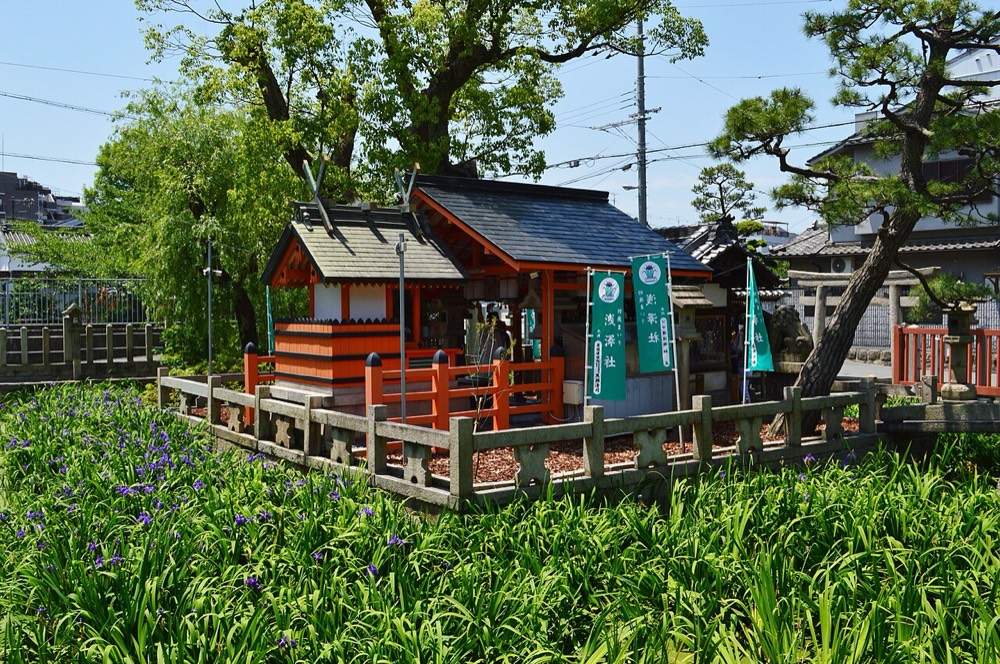
Neither Asazawa-sha nor Otoshi-sha is in the main precinct with the sanctuaries. Otoshi-sha is about a 2-minute walk southeast of the main shrine[3]; follow the signs on the grounds.
Otoshi-sha and the Omokaru stones: the final stop
Otoshi-sha (大歳社) enshrines the harvest deity Otoshi-no-kami and is now known for blessings on collecting money. Receive a prayer (¥1,000) and you get the "Otoshi-mamori", a small stone marked with the character 大[2].
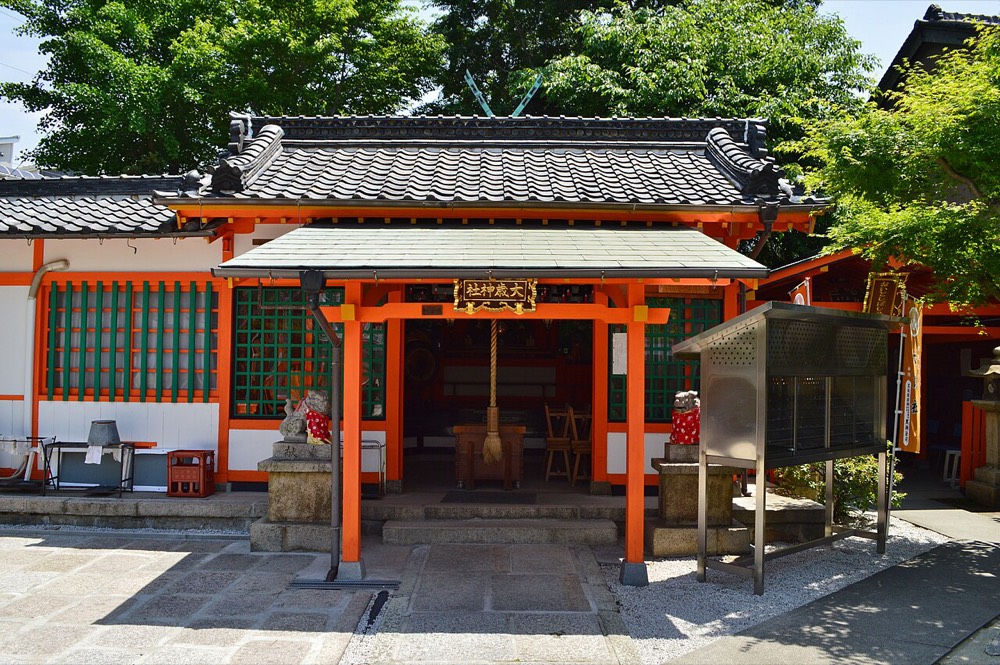
Oitoshiboshi-sha, within the Otoshi-sha grounds, has three "Omokaru stones", which often draw lines on weekends and Hattatsu days[3]. First bow twice, clap twice and bow once, then lift a stone to feel its weight. Rest your hand on it and make your wish, then lift it again; if it feels lighter the second time, your wish will come true. Open from gate opening until 16:00[1].
Sumiyoshi Taisha omamori and goshuin: where and when
Bottom line: both omamori and goshuin are handled at the charm office beside the main sanctuaries, open 9:00–17:00. If you arrive around 6:00, pray and look for your Godairiki stones first, then return to the charm office after 9:00[1].
- Godairiki stone charm: stones you pick yourself plus a charm bag (¥500), Sumiyoshi Taisha's most distinctive charm.
- Other omamori: the shrine lists charms for protection from misfortune, warding off bad luck, passing exams, good relationships, traffic safety, work, money luck and seed money, among others. Prices are not published online, so check at the charm office[12].
- Goshuin: issued at the charm office, which also sells goshuin books, goshuin bags and a goshuin book with a Sumiyoshi doll zodiac pattern. The shrine also announced an embroidered goshuin in collaboration with JR Central (February 2025)[12]. The offering amount is not published online.
- Lucky cats and Nankun talismans: received at Nankun-sha, not at the main charm office.
If you want a formal prayer (accepted 9:00–15:50), no booking is needed; just apply at the charm office[1].
Sumiyoshi Taisha opening hours: main sanctuaries, charm office and Gosho Gozen
Bottom line: the easiest mistake is assuming everything keeps the same hours. The main sanctuaries open earliest, but Gosho Gozen, the Omokaru stones and Nankun-sha all close at 16:00.
| Place | Ordinary hours |
|---|---|
| Main sanctuaries (opening) | Apr–Sep 6:00, Oct–Mar 6:30; 6:00 on the 1st of each month and on Hattatsu days |
| Main sanctuaries (closing) | 17:00 |
| Charm office (omamori, goshuin) | 9:00–17:00 |
| Prayer reception | 9:00–15:50 |
| Gosho Gozen | Gate opening–16:00 (charm bags from 9:00) |
| Omokaru stones | Gate opening–16:00 |
| Nankun-sha, Tanekashi-sha | 9:00–16:00 |
(Official site, checked November 2026[1].) Eating, drinking, smoking and drones are prohibited on the grounds, and bicycles may not be ridden in.
Sumiyoshi Taisha hatsumode: avoiding the 2027 New Year crowds
Bottom line: the first three days of January are crowded all day, with over 2 million visitors[6]. To avoid long waits, skip late December 31 through midday January 1 and go early on January 1, in the evening of January 3, or on a weekday morning from January 4.
The shrine has not yet announced its 2026–27 New Year hours. The table below shows 2025–26 as a past-year reference[7]:
| Date | Hours (past-year reference) |
|---|---|
| December 31 | Gates open 22:00, all night until 20:00 on January 1 |
| January 2–3 | 6:00–19:00 |
| January 4–5 | 6:00–18:00 |
| From January 6 | 6:30–17:00 |
Tips for handling the crowds:
- Don't drive: the shrine announces traffic controls around the area from 23:00 on December 31 to about 19:00 on January 1, and from 10:00 to about 19:00 on January 2 and 3, with the parking lot closed from December 31 to January 3[1].
- The bridge and First Main Sanctuary are the busiest: from New Year's Eve into January 1, the stretch from the main approach over the Sorihashi to the sanctuaries is the most congested. Follow staff directions when crowd control is in place, and don't push.
- Plan your late-night return: in past years Nankai did not run all night on New Year's Eve, so after a late visit you'll need to wait for the first train or take a taxi. If the station is packed, walking east to Sumiyoshi-higashi on the Nankai Koya Line is another option.
- New Year rituals to watch: the shrine lists the Wakamizu ritual at 5:00 and Saitansai at 6:00 on January 1, Toka Shinji at 13:00 on January 4, and Aouma Shinji (white horse ritual) at 11:00 on January 7, when a limited goshuin and charm are offered[15].
For overall New Year's Eve transport, other shrines and the Universal Studios countdown, see Osaka New Year 2026–2027. For hatsumode etiquette and Japanese New Year customs, see our Japan New Year guide.
Along the Hankai Tramway: a half-day itinerary
Bottom line: Sumiyoshi Taisha sits midway along the Hankai Tramway, with Shinsekai and Tennoji to the north and central Sakai to the south. A ¥700 one-day ticket pays for itself after three rides.
| Time | Plan | Notes |
|---|---|---|
| 8:30 | Board the Hankai Tramway at Tennoji-ekimae | About 20 min |
| 9:00 | Sumiyoshi Taisha: Sorihashi → main sanctuaries → Gosho Gozen | After 9:00, get your charm bag and goshuin at the charm office |
| 10:00 | Tanekashi-sha → Nankun-sha → Asazawa-sha → Otoshi-sha | About 40 min, including the Omokaru stones |
| 11:00 | Ride south from Sumiyoshi-toriimae to Shukuin | Central Sakai |
| 11:20 | Sakai Plaza of Rikyu and Akiko | About 1 min walk from Shukuin; exhibition ¥300 for adults[14] |
| 13:00 | Head back toward Ebisucho | Per the official rules you may need to change at Abikomichi; lunch in Shinsekai |
| 14:00 | Tsutenkaku and a Shinsekai stroll | See our Tsutenkaku and Shinsekai guide |
Sakai Plaza of Rikyu and Akiko covers the tea master Sen no Rikyu and the poet Yosano Akiko, and is closed on the third Tuesday of each month and over the New Year holidays; if you visit Sumiyoshi Taisha at New Year, drop the southern leg. For more winter plans in Osaka see our Osaka winter travel guide, and for more sights see Osaka attractions.
Who is Sumiyoshi Taisha for, and who should skip it?
Good for:
- Travelers who want the atmosphere of an ancient shrine within Osaka city; weekday mornings are relatively quiet.
- Omamori and goshuin collectors, or anyone who wants to take home a Godairiki charm with stones they picked themselves.
- Business owners hoping for prosperity who can visit on Hattatsu days monthly or whenever they're in Osaka, slowly collecting lucky cats.
- Fans of streetcars and old Osaka neighborhoods.
Not ideal for:
- Travelers with only half a day who want to focus on shopping in Umeda or Shinsaibashi; the round trip plus visiting takes at least 2 hours.
- Visitors with strollers or limited mobility who really want to cross the Sorihashi; it is steep and stepped, so you can only admire it from the side.
- Crowd-averse visitors who can only go during the first three days of January; a smaller shrine is a better choice then.
How to plan it smoothly
- Go in the morning: the main sanctuaries open at 6:00 or 6:30, but the charm office opens only at 9:00 and Gosho Gozen and Nankun-sha close at 16:00, so a morning visit means you won't miss anything.
- Nankai there, Hankai back: take the Nankai local in from Namba and ride the Hankai Tramway back to Tennoji or Shinsekai for two different views in one trip.
- Batch the charm office: lines form at the charm office on Hattatsu days and weekends, so find your Godairiki stones first and then get your charm bag and goshuin in one visit.
- Check the latest notices for New Year: opening hours, Nankai's extra stops and traffic controls can change every year, so check the shrine's and Nankai's announcements before you go.
FAQ
What is the fastest way from Namba to Sumiyoshi Taisha?
From Nankai Namba Station, take a Nankai Main Line 'Local' (Futsu) train to Sumiyoshitaisha Station, about 9 minutes and ¥240, then walk about 3 minutes east to the main approach. Express-type trains normally skip this station, so board a local. In past years, Airport Express and Sectional Express trains made extra stops here during the daytime from January 1 to 4.
How do I find the Godairiki stones at Sumiyoshi Taisha? Is there a fee?
Gosho Gozen is just south of the First Main Sanctuary. Inside the stone fence, look among the pebbles for three marked 'go' (五), 'dai' (大) and 'riki' (力), and put them in a Godairiki charm bag. Picking stones is free; the bag is ¥500 at the charm office, from 9:00. When your wish comes true, return your stones with twice as many thank-you pebbles.
How does the Sumiyoshi Taisha lucky cat collection work?
On the first Dragon day of each month (Hattatsu day), receive one small lucky cat at Nankun-sha: left paw raised in odd months (family safety), right paw in even months (business prosperity). Collect 48 over four years to exchange for a medium cat; with two medium cats plus another 48 small ones, you get a large cat in year 12. The shrine's website does not list the cat offering price, so check on site.
What time does Sumiyoshi Taisha open, and when can I get a goshuin?
The main sanctuary area opens at 6:00 from April to September and 6:30 from October to March (6:00 on the 1st of each month and on Hattatsu days), and closes at 17:00. The charm office, where you get omamori and goshuin, is open 9:00–17:00, so if you arrive early you can only pray at first. Hours differ during New Year and the summer festival.
When is Sumiyoshi Taisha less crowded for hatsumode?
The first three days of January are busy all day, with the worst crowds from late December 31 through January 1 daytime. In past years the gates opened at 22:00 on December 31 for all-night visits. To avoid the crush, go early on the morning of January 1 or on a weekday morning from January 4. The 2027 New Year hours have not been announced yet.
Sources
- Sumiyoshi Taisha: Access: Gate hours, charm office and Gosho Gozen hours, walking times from stations, New Year traffic controls and parking closure (checked November 2026)
- Sumiyoshi Taisha: Hattatsu mairi: Four-shrine route, lucky cat collection rules, 2026 Hattatsu days, reception hours and prayer fees
- Sumiyoshi Taisha: Highlights: Sorihashi dimensions and history, Gosho Gozen and Godairiki stones, Omokaru stones, Issun-boshi bowl, stroking rabbit
- Sumiyoshi Taisha: Main sanctuaries: Four main sanctuaries built in 1810, National Treasure designation, deities and layout
- Sumiyoshi Taisha: How to walk the grounds: Official routes and times, no set order for the main sanctuaries, Godairiki charm bag ¥500
- OSAKA-INFO: Sumiyoshi Taisha: Overview, access, visitor numbers in the first three days of the New Year
- Jorudan Hatsumode 2026: Sumiyoshi Taisha: 2025–26 New Year opening hours (past-year reference)
- Tetsudo Channel: Kansai railways' 2025–2026 New Year operations: Nankai express trains making extra stops at Sumiyoshitaisha from January 1 to 4 (past-year reference)
- Hankai Tramway: Fares and tickets: Flat fare of ¥240, transfer rules
- Hankai Tramway: Discount tickets: Tekuteku Kippu and digital one-day ticket prices and sales points
- Ekitan: Namba (Nankai) to Sumiyoshitaisha: Nankai Main Line local travel time and fare; Hankai Uemachi Line Tennoji-ekimae to Sumiyoshi travel time
- Sumiyoshi Taisha: Charms and amulets: Types of omamori, goshuin books, embroidered goshuin, Nankun-sha items
- Sumiyoshi Taisha news: About the Godairiki stone charm: Charm bag available in 10 colors from January 2026
- OSAKA-INFO: Sakai Plaza of Rikyu and Akiko: 1-minute walk from Shukuin Station, exhibition admission
- Sumiyoshi Taisha: January events: Times of the Wakamizu ritual, Saitansai, Toka Shinji and Aouma Shinji
Fares, opening hours and event dates can change. Information checked on 2026.11.21; please confirm with official sources before you go.