Tsukiji Outer Market Food Guide: Prices, Budget, a Walking Route from the Station and Year-End Closing Days
Tsukiji Outer Market prices for tamagoyaki, oysters, seafood bowls and sushi, a budget for two, a 90-minute route from the station, and Dec 2026–Jan 2027 closing days.
Quick answer
Tsukiji Outer Market has about 460 shops; visit 9:00–13:00. Snacks mostly cost ¥200–500 (a tamagoyaki skewer is ¥200), oysters about ¥800–1,000 each, and seafood bowls about ¥1,900–3,500. Two people grazing for 90 minutes spend about ¥1,600 on snacks only, or about ¥6,800 with a bowl each. December 2026 closing days are Wednesdays, Sundays and Dec 31 (open Dec 27 and 30); January 2027 closes Jan 1–4, Jan 11, Wednesdays and Sundays (open Jan 6).
How much does Tsukiji Outer Market cost, what is the easiest way to walk it, and will it be closed if you go at year end? Short answers: snacks mostly cost ¥200–500, seafood bowls about ¥1,900–3,500, and two people grazing for 90 minutes spend roughly ¥1,600 to ¥11,400. After the wholesale market moved to Toyosu in 2018, what remains is Tsukiji Outer Market, a shopping district of about 460 shops[4]. Below are a price table, a budget, a route starting from the station exit, the December and January closing days from the official calendar, and the visitor rules.
What is Tsukiji Outer Market, and how is it different from the old Tsukiji Market?
In short: only the "outer" part remains at Tsukiji, meaning the streets of shops around the former wholesale market; the tuna auction and wholesale trading are now at Toyosu.
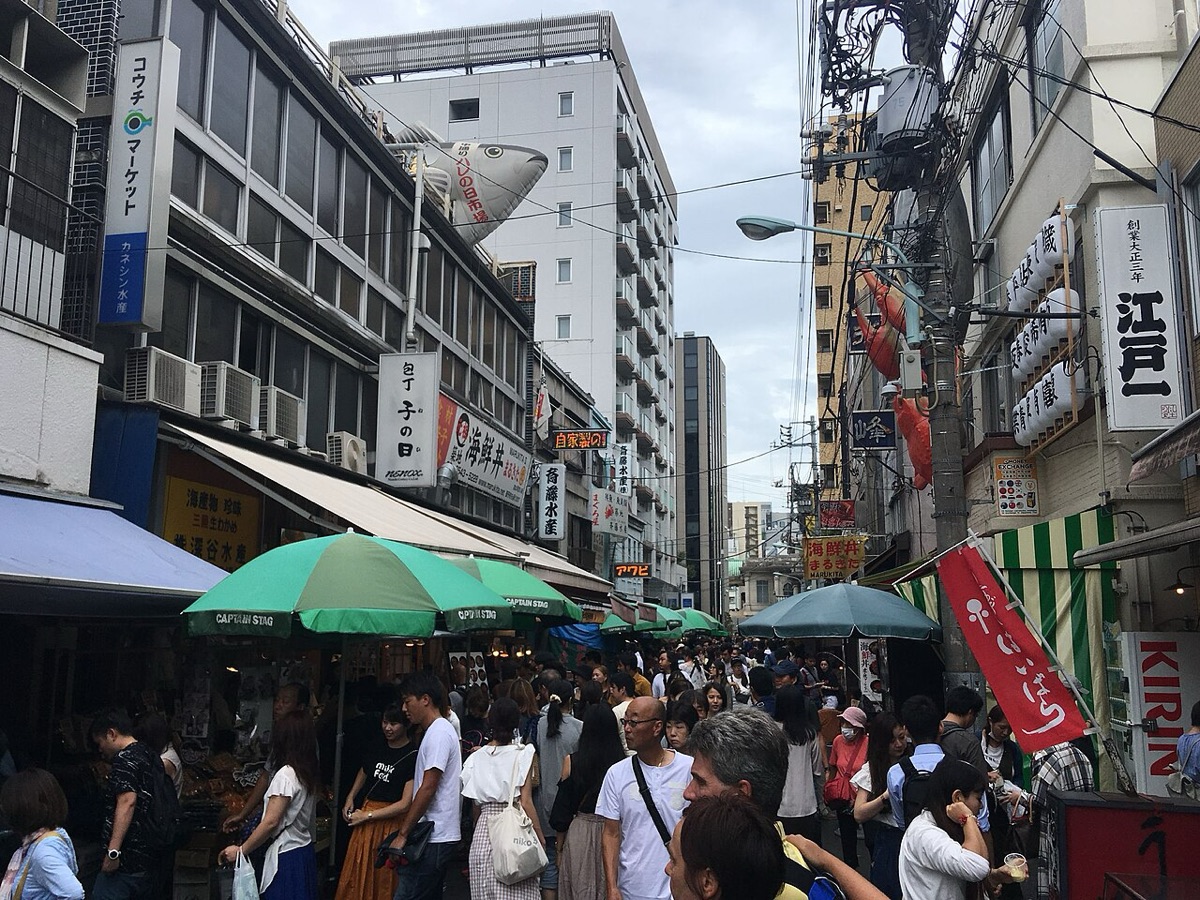
The old "Tsukiji Market" had two parts: Tokyo's central wholesale market (the inner market) and the retail and restaurant district around it (the outer market). When the wholesale market moved to Toyosu in 2018, the outer market shops stayed and kept trading, and GO TOKYO describes the area as still lively today[4].
Shops in Tsukiji Outer Market today fall into three groups:
- Restaurants: seafood bowls, sushi, ramen and cafés, many open from the morning.
- Snack stalls and food shops: tamagoyaki, grilled seafood, processed fish products, dried goods and seasonings.
- Kitchen tool and tableware shops: knives, sushi rolling mats, matcha whisks and dishes, popular as souvenirs.
Chuo City also runs "Tsukiji Uogashi" next to the market, in two buildings, Odawarabashi and Kaikobashi. The ground floor sells seafood and produce, and the third floor has the "Uogashi Shokudo" food court and a rooftop plaza[6].
Tsukiji Outer Market prices: budget, mid-range and premium
In short: snacks are mostly ¥200–500, oysters and teriyaki skewers about ¥700–1,000, and a sit-down seafood bowl or nigiri set starts at around ¥2,000. All prices are in yen, with the source and date on each row; prices at Tsukiji change often, so follow the shop's display.
| Price band | Item (shop) | Price | Source and date |
|---|---|---|---|
| Budget (under ¥500) | Kushitama tamagoyaki skewer (Tsukiji Yamacho) | 200 | Tokyo Shimbun, Sep 2025[11] |
| Budget | Mini meat bun (Suga Shoten) | 200 | Jalan, Feb 2026[12] |
| Budget | Maguro-yaki tuna pastry (Tsukiji Sanokiya) | 280 | Jalan, Feb 2026[12] |
| Budget | Matsusaka beef croquette (Ginza Yoshizawa, Tsukiji meat shop) | 300 | Jalan, Feb 2026[12] |
| Budget | Mentaiko or green onion tamagoyaki skewer (Tsukiji Yamacho) | 350 | Tokyo Shimbun, Sep 2025[11] |
| Mid-range (¥500–1,500) | Baby octopus teriyaki skewer (Aji no Hamato) | 680 | Jalan, Feb 2026[12] |
| Mid-range | Grilled oyster, 1 piece (Kakigoya Tsukiji Shokudo) | 800 | Shop's official menu[13] |
| Mid-range | Raw oyster, 1 piece (Kakigoya Tsukiji Shokudo) | 1,000 | Shop's official menu[13] |
| Mid-range | Tuna teriyaki skewer (Aji no Hamato) | 1,000 | Jalan, Feb 2026[12] |
| Mid-range | Tamagoyaki tasting set of 4 (Tsukiji Yamacho) | 1,100 | Tokyo Shimbun, Sep 2025[11] |
| Premium (¥1,500+) | Seafood bowl: cheapest whitebait bowl at one restaurant | 1,900 | SoraNews24, Dec 2025[15] |
| Premium | Omakase nigiri (Sushikuni) | from 2,000 | Official market shop page[14] |
| Premium | Seafood bowl: tuna / salmon bowl at the same restaurant | 2,400 / 3,500 | SoraNews24, Dec 2025[15] |
| Premium | Sushi course (Sushikuni, reservation required) | from 4,000 | Official market shop page[14] |
| Premium | Sea urchin bowl (top-priced single bowl at one restaurant) | 22,000 | SoraNews24, Dec 2025[15] |
What to keep in mind about prices:
- "Tsukiji is cheap" is an old impression. SoraNews24 reported in December 2025 that a mixed sashimi bowl that used to cost about ¥1,000 now costs roughly double[15]. On a tight budget, snacks are better value than a sit-down bowl.
- Tamagoyaki is the cheapest and most reliable: a kushitama skewer is ¥200, and a whole take-home tamagoyaki starts at ¥800[11].
- Grilled oysters cost less than raw: at the same shop, a grilled oyster is ¥800 and a raw one ¥1,000[13].
- Sea urchin bowls vary the most; if you see "market price" or no price, ask before ordering.
To build a food day with Tsukiji, monjayaki in Tsukishima and ramen, see the Tokyo food guide.
How much do two people spend in 90 minutes? A sample budget
In short: snacks only come to about ¥1,600, a seafood bowl each plus a shared oyster about ¥6,800, and adding oysters, teriyaki skewers and a pricier bowl takes it to ¥11,000 or more. The estimates below use the sourced prices from the previous section:
| Plan | What each person eats | Total for 2 |
|---|---|---|
| Light snacks | Kushitama 200 + tuna pastry 280 + Matsusaka beef croquette 300 | About ¥1,560 |
| Standard brunch | Kushitama 200 + croquette 300 + tuna bowl 2,400; one raw oyster shared, 1,000 | About ¥6,800 |
| Splurge | Kushitama 200 + raw oyster 1,000 + tuna teriyaki skewer 1,000 + salmon bowl 3,500 | About ¥11,400 |
MATCHA's guide, as of August 2026, also puts the budget for 3–5 items at ¥3,000–5,000 per person[16], in line with the standard to splurge plans above. Actual spending depends on portion sizes, the season and what is left after queues, so carry a bit more cash than your estimate; GO TOKYO notes that many shops take cash only[5].
A 90-minute Tsukiji Outer Market route from the station exit
In short: leave Tsukiji or Tsukiji-shijo Station at 9:00, pick up a map at the information center, visit Namiyoke Inari Shrine, snack your way back through the lanes, then sit down for a seafood bowl. The official "First time at Tsukiji" page suggests a plan of about three hours, from 9:00 to 12:00[17]; below is a condensed 90-minute version, with timings estimated by this site from the official plan.
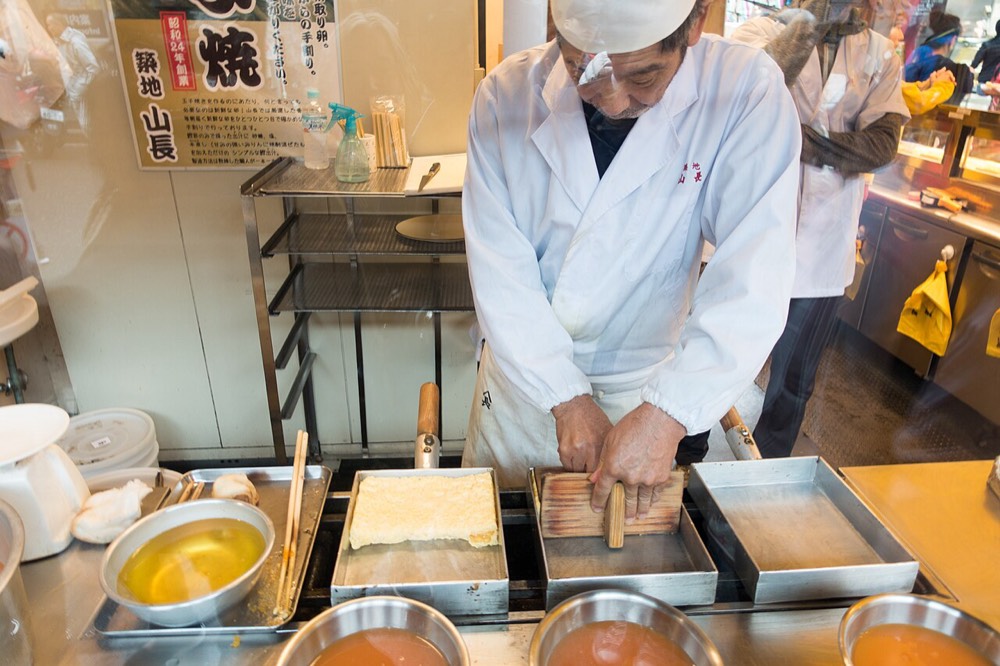
- Leave the station (0 min): take the Toei Oedo Line to Tsukiji-shijo Station and use Exit A1, or the Tokyo Metro Hibiya Line to Tsukiji Station and use Exit 1 or 2; the official site lists both as about a 1-minute walk to the market[3]. Put suitcases in a station coin locker first[1].
- Platto Tsukiji information center (0–10 min): pick up a market map and ask about shops you want to find. It is on the ground floor of the building hung with senjafuda name plates, on the street running from Shin-Ohashi-dori toward Namiyoke Shrine; it opens 8:00–14:00 on weekdays and 10:00–14:00 on Sundays, holidays and market closing days[18]. Strollers can be left here.
- Namiyoke Inari Shrine (10–20 min): continue along the same street toward the shrine, Tsukiji's guardian shrine, known for its giant lion heads; the official plan also puts it before shopping[17]. It is at Tsukiji 6-20-37, about 5 minutes on foot from Tsukiji-shijo Station and 7 minutes from Tsukiji Station[19].
- Snack time (20–60 min): work back through the lanes eating a tamagoyaki skewer, a tuna pastry, a croquette and so on, finishing each item at the shop before moving on. Browse the kitchen tool and dried goods shops along the way.
- Sit down for a bowl or sushi (60–90 min): the official plan suggests eating lunch a little early[17]. Another option is Uogashi Shokudo on the third floor of Tsukiji Uogashi, open from 7:00[4].
If you still have energy, cross the road to Tsukiji Hongwanji (see below) or walk on toward Ginza.
Tsukiji Outer Market closing days: December 2026 to January 2027
In short: in December, all Wednesdays and Sundays except Dec 30 are closed, plus Dec 31; Sunday Dec 27 is a special open day. In January, Jan 1–4 are closed in a row, plus Coming of Age Day on Jan 11 and Wednesdays and Sundays; Wednesday Jan 6 is open. Based on the calendar on the Tsukiji Outer Market official site (checked 18 November 2026)[9][10]:
| Month | Closing days | Note |
|---|---|---|
| December 2026 | Dec 2 (Wed), 6 (Sun), 9 (Wed), 13 (Sun), 16 (Wed), 20 (Sun), 23 (Wed), 31 (Thu) | Dec 27 (Sun) special open day; Dec 30 (Wed) open as usual |
| January 2027 | Jan 1 (Fri)–4 (Mon), 10 (Sun), 11 (Mon, Coming of Age Day), 13 (Wed), 17 (Sun), 20 (Wed), 24 (Sun), 27 (Wed), 31 (Sun) | Jan 6 (Wed) open as usual |
Three things to note:
- This is the Tokyo Metropolitan Central Wholesale Market closing calendar. The official site notes that some outer market shops also close on these days, but each shop sets its own days, so check directly with any shop you want to visit[2].
- New Year closures vary by shop: Tsukiji Yamacho, for example, closes January 1–3[11], and the Platto Tsukiji information center closes over the year-end and New Year period[18].
- Open every day at year end: Dec 24–30 are all open days (Dec 27 is the special opening), and closures start on Dec 31.
On regular days, hours come in three bands[2]: 6:00–9:00 mainly for trade buyers, 9:00–14:00 regular sales, and after 14:00 at each shop's discretion. GO TOKYO recommends 9:00–13:00, noting that many shops close before evening[4]. Tsukiji Uogashi is open 5:00–15:00, with all shops trading 7:00–14:00, but Chuo City asks general visitors to come after 9:00[6].
Tsukiji Outer Market rules: no eating while walking, and what else to know
In short: the market officially asks visitors not to eat while walking; finish your food in front of or inside the shop. The following is summarized from the official visitor guidelines[1]:
- Do not eat while walking: the alleys are narrow and walking while eating blocks others; eat inside shops or in designated places.
- Store large luggage first: put suitcases in coin lockers; strollers can be left at the information center "Platto Tsukiji".
- Avoid moving in large groups: the lanes are narrow, and hold children's hands.
- Ask before taking photos: some shops display no-photo signs, so follow them.
- Do not touch the goods: especially fresh seafood; ask staff if you need something.
- No haggling: the market explains that goods are sold at wholesale prices and bargaining is not the custom.
- Smoke only in smoking areas: no smoking while walking and no littering.
Chuo City also bans eating and eating while walking on the ground floor of Tsukiji Uogashi[6].
Tsukiji vs Toyosu: how to choose
In short: Tsukiji is for strolling and snacking; Toyosu is for watching the auction and eating sushi in a big building. Visiting Toyosu, the auction and getting there are covered in detail in the Toyosu Market guide; here are only the key differences:
| Comparison | Tsukiji Outer Market | Toyosu Market |
|---|---|---|
| Best for | Snacking stall by stall, kitchen tools | Tuna auction viewing, in-market sushi |
| Hours | Recommended 9:00–13:00 | Visitor passages and dining areas 5:00–17:00[7] |
| Closures | Broadly the same at both: Sundays, national holidays and most Wednesdays | Same |
To do both in one day, go on an open-day morning: Toyosu first, then back to Tsukiji for lunch.
Tsukiji Hongwanji and nearby sights
In short: Tsukiji Hongwanji is right across from the market, a few minutes' walk after eating and a good way to settle your meal.
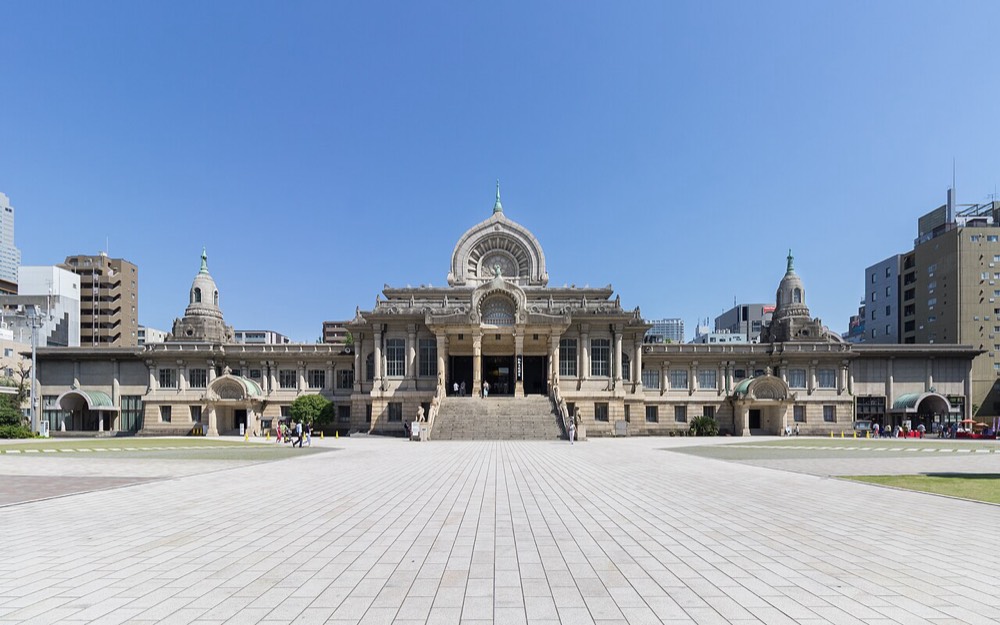
Tsukiji Hongwanji (つきじほんがんじ) is a temple of the Jodo Shinshu Hongwanji school. Its main hall is a stone building in ancient Indian style, completely different from typical wooden Japanese temples and easy to spot. According to Walkerplus information as of April 2026, the main hall is open for visits 6:00–16:00, with the gates closing after the evening service[8]; times may change, so follow the temple's own notices.
Other places to combine:
- Ginza: within walking distance of Tsukiji for an afternoon of shopping.
- Shiodome: GO TOKYO notes that Shiodome is also walkable from Tsukiji[4].
- Tsukishima: for monjayaki at dinner, take the Oedo Line.
Getting to Tsukiji Outer Market by subway or bus
In short: Exit A1 of Tsukiji-shijo Station on the Oedo Line, or Exit 1 or 2 of Tsukiji Station on the Hibiya Line, is about 1 minute from the market. Options listed on the official site[3]:
| Line | Station / exit | Walk |
|---|---|---|
| Toei Oedo Line | Tsukiji-shijo, Exit A1 | About 1 min |
| Tokyo Metro Hibiya Line | Tsukiji, Exit 1 or 2 | About 1 min |
| Tokyo Metro Hibiya Line, Toei Asakusa Line | Higashi-Ginza, Exit 5 or 6 | About 5 min |
By bus, Toei Bus routes "都04", "都05-1" and "都05-2" run from Tokyo Station's Marunouchi South Exit to "Tsukiji 3-chome"; from Shimbashi, route "業10" stops there too[3]. For buying tickets and transferring between Tokyo Metro and Toei lines, see the Tokyo transport guide.
Before you go
- Day: in December and January, check the closing-day table above; for a specific shop, also check its own notices.
- Time: arrive after 9:00 and eat lunch early for the most choice.
- Cash: bring a little more yen than your budget; many shops take cash only.
- Luggage: leave suitcases in station lockers, not in the market.
- Manners: no eating while walking, no touching goods, ask before taking photos.
To fit Tsukiji into a full Tokyo trip, see the 5-day Tokyo itinerary, pairing a market breakfast with Ginza or Asakusa on the same day.
FAQ
How much does it cost to eat at Tsukiji Outer Market?
Snacks only, about ¥800 per person covers a tamagoyaki skewer, a tuna-shaped pastry and a croquette. Add a seafood bowl and it is around ¥3,000 per person. Oysters are about ¥800–1,000 each, and a single sea urchin bowl can top ¥20,000, so budget separately for premium items. Prices change often; follow the shop's display.
What time does Tsukiji Outer Market open, and when is the best time to go?
Officially, 6:00–9:00 is mainly for trade buyers and 9:00–14:00 is regular sales time. Visitors should arrive after 9:00; between 9:00 and 13:00 the most shops are open. The market's own suggested plan has you eat lunch a little early, around 11:00. Many shops start closing after 14:00.
Which days is Tsukiji closed in December and January?
On the official calendar, December 2026 closing days are Dec 2, 6, 9, 13, 16, 20, 23 and 31; Sunday Dec 27 is a special open day and Dec 30 is open. January 2027 closes Jan 1–4, 10, 11, 13, 17, 20, 24, 27 and 31; Wednesday Jan 6 is open. These are wholesale market closing days, and individual outer market shops may differ.
Can you eat while walking at Tsukiji?
No. The market officially asks visitors not to eat while walking, since the narrow alleys get blocked. If you buy tamagoyaki or grilled seafood, finish it in front of the shop, at its seats or in a designated eating area before moving on; eating is also banned on the ground floor of Tsukiji Uogashi.
Tsukiji or Toyosu: which market should I visit?
Choose Toyosu to watch the tuna auction and eat sushi inside a large market building. Choose Tsukiji Outer Market to graze on snacks stall by stall in narrow lanes and shop for kitchen tools and dried goods. Both have almost the same closing days, so avoid Sundays, holidays and most Wednesdays.
Can I pay by card at Tsukiji Outer Market?
Some shops take cards or e-money, but GO TOKYO notes that many accept cash only. Snack stalls mostly deal in amounts of a few hundred yen, so carry ¥1,000 notes and coins. There is also no haggling; prices are as marked.
Sources
- Tsukiji Outer Market official site | Requests for visitors: Rules on eating while walking, photos, luggage and groups
- Tsukiji Outer Market official site | Calendar and hours: Business hour bands and closing day calendar
- Tsukiji Outer Market official site | Access: Subway exits and bus routes
- GO TOKYO | Tsukiji Outer Market: Number of shops, recommended hours, closing days and featured shops (updated August 2026)
- GO TOKYO (Traditional Chinese) | Tsukiji Outer Market: Cash payment reminder and facilities
- Chuo City | Tsukiji Uogashi: Tsukiji Uogashi hours, floors and visitor entry time
- Tokyo Metropolitan Central Wholesale Market | Visiting Toyosu Market: Toyosu visitor passage hours and closing days
- Walkerplus | Tsukiji Hongwanji: Tsukiji Hongwanji visiting hours (information as of April 2026)
- Tsukiji Outer Market official site | Calendar, December 2026: December 2026 closing days and special open day (checked 18 November 2026)
- Tsukiji Outer Market official site | Calendar, January 2027: January 2027 closing days (checked 18 November 2026)
- Tokyo Shimbun Digital | Tsukiji Yamacho (16 September 2025): Prices of tamagoyaki skewers, tasting set and take-home tamagoyaki, hours and New Year closure
- Jalan News | Tsukiji Outer Market street food (as of 18 February 2026): Tax-inclusive prices of tuna pastry, teriyaki skewers, buns and croquettes
- Kakigoya Tsukiji Shokudo | Menu: Raw and grilled oyster and seafood prices
- Tsukiji Outer Market official site | Sushikuni: Starting prices for nigiri and courses, hours and closing day
- SoraNews24 | Tsukiji's tourist-target prices (24 December 2025): Actual seafood bowl prices at an outer market restaurant (whitebait, tuna, salmon and sea urchin bowls)
- MATCHA | Tsukiji Outer Market street food guide (as of August 2026): Per-person budget estimate for 3–5 items
- Tsukiji Outer Market official site | First time at Tsukiji: Official suggested morning plan and timings
- Tsukiji Outer Market official site | Information center Platto Tsukiji: Location, opening hours and stroller storage
- GO TOKYO | Namiyoke Inari Shrine: Shrine address and walking times from stations (updated June 2026)
Fares, opening hours and event dates can change. Information checked on 2026.11.18; please confirm with official sources before you go.