Shinjuku Gyoen Autumn Leaves 2026: Maple and Ginkgo Peak, Chrysanthemum Exhibition, Tickets and Hours
Shinjuku Gyoen autumn leaves 2026: usual maple and ginkgo peak, the Nov 1-15 chrysanthemum show, 500-yen tickets, hours, Monday closures and gates.
Quick answer
Leaves at Shinjuku Gyoen usually start turning in mid-October and peak from late November to early December, with maples, ginkgo, plane trees and dawn redwoods changing colour in waves. There is no evening light-up. The 2026 Chrysanthemum Exhibition runs November 1 to 15 in the Japanese Traditional Garden, and the garden is open on Mondays during that period. Admission is 500 yen for adults and 250 yen for seniors 65+ and students from high school up; junior high students and younger enter free. From October 1 to March 14 the garden is open 9:00 to 16:30 (last entry 16:00). It normally closes on Mondays, and alcohol is not allowed.
Shinjuku Gyoen autumn leaves are the easiest large-scale foliage viewing in central Tokyo: about 10 minutes on foot from the south exit of Shinjuku Station, you can see red maples, yellow ginkgo and the plane-tree avenue of a French formal garden in one 58-hectare national garden. This guide covers the usual peak for maples and ginkgo, the 2026 Chrysanthemum Exhibition dates, tickets and e-tickets, autumn and winter hours, the exceptions to the Monday closure, and which of the three gates to use, so you can pick the right day and the right entrance.
When are Shinjuku Gyoen's autumn leaves best? 2026 peak guide
In short: in a typical year the leaves start turning in mid-October and peak from late November to early December[5]. This is a typical-year reference; the 2026 timing will shift with November temperatures.
The garden has many species, so the colour arrives in waves rather than all at once. Toei Transportation notes that dogwoods (hanamizuki) change first, followed by ginkgo, maples and dawn redwoods, and that the usual foliage period runs from mid-November to mid-December[7]. Walkerplus lists the main species as ginkgo, maple, dawn redwood and plane trees (platanus)[5].
Based on past years, you can plan roughly like this:
- Early November: during the Chrysanthemum Exhibition, cherry leaves and some other trees turn first; most maples are still green.
- Mid to late November: ginkgo and plane trees turn yellow, and the Formal Garden area gets busy first.
- Late November to early December: maples in the Japanese Traditional Garden reach their peak, which is also when weekend crowds are biggest.
- Mid-December: dawn redwoods turn russet, maples begin to drop and the ground is covered with leaves.
To compare Shinjuku Gyoen with other Tokyo foliage spots, see Tokyo autumn leaves 2026: spots and peak times; for the whole country, see Japan autumn leaves 2026 forecast by region.
Where are the best maples and ginkgo in Shinjuku Gyoen? A foliage route
In short: maples are concentrated in the Japanese Traditional Garden, ginkgo and plane trees are best around the Formal Garden, and the area just inside Shinjuku Gate is full of autumn colour too. These three are the highlights Walkerplus recommends[5].
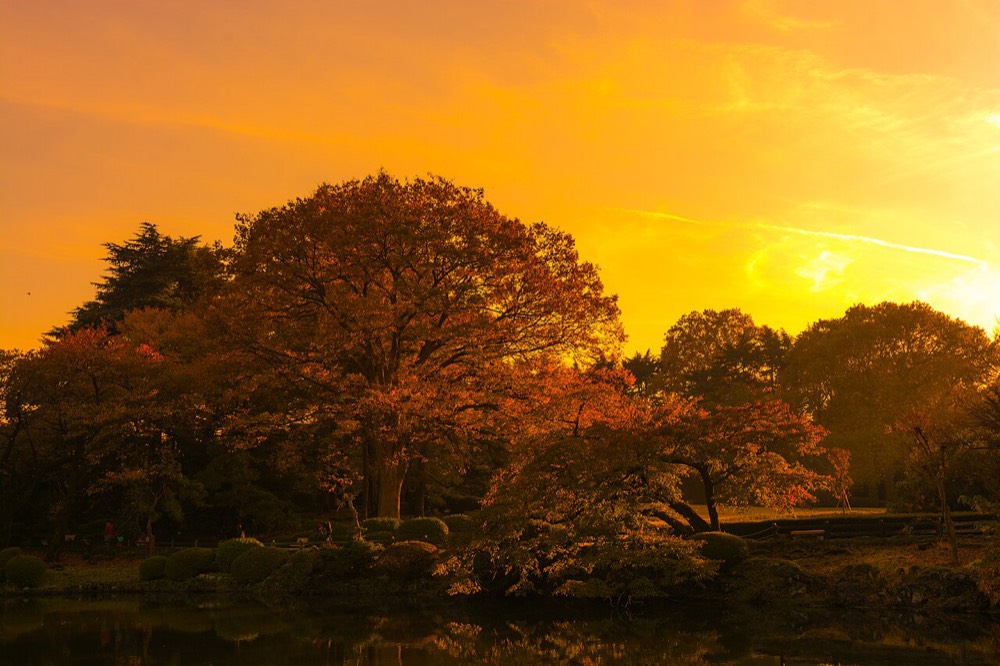
What makes Shinjuku Gyoen interesting is that it combines three garden styles in one park:
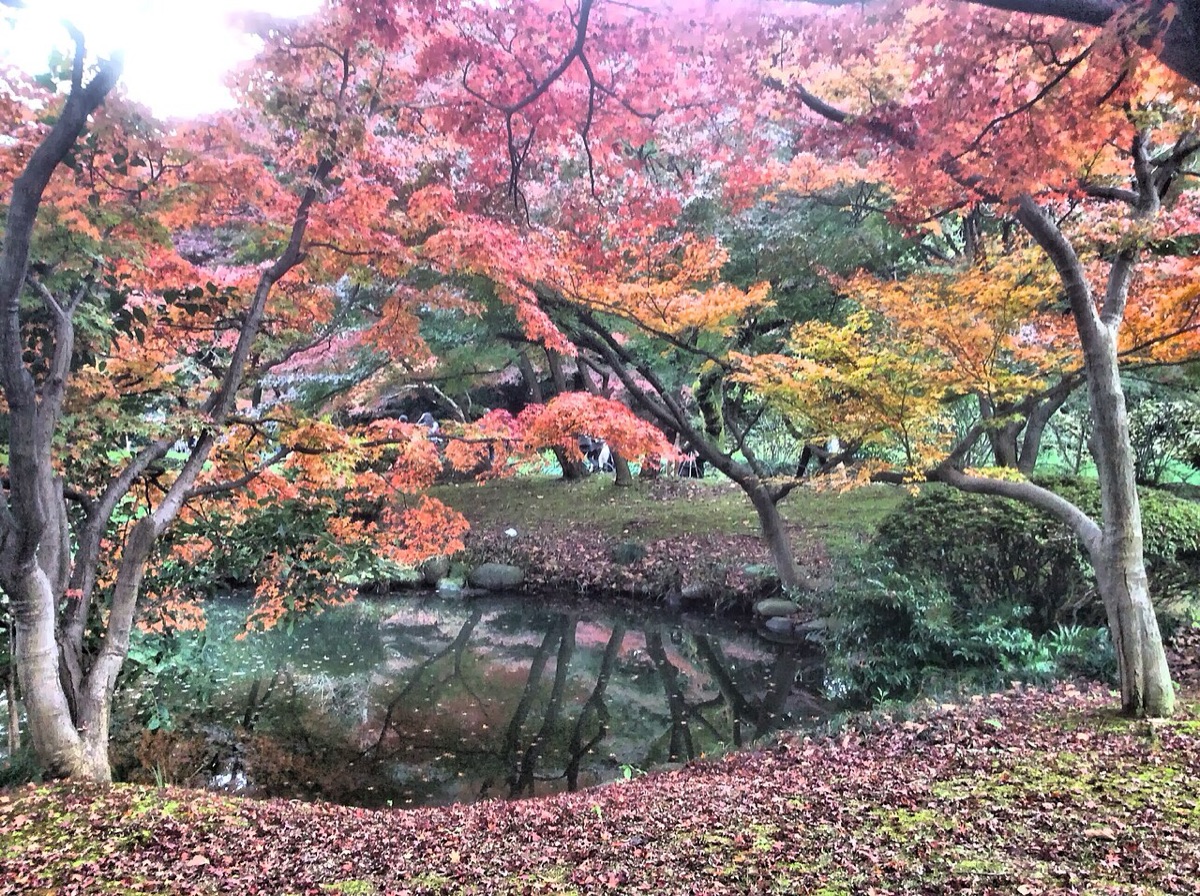
- Japanese Traditional Garden: a pond-strolling garden. When the maples by the ponds turn red and reflect in the water, you get the classic Shinjuku Gyoen maple scene. The Kyu-Goryotei pavilion here is built in a southern Chinese style, and the view from it across the pond is a good photo spot.
- Formal Garden: a symmetrical French design. The plane-tree avenue turns yellow and then brown, and walking under it as the leaves fall feels like a European park.
- Landscape Garden: wide English-style lawns ringed by big trees that change colour in autumn. Many people bring lunch and sit on the grass.
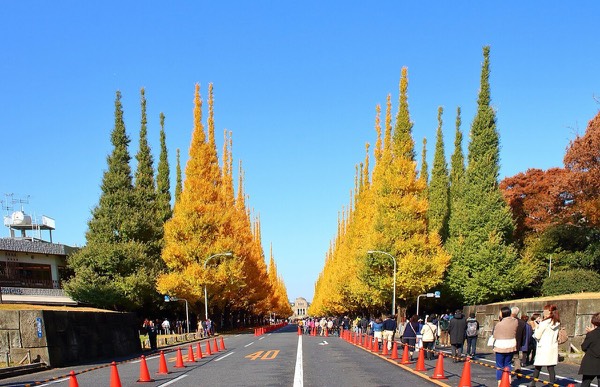
Ginkgo at Shinjuku Gyoen doesn't form a golden tunnel like Meiji Jingu Gaien; the trees stand alone around the lawns and paths, which means fewer crowds. If you want a full ginkgo avenue, you can walk on to Gaien the same day; see the Meiji Jingu Gaien ginkgo avenue guide. Leave by Sendagaya Gate and walk toward the National Stadium to get there.
A suggested loop (about 2 hours):
- Enter at Shinjuku Gate and look at the big lawn and the trees around it.
- Head south to the Formal Garden for the plane-tree avenue.
- Loop to the Japanese Traditional Garden for the maples by the ponds and photos at Kyu-Goryotei.
- During the exhibition, see the chrysanthemums in the pavilions, then leave by Okido Gate or Sendagaya Gate.
Shinjuku Gyoen Chrysanthemum Exhibition 2026: dates and highlights
In short: the 2026 Chrysanthemum Exhibition runs Sunday, November 1 to Sunday, November 15 in the Japanese Traditional Garden. The garden opens every day during the exhibition, Mondays included, and regular admission covers it[6]. The official site also says it is held every year from November 1 to 15[2].
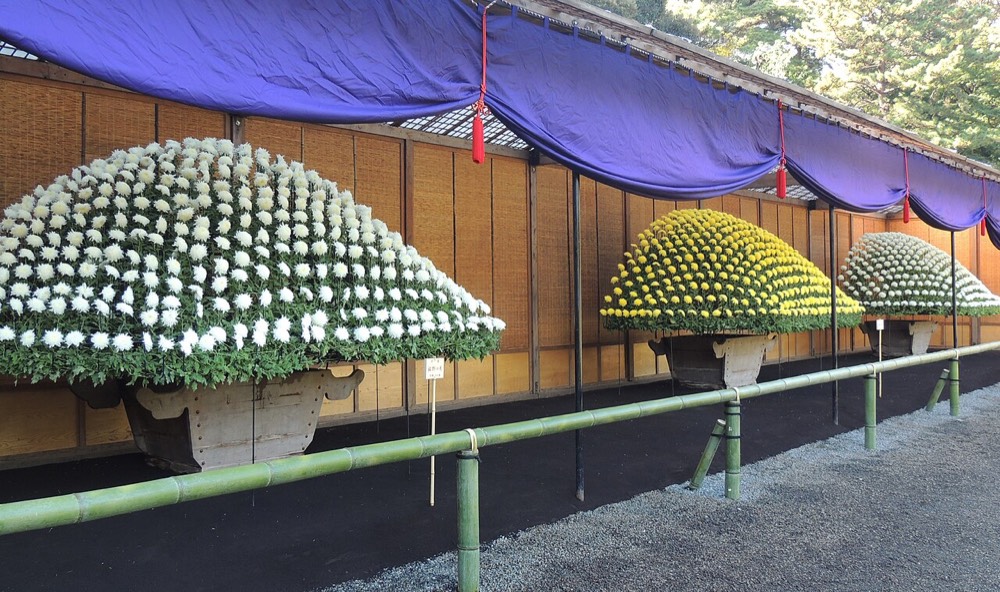
This is not an ordinary flower show but a display of classical chrysanthemums that continues an imperial viewing tradition. According to the official site, the Imperial Household Ministry held its first chrysanthemum viewing at the Akasaka Detached Palace in 1878, the venue moved to Shinjuku Gyoen in 1929, and the display opened to the public after the garden became a national garden in 1949[2]. The flowers are shown in "uwaya", roofed pavilions with curtains set up in the Japanese garden, with each section devoted to one growing style[2]:
| Display style | What to look for |
|---|---|
| Kengai-zukuri | Small chrysanthemums trained to cascade like wild ones hanging off a cliff |
| Ozukuri | Hundreds of blooms from a single ungrafted plant, shaped into a semicircle; the highlight of the show |
| Edo-giku | Petals curl and change shape as the flower opens; also called "dancing chrysanthemum" |
| Ise-giku, Choji-giku, Saga-giku | Three classical varieties shown in one bed |
| Ichimonji-giku, Kudamono-giku | Flat single-petal blooms contrasted with thin tubular petals |
| Higo-giku | Single-petal classical variety from Kumamoto, in the smallest bed |
| Ogiku | Large round blooms planted in yellow, white and red |
The exhibition and the maple peak usually don't overlap: in early November most maples in the Japanese garden are still green. If you can only go once, pick November 1 to 15 for chrysanthemums, or late November onward for red maples. For November weather and what to wear, see the Japan November travel guide.
How much is Shinjuku Gyoen admission? Hours and closed days
In short: adults pay 500 yen, and from October 1 to March 14 the garden is open 9:00 to 16:30 with last entry at 16:00. It normally closes on Mondays[1].
| Item | Details |
|---|---|
| Adults | 500 yen; groups of 30+ pay 400 yen |
| Seniors 65+, students from high school up | 250 yen, ID required |
| Junior high students and younger | Free |
| Annual pass | Adults 2,000 yen; high school students 1,000 yen |
| Autumn/winter hours (Oct 1 to Mar 14) | 9:00 to 16:30 (last entry 16:00) |
| Spring/summer hours (Mar 15 to Sep 30) | 9:00 to 18:00 (until 19:00 from Jun 11 to Jul 31) |
| Closed | Every Monday (next weekday if Monday is a holiday), Dec 29 to Jan 3 |
| Open on Mondays | Cherry blossom season Mar 25 to Apr 24; Chrysanthemum Exhibition Nov 1 to 15 |
This table is based on the official admission information[1]. Holders of a disability handbook and one companion enter free; show the handbook at the ticket window[1].
How to buy tickets: IC card or e-ticket
- Transit IC card: tap Suica, PASMO or another transit IC card at the entry gates; this is the simplest option[1].
- E-ticket: the Ministry of the Environment sells e-tickets through Asoview. Buy on your phone, show the QR code at the gate, and use it within six months of purchase[1].
- Ticket window: buy at the entrance.
Weekends and holidays during cherry blossom season may require advance reservations[1], but the official site has not announced any reservation system for autumn, so buying at the gate or online both work.
Closed days to watch in November and December 2026
- November 1 to 15: open every day during the exhibition, including Mondays November 2 and 9.
- November 16 (Monday): Monday closures resume.
- November 23 (Monday, Labor Thanksgiving Day): open for the holiday; closed instead on Tuesday, November 24.
- November 30, December 7, 14, 21 and 28: closed (Mondays).
- December 29 to January 3: closed for the New Year holidays.
The foliage peak falls in late November and early December, and the most common mistake is planning a visit on a Monday, or on the Tuesday after the November 23 holiday.
Which Shinjuku Gyoen gate should you use? Getting there
In short: Shinjuku Gate is closest to Shinjuku Station and the busiest; Okido Gate is best for going straight to the Japanese garden and the chrysanthemums; use Sendagaya Gate if you come from JR Sendagaya Station[4].
| Gate | Nearest station | Walk |
|---|---|---|
| Shinjuku Gate | JR / Keio / Odakyu Shinjuku Station, South Exit | About 10 min |
| Shinjuku Gate | Tokyo Metro Marunouchi Line, Shinjuku-gyoemmae Station, Exit 1 | About 5 min |
| Shinjuku Gate | Tokyo Metro Fukutoshin Line / Toei Shinjuku Line, Shinjuku-sanchome Station | About 5 min |
| Okido Gate | Tokyo Metro Marunouchi Line, Shinjuku-gyoemmae Station, Exit 2 | About 5 min |
| Sendagaya Gate | JR Sobu Line, Sendagaya Station | About 5 min |
| Sendagaya Gate | Toei Oedo Line, Kokuritsu-Kyogijo Station, Exit A5 | About 5 min |
This table is based on the official access page[4]. All three gates have coin lockers[1], so you can leave bags there. For subway and JR transfers and choosing an IC card, see the Tokyo transport guide.
Shinjuku Gyoen rules: alcohol, picnics and photography
In short: alcohol is not allowed in the garden, which is the biggest difference from most Tokyo parks. Pets and drones are also banned, and smoking is prohibited throughout[3].
According to the official garden rules[3], the main points are:
- Alcohol: not allowed in. If you want a beer with your autumn picnic, save it for after you leave.
- Animals: pets are not allowed, except assistance dogs.
- Smoking: banned everywhere, including paths and parking areas, and e-cigarettes too.
- Drones and radio-controlled toys: not allowed in.
- Ball games: no catch or football. Only in the children's area may children up to elementary school age use soft rubber balls, jump ropes and similar safe equipment.
- Occupying space: don't hold the same bench or patch of lawn for a long time.
- Photography with equipment: there is a separate rules page. Ordinary visitors taking photos with a phone or camera are fine, but check the rules before commercial shoots or setting up large equipment.
Can you eat inside? Yes. There are restaurants, cafes and a teahouse; Walkerplus lists Starbucks Coffee Shinjuku Gyoen, Restaurant Yurinoki and the Rakuutei teahouse, among others[5]. There are no food stalls. Picnicking on the lawns in autumn is lovely; just leave the alcohol at home and take your rubbish with you.
How to plan it: a half-day Shinjuku Gyoen foliage visit
Shinjuku Gyoen works best as a half-day stop combined with nearby sights:
- Arrive at 9:00 opening: on peak-foliage weekends, queues form at the Shinjuku Gate ticket window and gates. Going early means fewer people and softer light.
- 9:00 to 11:00, loop the garden: Formal Garden, then the Japanese Traditional Garden, then the Landscape Garden; add the pavilions in the Japanese garden during the exhibition.
- Lunch: leave by Shinjuku Gate for Shinjuku-sanchome or the Shinjuku Station area, or leave by Sendagaya Gate and continue to the Meiji Jingu Gaien ginkgo avenue.
- Afternoon: in autumn and winter, entry stops at 16:00 and the garden closes at 16:30. Sunset in Tokyo in late November is also around 16:30, so an afternoon-only visit leaves very little time.
FAQ
When are the autumn leaves at Shinjuku Gyoen best in 2026?
In a typical year the leaves start turning in mid-October, and the most trees are red and yellow at once from late November to early December. The 2026 timing depends on November temperatures, so check Walkerplus or tenki.jp foliage reports about a week before you go, or call the garden's service center.
How much is Shinjuku Gyoen admission, and can I pay with an IC card?
Adults pay 500 yen. Seniors 65+ and students from high school up pay 250 yen with ID, and junior high students and younger enter free. You can tap Suica, PASMO or other transit IC cards at the entry gates, or buy an e-ticket in advance on the official online sales page and show the QR code at the gate. E-tickets are valid for six months from purchase.
Is Shinjuku Gyoen open on Mondays?
It normally closes every Monday, or the next weekday when Monday is a public holiday. During the Chrysanthemum Exhibition (November 1 to 15) it opens on Mondays too. In 2026 it is open on Monday, November 23 (Labor Thanksgiving Day) and closed on Tuesday, November 24. It also closes for the New Year holidays, December 29 to January 3.
When is the 2026 Shinjuku Gyoen chrysanthemum exhibition, and is there an extra fee?
The 2026 Chrysanthemum Exhibition runs November 1 to 15 in the Japanese Traditional Garden, where classical chrysanthemums are displayed under traditional roofed pavilions. There is no separate ticket; regular admission covers it, and the hours match the garden's (9:00 to 16:30, last entry 16:00).
Can I bring alcohol or have a picnic at Shinjuku Gyoen?
Alcohol is not allowed; it is on the list of prohibited items. Pets (except assistance dogs) and drones are also banned, and smoking, including e-cigarettes, is prohibited everywhere. You can eat on the lawns, but don't occupy the same bench or patch of grass for a long time, and ball games are not allowed outside the children's area.
Which Shinjuku Gyoen gate should I use?
Shinjuku Gate is about 10 minutes on foot from the south exit of Shinjuku Station, or about 5 minutes from Exit 1 of Shinjuku-gyoemmae Station (Marunouchi Line). For the chrysanthemum display in the Japanese garden, Okido Gate is closer (about 5 minutes from Exit 2 of Shinjuku-gyoemmae). From JR Sendagaya Station or Kokuritsu-Kyogijo Station (Toei Oedo Line), use Sendagaya Gate, about 5 minutes on foot.
Sources
- Ministry of the Environment, Shinjuku Gyoen: Admission Information: Admission fees, annual passes, e-tickets, seasonal hours and closed days
- Ministry of the Environment, Shinjuku Gyoen: Chrysanthemum Exhibition: Venue, display styles and history
- Ministry of the Environment, Shinjuku Gyoen: Garden Rules: Rules on alcohol, pets, drones and smoking
- Ministry of the Environment, Shinjuku Gyoen: Access: The three gates and nearest stations
- Walkerplus Autumn Leaves: Shinjuku Gyoen: Usual start of colour change and peak, tree species, recommended spots, cafes and restaurants
- GO TOKYO: Chrysanthemum Exhibition: 2026 dates, hours and admission
- Toei Transportation: Autumn Leaves at Shinjuku Gyoen: Usual foliage period and order in which trees change colour
Fares, opening hours and event dates can change. Information checked on 2026.10.31; please confirm with official sources before you go.