Nabana no Sato Illumination 2026-27: Dates, Tickets, Getting There from Nagoya and Lighting Times
Nabana no Sato's 2026-27 illumination runs Oct 17 to May 31. Tickets with a 1,000-yen voucher, lighting times, Christmas tickets and access from Nagoya.
Quick answer
Nabana no Sato (なばなの里) in Kuwana, Mie Prefecture runs its 2026-27 winter illumination from October 17, 2026 to May 31, 2027 (closed January 6–7), with the new main-area theme 'Wild Paradise' (野生の楽園). Hours are 10:00–21:00 and the lights come on around 17:00 depending on sunset. Admission is 2,500–3,000 yen at convenience stores and includes a 1,000-yen in-park voucher; December 23–25 requires a date-specific ticket. From Nagoya, Kintetsu train plus bus takes about 35 minutes (checked October 2026).
When does the Nabana no Sato illumination 2026-27 start, how much are tickets, what time do the lights come on and how do you get there from Nagoya? Nabana no Sato (なばなの里) in Kuwana, Mie Prefecture hosts the best-known winter illumination near Nagoya, and this season runs from October 17, 2026 all the way to May 31, 2027. This guide covers the official dates, admission and voucher by period, the new main-area theme "Wild Paradise" (野生の楽園), the Tunnel of Light and water illumination, the date-specific Christmas tickets for December 23–25, and how to get there from Nagoya by Kintetsu train or bus, plus when to go to avoid the crowds.
Nabana no Sato illumination 2026 dates and opening hours
The answer: Saturday, October 17, 2026 to Monday, May 31, 2027, closed January 6 and 7, 2027[3]. Hours are 10:00–21:00, extended to 22:00 on certain days, with last entry 30 minutes before closing[1].
Nabana no Sato is a flower park run by Nagashima Resort, with flowers by day and lights by night. Key times during the illumination season:
| Item | Details |
|---|---|
| Dates | October 17, 2026 – May 31, 2027 |
| Closed | January 6 and 7, 2027 |
| Hours | 10:00–21:00 (22:00 on certain days) |
| Lighting time | From about 17:00, varies with sunset, on until closing |
| Last entry | 30 minutes before closing |
| Christmas special operation | 12/23 15:00–22:00; 12/24 and 12/25 15:00–23:00 |
| Rain | Open as usual |
The lighting time shifts with the seasonal sunset. The official site has an opening-hours calendar where you can click a date to see that day's hours and lighting time[1]. The park specifically notes that it stays open in the rain, when reflections on the wet ground make the lights even prettier, so there is no need to cancel because of rain.
How much are Nabana no Sato tickets? Admission and the 1,000-yen voucher
The answer: admission has three price levels depending on the date, convenience store tickets are 200 yen cheaper than the gate, and every ticket includes a 1,000-yen voucher and Begonia Garden entry[1]. Official adult prices (checked October 2026):
| Period | Convenience store | Gate | Includes |
|---|---|---|---|
| 10/17–11/20 | 2,500 yen | 2,700 yen | 1,000-yen voucher + Begonia Garden |
| 11/21–12/22 | 3,000 yen | 3,200 yen | 1,000-yen voucher + Begonia Garden |
| 12/23–12/25 | Date-specific ticket (price under review) | 5,500 yen (only if any remain) | 2,000-yen voucher + Begonia Garden |
| 12/26–2/28 | 3,000 yen | 3,200 yen | 1,000-yen voucher + Begonia Garden |
| 3/1–5/31 | 2,500 yen | 2,500 yen | 1,000-yen voucher + Begonia Garden |
Children below elementary school age are free. Things to know when buying:
- Using the voucher: the voucher included in the ticket works at restaurants and shops in the park, for souvenirs or dinner, but not at some ticket machines. It also has an expiry date printed on it[6]. In other words, the actual "entry" cost is only about 1,500–2,000 yen.
- Get your ticket at a convenience store first: the official site asks visitors to buy and print tickets at FamilyMart or 7-Eleven before arriving, because issuing tickets at the gate can take over 30 minutes when busy[1]. Convenience store tickets can be bought and used on the same day, and you go straight in without exchanging them[6].
- Kintetsu train + bus set ticket: sold at the limited-express ticket counters of major Kintetsu stations. It bundles a Kintetsu round trip, a direct bus round trip, admission and a 1,000-yen voucher. Sales began September 17, 2026, but it cannot be used December 23–25[8].
- Restaurant reservations can waive admission: the official site says reserving at designated restaurants means you do not need to buy an admission ticket[6]. This suits people planning dinner in the park anyway; check the official site for which restaurants qualify and availability.
- Tickets cannot be refunded or exchanged for another type, and the park takes no responsibility for tickets bought through unofficial resale channels[6].
The "Wild Paradise" main area: what is this season's show?
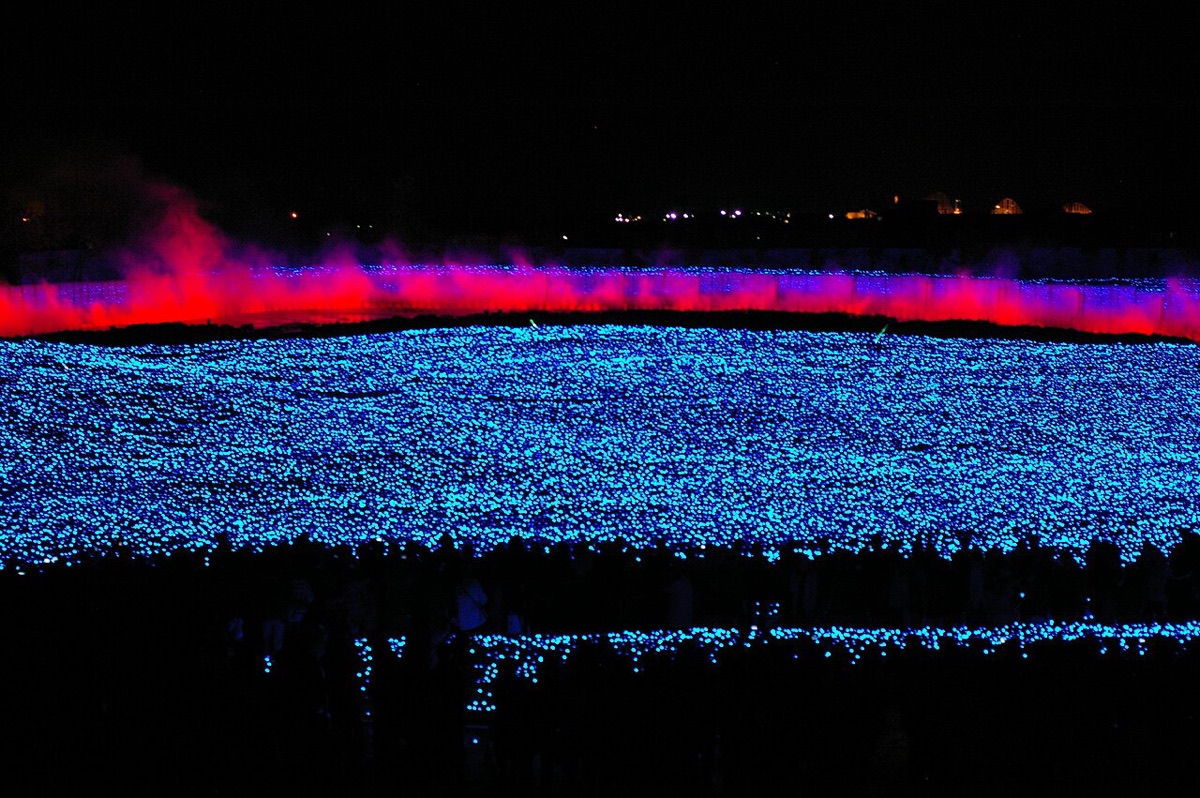
The answer: the new 2026-27 main-area theme is "Wild Paradise" (野生の楽園), a story the park calls "the land of life" that runs from the age of dinosaurs to the African savanna and a giant waterfall[2].
The biggest draw each season is the main theme area, about 8,000 tsubo (26,400 square meters), with a new theme every year[10]. Last season (2025-26) was the golden "ZIPANGU", and before that came "Mount Fuji" and "Golden Pyramid". The park stresses that everything is made with real LED bulbs, without projection mapping[10].
According to the official description, this year's main area unfolds in chapters[2]:
- Prologue: Ancient continent and the age of dinosaurs – a primeval forest from about 230 million years ago, with giant dinosaurs such as T. rex looming close, ending in a volcanic eruption that changes the scene.
- Chapter 2: Wild paradise – a great eagle swoops down, and flamingos, elephants and hippos gather at an oasis.
- Chapter 3: Savanna sunset and desert – baobab trees and dunes under the setting sun, with herds of lions, zebras and giraffes running.
- Chapter 4: From sea to land – jellyfish, manta rays and whales underwater, leading to a huge waterfall modeled on Victoria Falls, complete with a rainbow.
- Epilogue: Jacaranda under the moon – the show closes quietly with blue-violet jacaranda blooming in the night.
The main-area show links the whole field of lights to music and runs in a loop, and the viewing area in front gets more crowded as the night goes on. For a full overhead view, ride the Island Fuji observation tower, which rises 45 meters above the ground (paid, cash only, suspended in bad weather)[6].
Tunnel of Light, water illumination and other highlights
The answer: besides the main area, the 200 m Tunnel of Light, the water illumination on the pond and the Twin Trees by the chapel are Nabana no Sato's permanent highlights[3].
- Tunnel of Light (光のトンネル): about 200 m long, at the flower plaza entrance in front of the main area, lit from lighting time until closing. The bulbs sit in petal-shaped sockets, giving the whole tunnel a warm golden glow. It was installed in 2006 and switched to LED in 2017[5]. This is the most popular photo spot and is busiest in the first half hour after lighting.
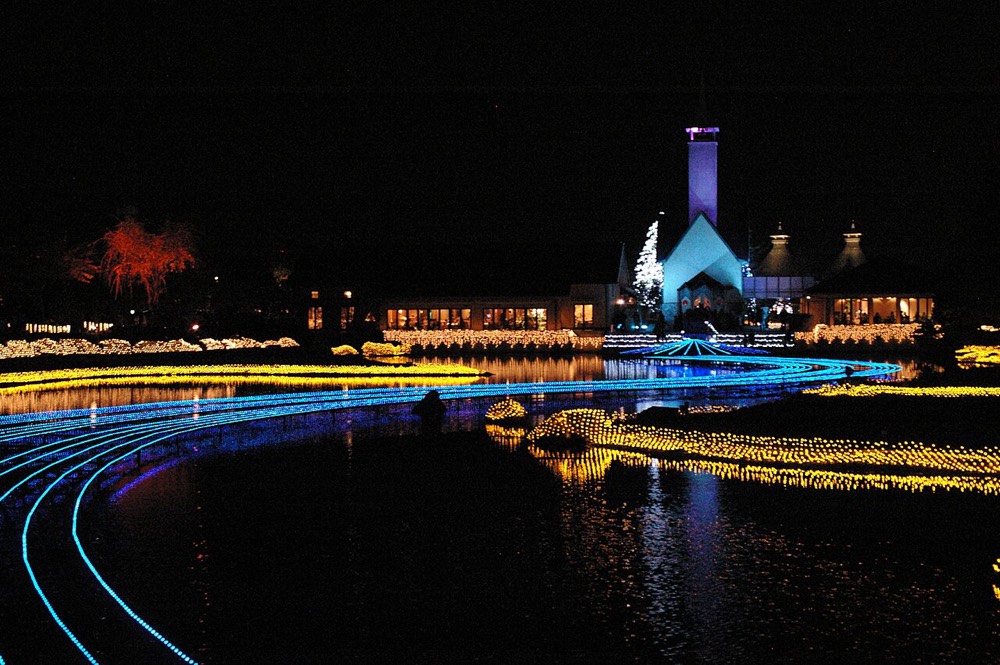
- Water illumination: on the pond in the middle of the park, themed on a flowing river, with a program of about 10 minutes that changes color to music. The park recommends watching from the bridge opposite the chapel[9].
- Twin Trees (ツインツリー): the symbolic trees that light up when the chapel bell rings; the chapel area is another popular photo spot[6].
- Champagne-gold field and seasonal flower light-ups: cosmos from October to mid-November, autumn leaves from late November to late December, Kawazu cherry blossoms and weeping plum from late February to late March, and tulips from late March[3].
- Begonia Garden (ベゴニアガーデン): entry is included in admission, and there is a special sound and light show after lighting. It is warm indoors, so it is a good place to wait for lighting with older relatives or children[1].
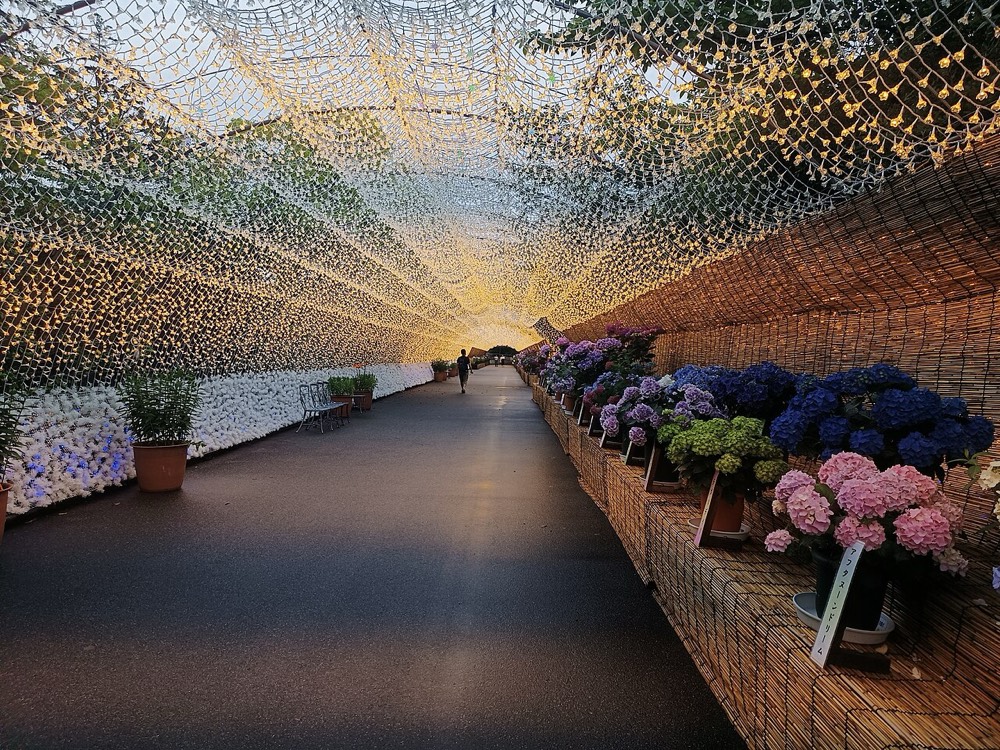
The flowers along both sides of the Tunnel of Light change with the seasons. The photo above shows early-summer hydrangeas, so a winter visit will look different.
Getting from Nagoya to Nabana no Sato: Kintetsu + bus or direct bus
The answer: the best route is Kintetsu Nagoya → Kintetsu Nagashima → direct bus, about 35 minutes at the fastest, and it is barely affected by traffic[4].
During the illumination season there are three main routes:
| Route | Travel time | Fare / notes |
|---|---|---|
| Kintetsu Nagoya → Kintetsu Nagashima (semi-express) + direct bus | About 25 min train + about 10 min bus | Bus 250 yen for adults, IC cards accepted |
| Kintetsu Nagoya → Kintetsu Nagashima (weekend extra-stop express) + direct bus | About 17 min train + about 10 min bus | Certain days only |
| Meitetsu Bus Center → Nabana no Sato direct bus | About 30 min (longer in traffic) | No transfer; check Meitetsu Bus for fares |
Kintetsu train + direct bus (recommended)
- At Kintetsu Nagoya Station, take a semi-express or local train toward Kuwana and Yokkaichi (limited expresses do not stop at Nagashima). The semi-express takes about 25 minutes to Kintetsu Nagashima and runs on weekdays too[4].
- On weekends and holidays, some express trains make extra stops at Nagashima, taking about 17 minutes: weekends and holidays from October 31, 2026 to January 11, 2027, plus December 23–25[8]. If you board an express on a weekday, change at Kintetsu Yatomi Station[4].
- Outside the station, take the Mie Kotsu direct bus to Nabana no Sato, about 10 minutes, 250 yen for adults and 130 yen for children one way, IC cards accepted[8].
Note: during the illumination, all buses on the Kuwana Station ⇔ Nabana no Sato route are suspended[8]. If you are coming from JR or Kintetsu Kuwana Station, transfer at Kintetsu Nagashima instead; it is one stop, about 5 minutes, by Kintetsu local train from Kuwana.
Direct bus from Meitetsu Bus Center
Meitetsu Bus Center next to Nagoya Station has direct buses to Nabana no Sato with no transfer, officially about 30 minutes[4]. The official site also warns that roads get congested and the trip can take much longer on weekend evenings, so use the restroom before boarding. From the central ticket gate of Meitetsu Nagoya Station, walk about 50 m south and take the escalator up to the bus center.
From Tokyo or Osaka
From Tokyo or Osaka, take the Shinkansen to Nagoya and switch to Kintetsu; see the Shinkansen booking guide for how to buy tickets. From the Kansai area you can also take a Kintetsu limited express to Kintetsu Kuwana, then a semi-express or local train one stop to Nagashima[4].
Driving
The park has about 5,700 free parking spaces. From Nagoya it is about 30 minutes by expressway, and the Isewangan Expressway's Wangan Nagashima IC is the most convenient exit[4]. The park warns that Route 1 and the Higashi-Meihan Expressway get congested on the way back, and suggests heading south along the Ibi and Nagara river embankments to join the Isewangan Expressway.
How to avoid the crowds: best arrival time and Christmas tips
The answer: arrive before 16:00 on weekdays or before 15:00 on weekends and holidays, avoid the peak right after lighting, and leave after 19:00 on weekdays or after 20:00 on weekends[4].
The access page suggests arriving before 16:00 on weekdays and before 15:00 on weekends and holidays, and leaving after 19:00 on weekdays and after 20:00 on weekends[4]. In practice:
- Arrive before lighting and use your voucher for a snack or some shopping.
- The 30 minutes around lighting time are the most crowded, so wait it out in the Begonia Garden[6].
- Once the crowds thin, head to the Tunnel of Light and the main area, and finish near the water illumination.
Christmas, December 23–25: you must buy a date-specific ticket
These three days are a limited Christmas special operation. There is no daytime opening; the park opens at 15:00, closing at 22:00 on the 23rd and 23:00 on the 24th and 25th[1]. Things to know:
- You must buy a date-specific ticket in advance at FamilyMart, 7-Eleven or the e-ticket service Asoview. Tickets are first come, first served and limited in number[3].
- Regular tickets, convenience store advance tickets, member perks and the Kintetsu set ticket are not valid on these days, and disability discounts do not apply[1].
- The official site still lists the date-specific ticket price as "under review"; it includes a 2,000-yen voucher and Begonia Garden entry. Same-day tickets at the gate are 5,500 yen, sold only if date-specific tickets remain[1].
- In past years date-specific tickets went on sale on a set day in November; check the official site for this year's release date.
To compare Christmas lights across Japan, see Japan Christmas illuminations 2026.
Nabana no Sato + Nagashima Spa Land day plan
The answer: spend the day at the amusement park or outlet mall in Nagashima Onsen, then move to Nabana no Sato for the lighting in the evening. This is the most common plan and saves the most travel time.
Nabana no Sato is about 10 km north of Nagashima Onsen (home to Nagashima Spa Land, Yuami-no-Shima and Mitsui Outlet Park Jazz Dream Nagashima), about 15 minutes by car[4]. From the Nagashima Onsen bus stop, buses run via Nabana no Sato to Meitetsu Bus Center: about 15 minutes to Nabana no Sato and another 40 minutes to Nagoya[4]. On certain days a free shuttle also runs between Nabana no Sato and Nagashima Resort. Note that extra direct buses to Nagashima Onsen do not stop at Nabana no Sato, so check before boarding.
| Time | Plan |
|---|---|
| 9:00 | Leave Nagoya for Nagashima Onsen |
| 9:30–14:30 | Nagashima Spa Land or Mitsui Outlet |
| 15:00 | Bus or drive to Nabana no Sato |
| 15:30–17:00 | Begonia Garden, dinner (using your voucher) |
| 17:00–19:30 | Lighting, Tunnel of Light, main area, water illumination |
| 20:00 | Bus back to Kintetsu Nagashima or Meitetsu Bus Center |
If you are traveling in November, see the Japan November travel guide; for December, read the Japan December travel guide for weather, what to wear and year-end crowds.
Before you go
- Buy tickets at a convenience store first: advance tickets are 200 yen cheaper than the gate and skip the ticket line; December 23–25 requires a date-specific ticket.
- Note the closure days: the park is closed January 6 and 7, 2027.
- Dress warmly: the park is near the mouths of the Kiso Three Rivers and winter nights are windy, so hats, gloves and heat packs help.
- Do not waste the voucher: the 1,000-yen voucher has an expiry date, so spending it in the park on the day is the best value.
- Plan your return: check the last buses and Kintetsu trains before you go, and allow time to queue for the bus on weekend nights.
FAQ
How much are Nabana no Sato illumination tickets in 2026, and how does the voucher work?
Admission depends on the date: 2,500 yen at convenience stores for 10/17–11/20 and 3/1–5/31; 3,000 yen at convenience stores and 3,200 yen at the gate for 11/21–12/22 and 12/26–2/28. Every ticket includes a 1,000-yen voucher and Begonia Garden entry. The voucher works at restaurants and shops in the park, though not at some ticket machines. Children below elementary school age are free.
What time do the Nabana no Sato lights come on, and how late is it open?
The lights come on around 17:00, depending on sunset, and stay on until closing. The park normally closes at 21:00, or 22:00 on certain days, with last entry 30 minutes before closing. Arrive about an hour before lighting, visit the Begonia Garden or eat first, then see the main area and the Tunnel of Light after dark.
How does Christmas (December 23–25) work at Nabana no Sato?
These three days are a limited Christmas special operation. There is no daytime opening; the park opens at 15:00 and closes at 22:00 on the 23rd and 23:00 on the 24th and 25th. You need a date-specific ticket bought in advance at FamilyMart, 7-Eleven or Asoview. Regular tickets, the Kintetsu set ticket and member perks are not valid. The advance price is still listed as under review, and same-day tickets are 5,500 yen only if any remain.
What is the fastest way from Nagoya to Nabana no Sato?
Take the Kintetsu Nagoya Line to Kintetsu Nagashima Station (about 25 minutes by semi-express, or about 17 minutes on express trains that make extra stops on some weekends), then the Mie Kotsu direct bus for about 10 minutes, 250 yen for adults, IC cards accepted. The fastest total is about 35 minutes. A direct bus also runs from Meitetsu Bus Center, officially about 30 minutes, but traffic can delay it a lot on weekends.
Can I combine Nabana no Sato with Nagashima Spa Land in one day?
Yes. Nabana no Sato is about 10 km north of Nagashima Onsen, about 15 minutes by bus, and a free shuttle runs on certain days. The usual plan is the amusement park or outlet mall during the day and Nabana no Sato for the lighting in the evening. Roads get congested on weekend afternoons, so allow extra time.
Sources
- Nabana no Sato: Illumination hours and fees: 2026-27 dates, admission by period, Christmas special operation
- Nabana no Sato: Main theme area: Chapters of the 'Wild Paradise' theme
- Nabana no Sato: Illumination: Dates, closures, 12/23–25 date-specific tickets, seasonal flower light-ups
- Nabana no Sato: Access during the illumination: Kintetsu, direct buses, driving and suggested arrival times
- Nabana no Sato: 200 m Tunnel of Light: Length and location of the Tunnel of Light
- Nabana no Sato: Popular spots and tips: Convenience store tickets, Kintetsu set ticket, Island Fuji, avoiding crowds
- Tetsudo Channel: Nabana no Sato Illumination 2026-27: Lighting time, extra express stops, Kuwana bus route suspension
- Jorudan: Extra express stops at Kintetsu Nagashima and direct buses: Direct bus fares, operating period, set ticket sales
- Nabana no Sato: Water illumination: About 10-minute water illumination program
- Nabana no Sato: Past theme areas: Main area size and past themes
Fares, opening hours and event dates can change. Information checked on 2026.10.29; please confirm with official sources before you go.